
What is Klear-Reasoner
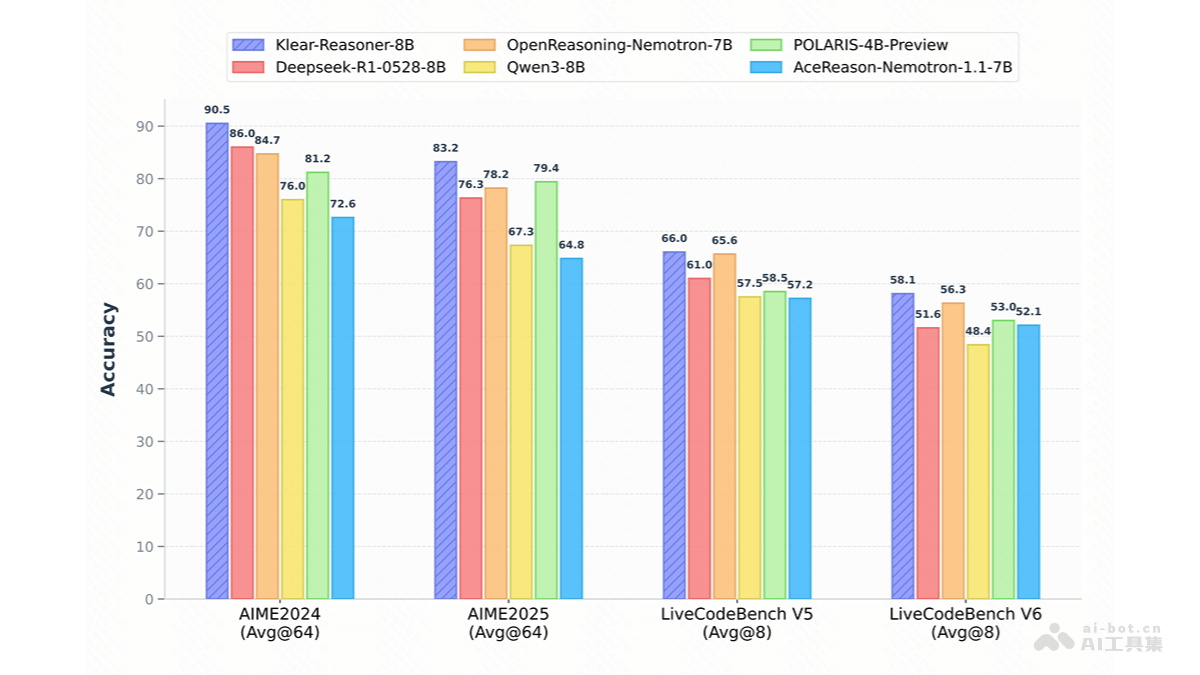
Klear-Reasoner is a reasoning model launched by Kuaishou based on Qwen3-8B-Base, focused on improving mathematical and code reasoning capabilities. The model is trained through long chain-of-thought supervised fine-tuning (long CoT SFT) and reinforcement learning (RL). Its core innovation is the GPPO algorithm, which addresses the limited exploration capability and slow convergence on negative samples of traditional methods by retaining clipped gradient information, achieving top-tier performance among 8B models on benchmarks such as AIME and LiveCodeBench. The training details and full pipeline of Klear-Reasoner are publicly available, providing an important reference and reproduction path for the development of reasoning models.
Klear-Reasoner's Main Features
- Mathematical Reasoning: Klear-Reasoner performs excellently on complex mathematical problems and can solve highly difficult math competition problems.
- Code Generation and Reasoning: It can generate high-quality code, achieving 66.0% and 58.1% accuracy on the LiveCodeBench V5 and V6 evaluations, respectively.
- Long Chain-of-Thought Reasoning: Klear-Reasoner can handle complex long chain-of-thought tasks, improving the model's performance in multi-step reasoning through long chain-of-thought supervised fine-tuning (long CoT SFT) and reinforcement learning (RL) training.
- Data Quality Optimization: During training, Klear-Reasoner prioritizes high-quality data sources to ensure the model learns accurate reasoning patterns, while retaining some erroneous samples to enhance the model's exploration capability.
Klear-Reasoner's Technical Principles
- Long Chain-of-Thought Supervised Fine-Tuning (long CoT SFT): Use high-quality data sources for supervised fine-tuning to ensure the model learns accurate reasoning patterns. Prioritize a small number of high-quality data sources to avoid noise introduced by low-quality data. Retain some erroneous samples, especially in highly difficult tasks, to help the model's exploration capability.
- Reinforcement Learning (RL): Use reinforcement learning to further improve the model's reasoning capability, especially on mathematical and code tasks. Based on a soft reward mechanism, rewards are given according to the pass rate of test cases, alleviating the reward sparsity problem and improving training efficiency. Filter out data with problematic test cases to ensure the high quality of training data.
- GPPO (Gradient-Preserving Clipping Policy Optimization) Algorithm: In traditional PPO and GRPO algorithms, the clip operation discards the gradients of high-entropy tokens, limiting the model's exploration capability and causing delayed convergence on negative samples. GPPO is based on the stop gradient operation, decoupling the clip operation from gradient backpropagation and retaining the gradients of all tokens. For high-entropy tokens, GPPO retains their gradients and constrains them within a certain range. For negative sample tokens, GPPO retains the gradients and limits them within a certain magnitude, accelerating error correction.
- Soft Reward Mechanism: In reinforcement learning for code tasks, using a soft reward mechanism (giving rewards according to the pass rate of test cases) is more effective than hard rewards (score if fully passed, otherwise zero). The soft reward mechanism can alleviate the reward sparsity problem, increase the density of training signals, reduce the variance of gradient estimation, and make the model's learning process more stable and efficient.
Klear-Reasoner's Project Address
- GitHub Repository:https://github.com/suu990901/KlearReasoner/
- HuggingFace Model Library:https://huggingface.co/Suu/Klear-Reasoner-8B
- arXiv Technical Paper:https://arxiv.org/pdf/2508.07629
Klear-Reasoner's Application Scenarios
- Education: As an intelligent math tutor, it provides students with detailed solution steps and reasoning processes, helping users better understand and master mathematical knowledge.
- Software Development: Automatically generate high-quality code snippets, assist developers in quickly implementing functional modules, and provide code review suggestions to improve code quality and development efficiency.
- Fintech: Analyze financial data for risk assessment and forecasting, provide logical reasoning support for financial institutions, and facilitate more precise decision-making.
- Scientific Research and Data Analysis: Klear-Reasoner can handle complex data analysis and scientific computing tasks, provide logical reasoning and model explanations for researchers, and improve research efficiency.
- Intelligent Customer Service: Quickly and accurately answer users' complex questions, provide a clear reasoning process, and improve user experience and problem-solving efficiency.