
What is Kimi-Audio
Kimi-Audio is an open-source audio foundation model launched by Moonshot AI, focused on audio understanding, generation, and dialogue tasks. It is pretrained on over 13 million hours of diverse audio data and possesses strong audio reasoning and language understanding capabilities. Its core architecture adopts hybrid audio input (continuous acoustic + discrete semantic tokens), combined with an LLM-based design, supporting parallel generation of text and audio tokens, while achieving low-latency audio generation through a chunked streaming decoder.
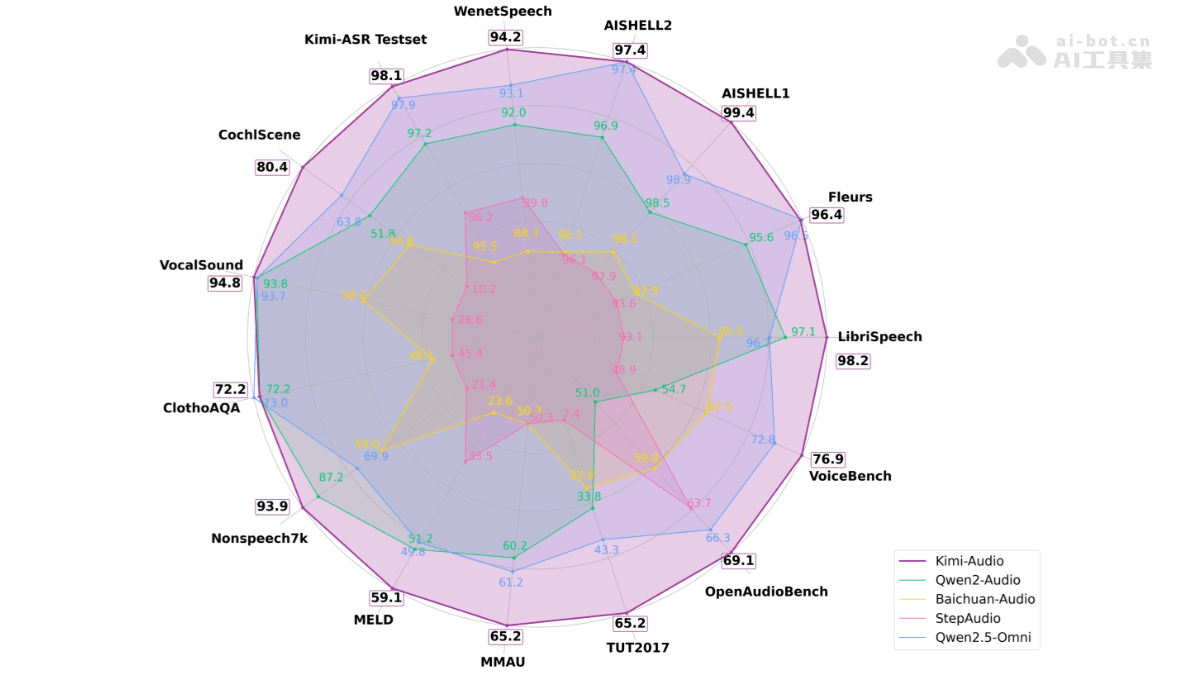
Kimi-Audio's Main Features
- Speech Recognition (ASR): Can convert speech signals into text content, supporting multiple languages and dialects.
- Speech Emotion Recognition (SER): Analyzes emotional information in speech, determines the speaker's emotional state (such as happiness, sadness, anger, etc.), and can be used in customer service systems, sentiment analysis, etc.
- Sound Event/Scene Classification (SEC/ASC): Recognizes and classifies environmental sounds (such as car horns, dog barks, rain, etc.) or scenes (such as offices, streets, forests, etc.).
- Audio Captioning (AAC): Automatically generates captions based on audio content, helping people with hearing impairments better understand audio information.
- Audio Question Answering (AQA): Generates corresponding audio answers based on user questions.
- End-to-End Speech Dialogue: Supports generating natural and fluent speech dialogue content.
- Multi-Turn Dialogue Management: Can handle complex multi-turn dialogue tasks, understand contextual information, and generate coherent speech responses.
- Text-to-Speech (TTS): Converts text content into natural and fluent speech, supporting multiple voice and tone options.
- Audio Content Analysis: Conducts comprehensive analysis of semantics, emotions, events, etc. in audio, and extracts key information.
- Audio Quality Assessment: Analyzes audio clarity, noise levels, etc., providing reference for audio processing.
Kimi-Audio's Technical Principles
- Hybrid Audio Input: Kimi-Audio adopts a hybrid audio input method, dividing the input audio into two parts:
- Discrete Semantic Tokens: Through vector quantization technology, audio is converted into discrete semantic tokens at a frequency of 12.5Hz.
- Continuous Acoustic Features: Uses a Whisper encoder to extract continuous acoustic features and downsamples them to 12.5Hz. This hybrid input method combines discrete semantics and continuous acoustic information, enabling the model to more comprehensively understand and process audio content.
- LLM-Based Core Architecture: The core of Kimi-Audio is a Transformer-based language model (LLM), initialized from a pretrained text LLM (such as Qwen 2.5 7B).
- Chunked Streaming Decoding: Kimi-Audio adopts a flow-matching-based chunked streaming decoder, supporting low-latency audio generation. By processing audio data in chunks, the model can output audio in real time during generation, significantly reducing latency. It supports a lookahead mechanism, further optimizing the fluency and coherence of audio generation.
- Large-Scale Pretraining: Kimi-Audio was pretrained on over 13 million hours of diverse audio data (including speech, music, and various sounds). This gives the model powerful audio reasoning and language understanding capabilities, enabling it to handle a variety of complex audio tasks, such as speech recognition, audio question answering, emotion recognition, and more.
- Flow Matching Model: Used to convert discrete tokens into continuous audio signals.
- Vocoder (BigVGAN): Used to generate high-quality audio waveforms. It ensures the naturalness and fluency of the generated audio.
Kimi-Audio Project Address
- Github Repository:https://github.com/MoonshotAI/Kimi-Audio
Kimi-Audio Performance
- Speech Recognition (ASR): On the LibriSpeech test sets, Kimi-Audio's word error rate (WER) reached 1.28%(test-clean) and 2.42%(test-other), significantly lower than other models. On the AISHELL-1 dataset, its WER was only 0.60%, showing excellent performance.
- Audio Understanding: In audio understanding tasks, Kimi-Audio achieved results close to or exceeding SOTA on multiple datasets. For example, on the ClothoAQA dataset, its test set performance reached 73.18%; on the VocalSound dataset, the accuracy reached 94.85%。
- Audio Question Answering (AQA): In audio question answering tasks, Kimi-Audio achieved 73.18% accuracy on the development set of the ClothoAQA dataset, demonstrating its strong ability to understand and generate audio question answering content.
- Audio Dialogue: In speech dialogue tasks, Kimi-Audio also performed well on multiple benchmarks. For example, on the AlpacaEval dataset of VoiceBench, its performance reached 75.73%, showing excellent fluency and coherence in speech dialogue.
- Audio Generation: Kimi-Audio performed excellently in non-speech audio generation. On the Nonspeech7k dataset, the accuracy reached 93.93%, demonstrating its ability to generate high-quality audio content.
Kimi-Audio Application Scenarios
- Intelligent Voice Assistant: Kimi-Audio can be used to develop intelligent voice assistants, supporting speech recognition, speech synthesis, and multi-turn dialogue functionality. It can understand users' voice commands and generate natural and fluent voice responses.
- Speech Recognition and Transcription: Kimi-Audio can efficiently convert speech signals into text content. It supports multiple languages and dialects, and is suitable for scenarios such as meeting minutes, voice notes, and real-time translation.
- Audio Content Generation: Kimi-Audio can generate high-quality audio content, including text-to-speech (TTS), audio captioning (AAC), and audio question answering (AQA). It can generate natural and fluent speech based on text content, and can also generate audio answers based on questions, making it suitable for fields such as audiobooks, video subtitle generation, and intelligent customer service.
- Sentiment Analysis and Speech Emotion Recognition: Kimi-Audio can analyze emotional information in speech and determine the speaker's emotional state (such as happiness, sadness, anger, etc.).
- Education and Learning: Kimi-Audio has various applications in the education field, such as English speaking practice and language learning assistance. It can help users practice pronunciation, correct grammatical errors, and provide real-time feedback through voice interaction.