
What is KAT-Dev-32B
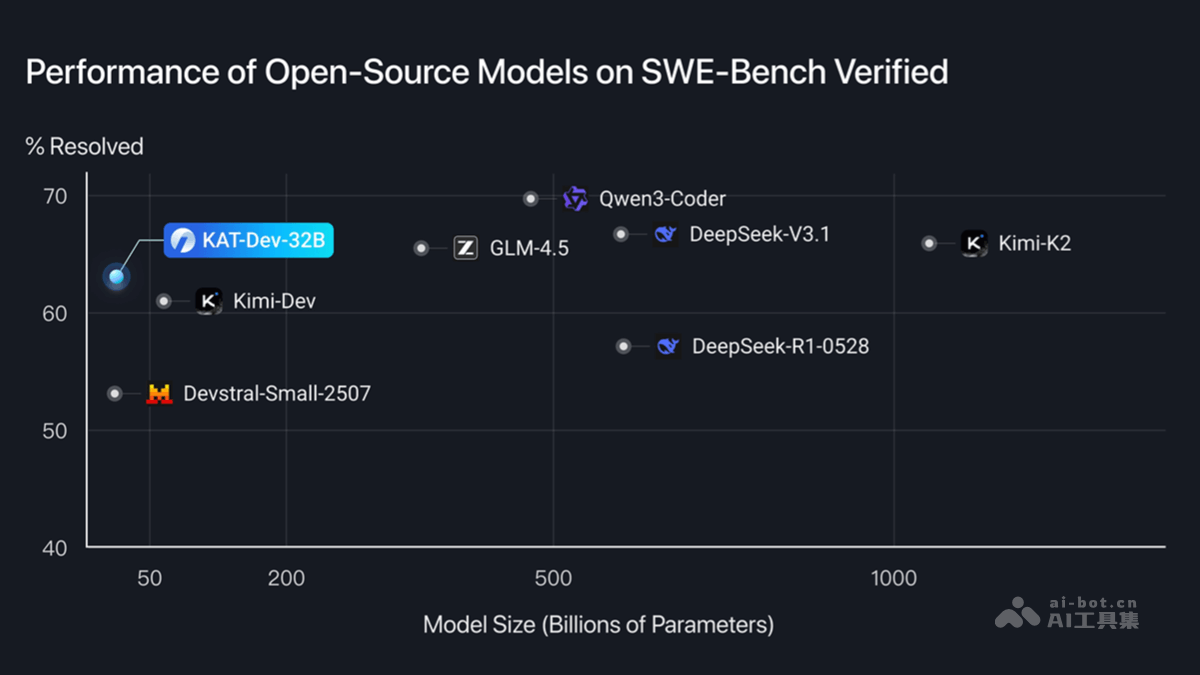
KAT-Dev-32B is an open-source code intelligence large model released by the Kuaishou Kwaipilot team, with 3.2 billion parameters. It achieved a 62.4% resolution rate on the SWE-Bench Verified benchmark, ranking 5th. The model was trained through multiple stages, including mid-training, supervised fine-tuning (SFT) and reinforcement fine-tuning (RFT) stages, as well as a large-scale agent reinforcement learning (RL) stage, to enhance its core capabilities such as tool use, multi-turn dialogue understanding, and instruction following. It supports mainstream programming languages such as Python, JavaScript, Java, C++, and Go, and is available on the Hugging Face platform for developers to use conveniently.
Main Features of KAT-Dev-32B
-
Code Generation: Generates corresponding code based on user requirement descriptions, supporting multiple mainstream programming languages such as Python, JavaScript, Java, C++, and Go.
-
Code Understanding: Helps developers understand complex code logic and quickly grasp code structure and functionality.
-
Bug Fixing: Quickly locates errors in code and provides fixing suggestions to improve development efficiency.
-
Performance Optimization: Optimizes code to improve runtime efficiency and enhance software performance.
-
Test Case Generation: Automatically generates test cases to improve test coverage and ensure software quality.
-
Multi-turn Dialogue Understanding: Can conduct multi-turn dialogues, understand user needs, and provide more precise code solutions.
-
Domain Knowledge Injection: Combines knowledge from specific domains to generate code that better conforms to industry standards.
-
Real Development Process Support: Simulates real development processes to help developers better adapt to actual development environments.
Technical Principles of KAT-Dev-32B
-
Based on Transformer Architecture: Adopts the Transformer architecture, can process long text sequences, captures long-distance dependencies in code, and provides powerful foundational capabilities for code generation and understanding.
-
Combination of Pre-training and Fine-tuning: First performs pre-training on large-scale code data to learn general programming patterns and language features; then performs fine-tuning for specific tasks to better adapt to specific application scenarios such as code generation and understanding.
-
Reinforcement Learning Optimization: Optimizes the model through reinforcement learning, enabling it to better follow programming standards and logic when generating code, improving code quality and usability.
-
Multi-task Learning: Simultaneously learns multiple programming-related tasks, such as code generation, code completion, and code repair, enabling the model to comprehensively apply multiple capabilities and understand and generate code more comprehensively.
-
Context Awareness: Can understand the contextual information of code, including variable definitions, function calls, etc., and generate code snippets consistent with the context, improving code accuracy and readability.
-
Domain Knowledge Fusion: Integrates knowledge from specific domains into model training, enabling the model to generate code that better conforms to the standards and conventions of that domain when handling domain-specific code.
Project Address of KAT-Dev-32B
- HuggingFace Model Repository:https://huggingface.co/Kwaipilot/KAT-Dev
Application Scenarios of KAT-Dev-32B
-
Code Understanding: Helps developers quickly understand the logical structure and functionality of complex code, facilitating code maintenance and refactoring.
-
Bug Fix: Automatically detect errors in code and provide fix suggestions, reducing debugging time.
-
Performance Optimization: Analyze code and propose performance optimization solutions to improve software operating efficiency.
-
Test Case Generation: Automatically generate test cases, improve test coverage, and ensure software quality.
-
Multi-language Support: Support multiple mainstream programming languages to meet the needs of different development scenarios.
-
Development Assistance: Provide real-time code suggestions and completions during the development process, enhancing the development experience.
-
Education and Learning: Provide sample code and explanations for programming learners, assisting programming instruction.