
What is KAT-Coder
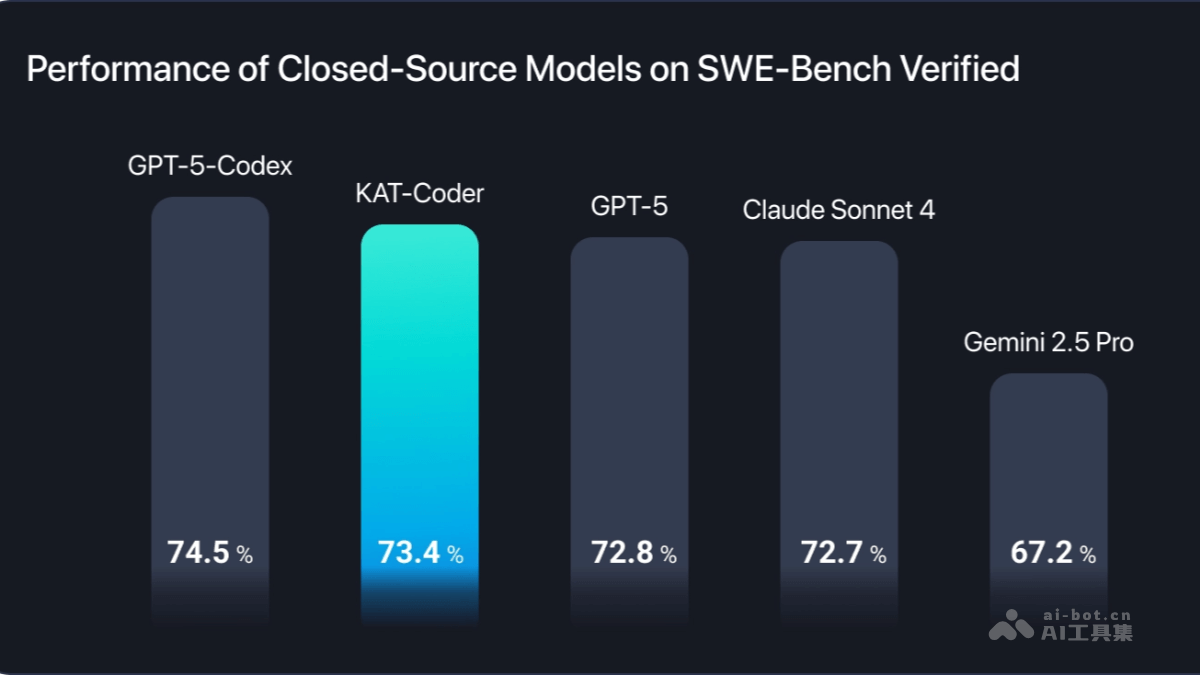
KAT-Coder is a closed-source flagship code generation model released by Kuaishou's Kwaipilot team, with powerful programming capabilities. It can efficiently complete tasks such as feature development, defect analysis, and unit test generation, and supports multiple programming languages such as Python, JavaScript, Java, etc. Users only need to describe their requirements, and the model can deliver a complete code solution. KAT-Coder has a resolution rate of up to 73.4% on the SWE-Bench Verified test, demonstrating outstanding performance. It provides API calls through the StreamLake platform, and enterprises and teams can integrate its capabilities for scenarios such as automated code review and intelligent programming assistance.
Main features of KAT-Coder
-
Code generation: It can quickly generate high-quality code snippets or complete code solutions based on user requirement descriptions, supports multiple programming languages such as Python, Java, JavaScript, etc., and greatly improves development efficiency.
-
Code review: It can automatically detect potential defects, errors, and non-standard practices in code, provide detailed review reports and improvement suggestions, help developers promptly discover and fix issues, and improve code quality.
-
Unit test generation: It can automatically generate unit test code, ensure the correctness and stability of code, reduce the workload of manually writing test code, and improve test coverage.
-
Problem diagnosis: For complex programming problems, KAT-Coder can provide detailed analysis and solutions, help developers quickly locate the root cause of problems, and save debugging time.
-
Multi-turn interaction: It supports multi-turn conversations with users, better understands user needs, provides more precise code generation and problem-solving services, and enhances user experience.
Technical principles of KAT-Coder
-
Multi-stage training: It adopts a multi-stage training method, including Mid-Training, supervised fine-tuning (SFT), reinforcement fine-tuning (RFT), and large-scale agent reinforcement learning (RL) stages. Through training at different stages, it gradually improves the model's performance and generalization ability.
-
Tool use capability training: During the training process, tool use capability training is greatly increased, enabling the model to better understand and use various programming tools and resources, and improving its application ability in actual programming scenarios.
-
Multi-turn interaction training: Through multi-turn interaction training, the model learns to better understand user needs in multi-turn conversations, provide more precise code generation and problem-solving services, and enhance the interaction experience with users.
-
Guidance from human engineers: In the reinforcement fine-tuning stage, "teacher trajectories" annotated by human engineers are introduced as training guidance, enabling the model to learn solutions that better conform to human programming habits and logic, and improving code readability and maintainability.
-
Large-scale reinforcement learning: It adopts large-scale agent reinforcement learning technology and, through methods such as prefix caching for numerical probability computation and entropy-based trajectory pruning, addresses the challenges of scaling agent reinforcement learning, further improving the model's performance and efficiency.
Project address of KAT-Coder
- Project official website:https://kwaipilot.github.io/KAT-Coder/
Application scenarios of KAT-Coder
-
Automatic code generation: It quickly generates high-quality code snippets or complete code solutions based on user requirement descriptions, supports multiple programming languages, and significantly improves development efficiency.
-
Code Review and Optimization: Automatically detects potential defects, errors, and non-standard practices in code, provides detailed review reports and improvement suggestions, and helps developers improve code quality.
-
Unit Test Generation: Automatically generates unit test code to ensure the correctness and stability of the code, reduces the workload of manually writing test code, and improves test coverage.
-
Complex Problem Diagnosis: For complex programming problems, provides detailed analysis and solutions, helping developers quickly locate the root cause of the problem and save debugging time.
-
Intelligent Programming Assistance: During the development process, provides developers with intelligent assistance features such as real-time code completion, function call suggestions, and syntax checking, improving the programming experience.
-
Technical Interviews and Learning: Used for solving coding problems in technical interviews to help interviewers evaluate candidates; it can also serve as a learning tool to assist developers in learning new programming languages or technologies.