
What is Kandinsky-3
Kandinsky-3 is a text-to-image (T2I) generation framework based on latent diffusion models, supporting high quality and realism in image synthesis. Kandinsky-3 can adapt to various image generation tasks, including text-guided inpainting/outpainting, image fusion, text-image fusion, and video generation, etc. The researchers have introduced a simplified version of the T2I model that maintains image quality while increasing inference speed by 3 times, requiring only 4 reverse steps to complete. The notable feature of Kandinsky-3 lies in the simplicity and efficiency of its architecture, enabling it to adapt to various image generation tasks.
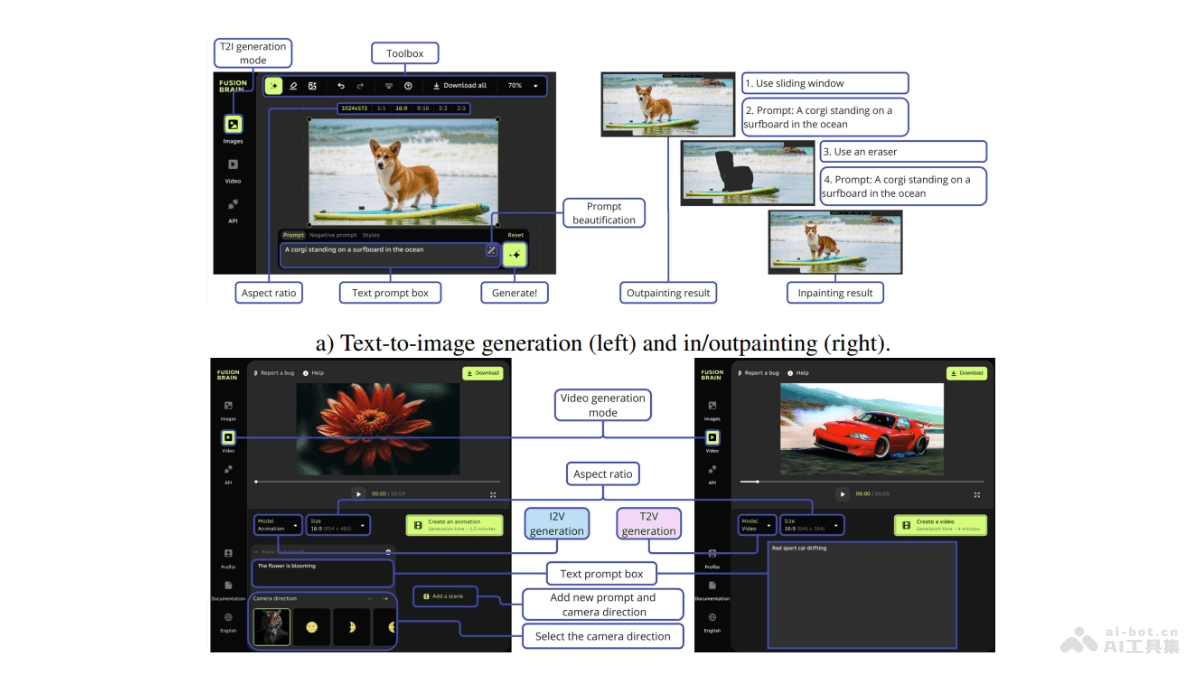
Main features of Kandinsky-3
- Text-to-image generation: Generates corresponding images based on text prompts provided by the user.
- Image inpainting/outpainting: Intelligently fills in missing or specified areas of an image, seamlessly blending with the surrounding visual content.
- Image fusion: Fuses multiple images or images with text prompts to create new visual effects.
- Text-image fusion: Combines text descriptions and image content to generate new images.
- Image variation generation: Generates variations in style or content based on the original image.
- Video generation: Includes image-to-video (I2V) and text-to-video (T2V) generation.
- Model distillation: Provides a simplified version of the model, increasing inference speed while maintaining image quality.
Technical principles of Kandinsky-3
- Latent diffusion model: Based on the latent diffusion model, which is used to gradually remove noise in the latent space to generate images.
- Text encoder: Uses the text encoder of the Flan-UL2 20B model to process the text prompts input by the user, converting them into latent representations understood by the model.
- U-Net network: The U-Net structured network can predict the noise in the denoising process, gradually building a clear image.
- Image decoder: Uses the image decoder of Sber-MoVQGAN to reconstruct the image from the latent representation.
- Global interaction: In the early stages of the U-Net, only convolution blocks are used to process the latent representation, and in the later stages, transformer layers are introduced to ensure global interaction between image elements.
Project address of Kandinsky-3
- Project official website:ai-forever.github.io/Kandinsky-3
- GitHub repository:https://github.com/ai-forever/Kandinsky-3
- HuggingFace model library:https://huggingface.co/kandinsky-community/kandinsky-3
- arXiv technical paper:https://arxiv.org/pdf/2410.21061
Application scenarios of Kandinsky-3
- Artistic creation: Artists create digital art works, quickly transforming ideas into visual images.
- Media and entertainment: In film production, generate or enhance concept art, helping directors and art directors preview scenes.
- Advertising industry: Design personalized advertising images, attract target audiences and improve advertising effectiveness.
- Education: As a teaching aid tool, helping students understand historical events or scientific concepts more intuitively.
- News and publishing: Create attractive illustrations and infographics for online news websites and magazines.