
What is Kairos-HomeWorld
Kairos-HomeWorld is the world's first whole-home 3D interactive world model, launched by Daxiao Robotics in collaboration with The Chinese University of Hong Kong and Shenzhen Hetao College. Through a four-stage hierarchical generation architecture, the model achieves end-to-end generation from text to structurally coherent, physically compliant, and object-interactive complete residential 3D scenes. It simultaneously open-sources 300,000 sets of real Chinese floor plans and a dataset of 5,000 whole-home simulation scenes, providing a localized training foundation for embodied intelligence.
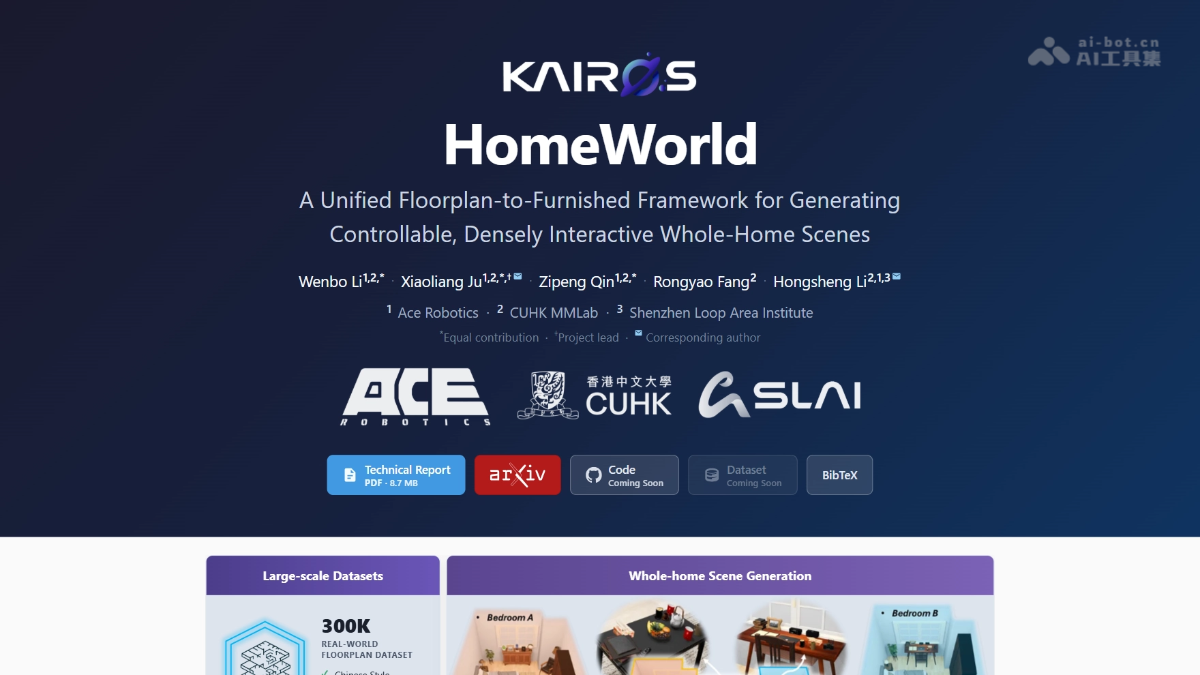
Main Features of Kairos-HomeWorld
- Whole-Home 3D Scene Generation: One-click generation of structurally coherent, physically reasonable, and functionally complete whole-home 3D scenes, covering complex multi-room layouts and supporting full size ranges from 30㎡ one-bedroom apartments to large flats of over 200㎡.
- Object-Level Full Interaction: Each scene contains an average of more than 15 interactive objects with physical properties (density, articulated structures, materials, etc.), supporting direct import into simulation engines for operations such as grasping, moving, stacking, and opening/closing.
- Exclusive Dataset for Chinese Households: Open-sources 300,000 structured and annotated real residential floor plans and 5,000 whole-home simulation scenes, fully reproducing local Chinese living features such as north-south ventilation, enclosed kitchens, and independent balconies.
- Robot Simulation Training: Supports full-process simulation training for robots to complete complex long-horizon household tasks such as cross-room navigation and multi-room item organization, greatly shortening the migration cycle from virtual to reality.
Technical Principles of Kairos-HomeWorld
- Four-Stage Hierarchical Generation Architecture: The framework decouples the complex whole-home generation task into four progressive stages: The first stage, based on a K-D tree structured representation method, transforms real residential floor plans into a hierarchical text structure that large language models can efficiently learn, avoiding room overlap and topological breaks; the second stage adopts a hierarchical strategy of "top-down global initialization + first-person detailed roaming," anchoring the generation process with a 3D building shell to solve geometric drift issues in 2D-to-3D lifting; the third stage builds a recursive closed-loop verification mechanism by fine-tuning a vision-language model, automatically detecting and correcting physical violations such as "sofa blocking the door" and "objects penetrating walls"; the fourth stage uses a surface-center object placement algorithm to generate interactive objects with complete physical properties for desktops and countertops.
- Physical Compliance and Closed-Loop Verification Mechanism: The system uses a fine-tuned VLM to perform visual analysis on generated scenes, identify layout conflicts and physical errors, and propose corrective actions through a reflection loop, keeping the furniture layout collision rate at the industry's optimal level and ensuring scenes comply with real physical rules.
- Interactive Object Asset Generation: With the help of the Physx-Omni model, the system automatically assigns physical properties such as material, density, articulation, and manifold to objects, generating an average of more than 15 operable objects. All assets can be directly instantiated into simulation engines, supporting realistic physical simulations such as collision, gravity, friction, and fluids.
How to Use Kairos-HomeWorld
- Resource Acquisition: Visit the Kairos-HomeWorld project homepage https://kairos-homeworld.github.io/ to download open-source datasets, model weights, and technical documentation.
- Environment Configuration: Deploy a simulation platform that supports Physx-Omni and configure GPU computing resources.
- Scene Generation: Input natural language instructions to trigger four-stage hierarchical generation, automatically completing the full-chain construction from floor plan to interactive 3D scene.
- Simulation Deployment: Import the complete generated scene into the simulation engine and instantiate interactive object assets with physical properties.
- Training Execution: Connect the robot model and issue household instructions to perform cross-room navigation and object manipulation training in the virtual environment.
- Transfer to Deployment: Extract the trained policy and transfer it to real robot hardware, then validate and fine-tune in real home environments.
Kairos-HomeWorld Core Advantages
-
Localized Data Foundation: The world's first dataset built specifically for Chinese households, covering local features such as north-south through layouts, dry-wet separation, and non-rectangular kitchens, solving the problem of European and American datasets not adapting well.
-
Leading Scale and Cost: 300,000 real floor plan images are the largest dataset of its kind in the world. Virtual generation has near-zero marginal cost and is not limited by the total amount of real housing available, making scaling efficiency far greater than on-site collection.
-
Breakthrough in Global Consistency: The first whole-home unified generation framework, solving the industry bottleneck where traditional methods can only cover a single room and lack global consistency and operability.
-
End-to-End Interactivity: Breaking the limitation of being viewable but unusable, it realizes full-chain automation from text to trainable scenes, significantly lowering the barrier to embodied intelligence R&D.
Kairos-HomeWorld Project Address
- Project Website:https://kairos-homeworld.github.io/
- GitHub Repository:https://github.com/Kairos-HomeWorld/HomeWorld
- arXiv Technical Paper:https://arxiv.org/pdf/2606.06390
Comparison of Kairos-HomeWorld with Similar Competitors
| Comparison Dimension | Kairos-HomeWorld | ProcTHOR |
|---|---|---|
| Scene Scope | Unified generation of whole-home multi-room scenes, with globally coherent structure | Mainly single rooms or simple residences, with limited whole-home consistency |
| Dataset Scale | 300,000 real floor plan images + 5,000 whole-home scenes | About 10,000 procedurally generated scenes |
| Regional Attributes | Designed specifically for Chinese households, restoring local living characteristics | Based on European and American living habits, lacking adaptation to Chinese floor plans |
| Object Interaction | Average of 15+ interactive objects with physical properties | Fewer interactive objects, with limited coverage of physical properties |
| Generation Method | Real floor plan data-driven + generative models | Rule-based procedural generation |
| Simulation Readiness | Complete 3D scenes can be directly imported into simulation engines for interactive training | Supports simulation, but scene complexity and realism are relatively low |
Kairos-HomeWorld Application Scenarios
-
Home Service Robot Training: Provides high-fidelity Chinese home simulation environments for cleaning, organizing, and companion robots, supporting cross-room long-horizon task training.
-
Embodied Intelligence R&D Platform: As a virtual training ground, it accelerates the iteration of embodied AI algorithms and reduces the cost and R&D barrier of transferring from simulation to real machines.
-
Smart Home Pre-validation: Simulates furniture layouts and device circulation paths in a virtual environment, optimizing interior space planning and smart home solution design.
-
Academic Research and Benchmark Testing: Provides large-scale standardized datasets and evaluation benchmarks for research on indoor scene understanding, robot path planning, object manipulation, and more.
-
Real Estate and Home Decoration preview: Quickly generate interactive 3D home-viewing models based on real floor plans, supporting decoration plan previews and spatial function verification.