

Recently, several reader teachers asked me: I want to do self-media, but my main job is too busy and I don't have time to edit. What should I do?
This question is very typical. Many of our readers are professionals in their own fields. What everyone lacks is not real content and substance, but time and process.
In the past, if you wanted to make videos, the default path was to slowly edit with CapCut, or pay someone to outsource it. But neither of these two methods is very friendly to ordinary professionals. Editing it yourself takes too much time, and finding someone to edit it makes it hard to guarantee daily updates and authenticity.
So when I recently saw Luo Zhenyu's video diary, my first reaction was: this is a new opportunity.。
Teacher Luo Zhenyu has already been continuously updating his video diary for more than 70 days, and in episode 56 he even specially recommended the “Kaipaivideo diary trio” he is using.
What's even more interesting is that video diaries are spreading from the circle of content creators to more industries.
Education and training teachers have begun using video diaries to talk about teaching reflections, real estate consultants have begun using video diaries to record showing processes, insurance practitioners have begun using video diaries to talk about real cases, and the beauty and big health industries have also begun using short videos to record service processes and customer changes.

These videos are not necessarily shot very exquisitely, nor do they necessarily have complicated camera movements. But they all share one thing in common: authentic, stable, and with a sense of a real person.
And I found that most video diaries use Luo Zhenyu's video diary template.
In order to see whether Kaipai is really suitable for making talking-head video diaries, I downloaded the App myself and ran through it once.
01. Hands-on test
This time I mainly tested the “video diary trio” mentioned by Luo Zhenyu: the AI speech-rate teleprompter, internet-savvy templates, and AI covers.
Teleprompter, solving the problem of “not daring to speak”
The easiest place for a talking-head video to get stuck is speaking. Many professionals have things in their heads, but they get nervous in front of the camera. Reading from a script looks stiff, and not reading from a script makes it easy to forget lines.
I put the talking-head script I had written in advance into Kaipai. After I started recording, the teleprompter scrolled along with my speaking speed. When I spoke quickly, the subtitles followed quickly; when I paused for a moment, the subtitles did not crazily run forward on their own.
What moved me most about this feature is that it did not interrupt expression. For self-media beginners, the most important thing is to naturally say the judgments in their heads. The teleprompter follows the person, rather than the person being rushed by the tool, so the pressure of talking-head delivery is much lower.
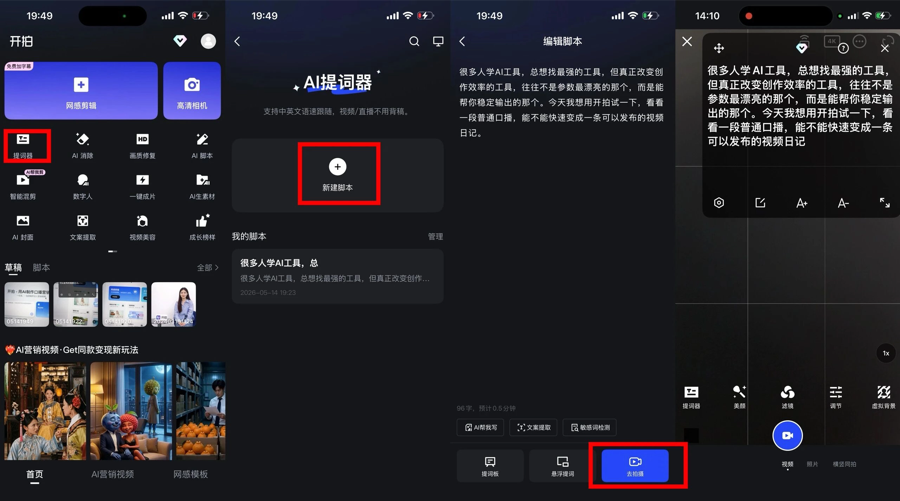
After trying this section, I clearly felt that Kaipai's understanding of talking-head scenarios is quite detailed.。
Internet-savvy templates, turning editing into a “multiple-choice question”
After recording the talking-head video, you enter the stage most likely to discourage ordinary people: editing.
In the past, when I used traditional editing tools to make talking-head videos, I often got stuck on very fragmented details. Should the subtitle style be changed? Where should the decorative text go? Will the stickers be too messy? Should sound effects be added? Is the rhythm too flat? Should the pauses in the middle be cut out? These things are not difficult when looked at individually, but doing them again for every video consumes a lot of energy. Kaipai's video diary template makes this lighter.
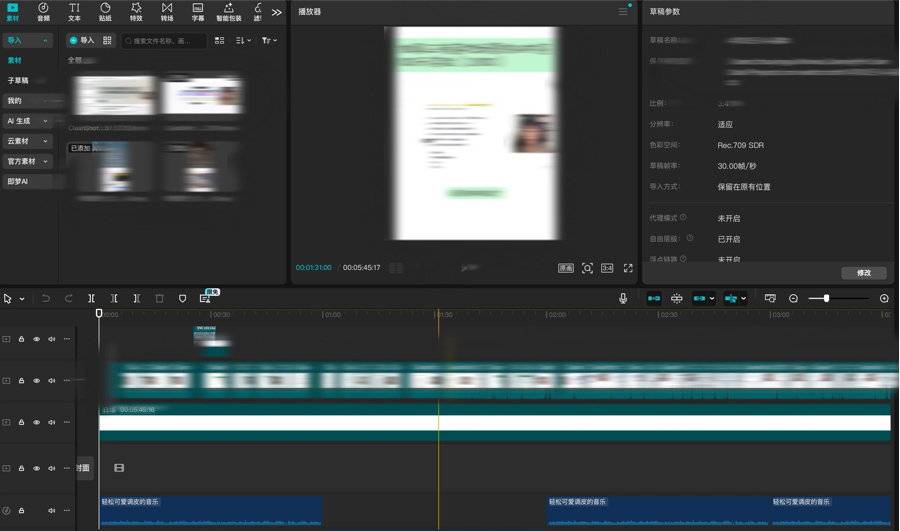
After recording the talking-head video, I directly choose an internet-savvy template suitable for a video diary, and the system automatically matches decorative text, stickers, sound effects, and basic packaging. Let friends feel it:
The whole experience is not like “editing a video,” but more like “choosing an expression style suitable for this piece of content of mine.”
This is especially important for beginners. Because what self-media beginners really need to hone is their viewpoints, cases, and expression, not spend their energy every day on editing details.

AI covers, completing the last step before publishing
Many people overlook the cover when making videos. Especially for content like video diaries, they just grab a random frame after recording and post it directly.
But on platforms like Xiaohongshu, Video Account, and Douyin, the cover actually directly affects clicks. When users scroll to a video, the first thing they see is the cover. No matter how good your content is, if the cover can't attract people, it's all for nothing. Kaipai's AI cover happens to fill this gap.

I choose a video diary cover template in Kaipai, and the system quickly generates a cover suitable for publishing. For people who aren't good at design, this feature is very convenient.
Actually, a cover doesn't need to be complicated; the key is to be clear. What is the title? What is the video topic? Why should viewers click in?
So I understand why Kaipai has been able to stand out in the talking-head video space. Its advantage isn't that it has more features than CapCut; its real advantage is that it better understands what a professional fears most from "having an idea" to "posting a video."
The core pain points for talking-head creators are "speed" and "not interrupting flow," and what they really need is this kind of uninterrupted workflow. The teleprompter solves speaking, internet-savvy templates solve quick editing, and AI covers solve the click expression before publishing. Kaipai's trio precisely solves this.。
Besides the video diary trio, I also tried several features. These features are all very beginner-friendly.
Generate an e-commerce sales video in just 5 seconds
Sales-oriented talking-head videos have a common problem: shooting costs are too high. To shoot a short video of a few dozen seconds, you need lighting, product display, and editing. Now Kaipai has launched AI-generated materials, and an e-commerce sales video can be generated in 5 seconds.
Whether placed on short video platforms for traffic or on traditional e-commerce platforms for product display, efficiency directly multiplies several times over.
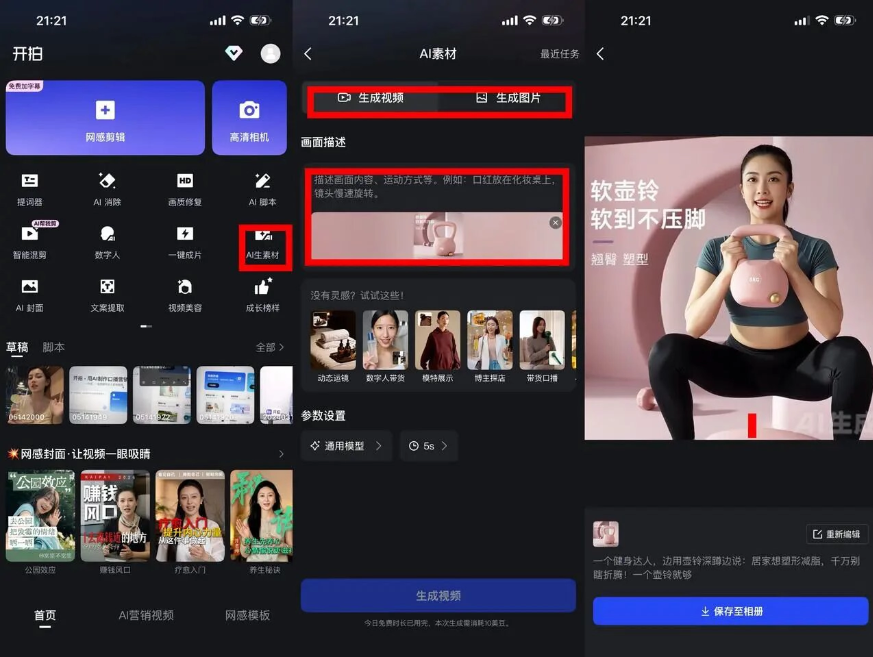
Scattered materials, one-click finished video
If you usually casually shoot some life or work clips, such as your computer desktop, on the way out, at an event site, during product use, or during food preparation, you can import these materials into Kaipai and let AI match visuals according to the script, generating a more complete video with one click.
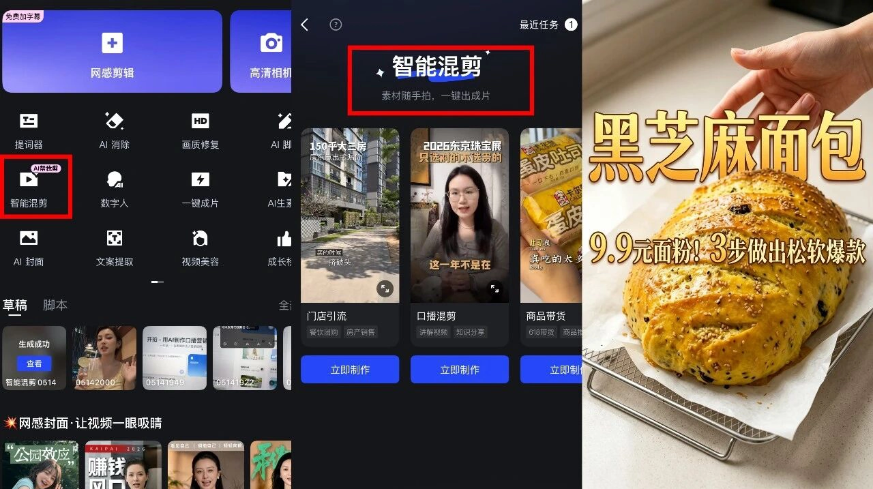
Smart mixed editing can handle voiceover, music, polishing copy, and finding suitable images on its own. This editing efficiency directly improves by several levels. This yeast sales video was made in less than 2 minutes. The key is that the operation is also particularly simple, and editing beginners can easily get started.
One-click generation of short drama sales videos
This feature is more suitable for people with customer acquisition needs. For example, industries such as beauty, insurance, education and training, big health, and consulting services can use one sentence to generate videos in short drama, speech, or stand-up comedy styles, to test the conversion effects of different content formats.
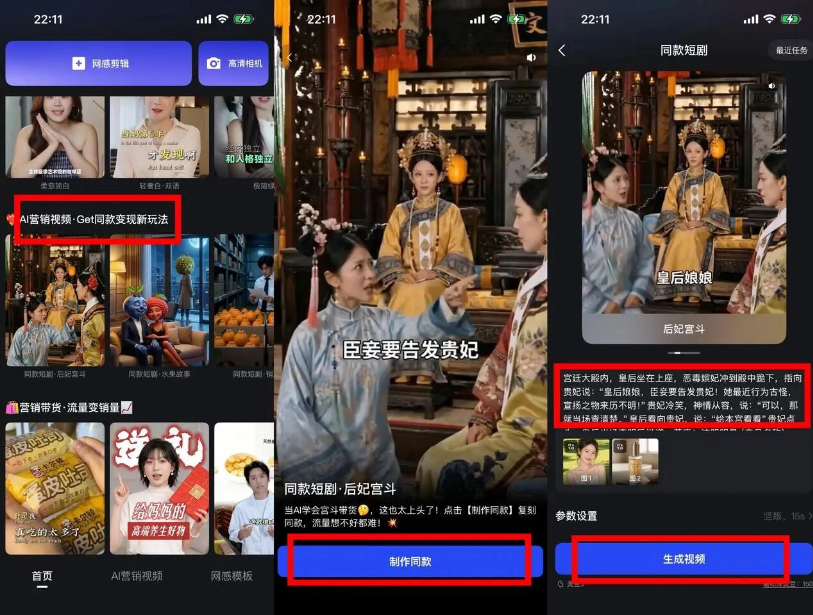
This kind of palace intrigue short drama sales format is still relatively novel at present. Friends can go try it and play around with it.
Kaipai has now become the number one user-scale player in the talking-head video space, gradually replacing other editing software.
From the actual test experience, every feature of Kaipai is polished around the production workflow of talking-head creators. It has indeed put in a lot of effort on the details.
02. Some sharing
I think there is a very important change here: the threshold for doing self-media is changing from "whether you can edit" to "whether you can tell a valuable observation every day."
CapCut is very powerful—it's an all-in-one editing tool that can handle complex editing, mashups, short dramas, and packaging. But for self-media beginners, they don't necessarily need a "big and comprehensive" editing workstation. What they need more is a lightweight tool that lets them quickly speak their views, edit them, and publish them.
If CapCut's advantage is its comprehensive features, then Kaipai's advantage is that it digs deep enough into the scenario of talking-head videos。
When a tool lets you express faster, publish faster, and persist more easily, migration will happen naturally.
Currently, video diaries are a great opportunity for professionals doing self-media. Their greatest value is not making one of your videos go viral, but letting others continuously see your professionalism,状态, and credibility.
The point of a tool is to make this process lighter.
Recently, Kaipai is launching a check-in challenge.
Time: from now until May 25, 2026
How to participate: contestants use the Kaipai app to make video diaries, with the topic "#跟着罗振宇开拍视频日记"
Publish to Xiaohongshu/Douyin/WeChat Channels platforms
Rewards: a 1,000 yuan cash prize (10 spots in total) and the opportunity for an in-person meeting with Teacher Luo Zhenyu (limited spots).
Teacher Luo says, "It's important to shoot every day," so the more diligently you shoot, the greater your chance of winning.
Friends, it's recommended not to overthink your first video.
Just say it first.
Just publish it first.
First let expression flow.
Many times, an account isn't thought up—it's shot one video at a time.
Original link:From CapCut to Kaipai: the barrier to making talking-head videos is being brought down