
What is KAG
KAG (Knowledge Augmented Generation) is a professional domain knowledge service framework launched by Ant Group. It enhances the question-answering performance of large language models (LLMs) in specific domains through knowledge augmentation, providing logical reasoning and question-answering solutions for building knowledge bases in vertical domains. KAG is based on a mutual indexing structure of knowledge and text chunks, integrating unstructured data, structured information, and business expert experience to form a unified business knowledge graph. KAG has introduced a logic-form-guided hybrid reasoning engine that transforms natural language questions into problem-solving processes combining language and symbols, supporting capabilities such as logical reasoning and multi-hop factual question answering. It effectively overcomes the ambiguity of traditional RAG vector similarity computation and the noise introduced by OpenIE, significantly improving the accuracy and efficiency of reasoning and question answering.
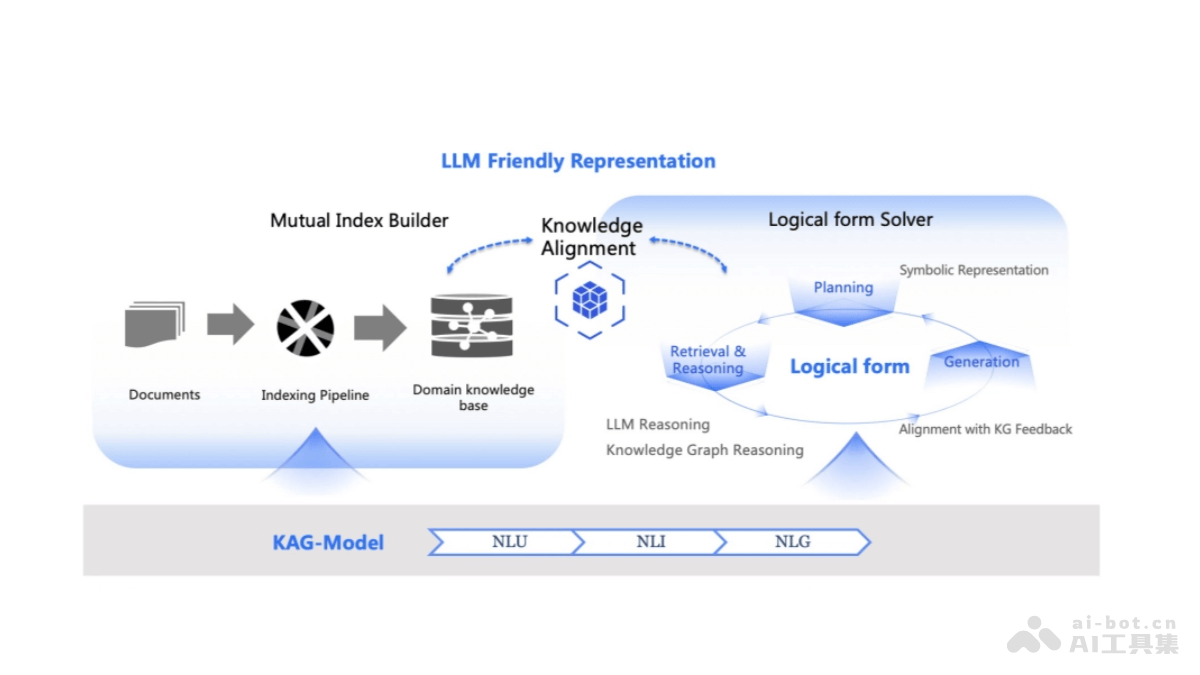
KAG's main features
- Professional domain question-answering enhancement: Combining knowledge graphs and vector retrieval to improve the question-answering capabilities of large language models in specific domains and generate more accurate, professional, and logically rigorous answers.
- Knowledge representation and retrieval optimization: Using an LLM-friendly knowledge representation framework to implement mutual indexing between knowledge graphs and raw text chunks, optimize the processes of knowledge representation, reasoning, and retrieval, and improve the accuracy and relevance of retrieval results.
- Hybrid reasoning and problem solving: Based on a logic-form-guided hybrid reasoning engine, it transforms natural language questions into problem-solving processes that combine language and symbols, enabling the integration of retrieval, knowledge graph reasoning, language reasoning, and numerical computation to effectively handle complex problems.
- Knowledge alignment and semantic enhancement: Performing knowledge alignment based on semantic reasoning, defining domain knowledge as various semantic relations, improving the standardization and connectivity of knowledge, and enhancing the accuracy and consistency of knowledge representation.
KAG's technical principles
- Combination of knowledge graphs and vector retrieval: Based on the structured semantic information of knowledge graphs and the efficiency of vector retrieval, knowledge graphs organize and represent domain knowledge, while vector retrieval is used to quickly obtain knowledge fragments related to the question.
- LLM-friendly knowledge representation: Designing the LLMFriSPG framework to adapt the data, information, and knowledge hierarchy of knowledge graphs to the input and output formats of large language models, achieving unified representation and effective transfer of knowledge.
- Mutual indexing mechanism: Establishing mutual indexing relationships between the structure of knowledge graphs and raw text chunks, allowing entities and relations in the graph structure to be associated with content in text chunks, thereby enhancing the semantic connectivity of knowledge and the accuracy of retrieval.
- Logic-form-guided reasoning: Using a logic-form language to decompose complex problems into multiple sub-problems, solving them based on operators such as planning, reasoning, and retrieval, realizing the symbolization and structuring of the problem-solving process, and improving the rigor and interpretability of reasoning.
- Semantic reasoning and knowledge alignment: In the process of constructing and retrieving knowledge graphs, using semantic reasoning techniques to align and integrate knowledge, identify and establish semantic relationships between knowledge, and improve the accuracy and consistency of knowledge.
KAG's project address
- GitHub repository:https://github.com/OpenSPG/KAG
- arXiv technical paper:https://arxiv.org/pdf/2409.13731
KAG's application scenarios
- Financial risk control: Integrating financial data and knowledge graphs to identify and provide early warning of risks such as credit default and fraud, and assist financial institutions in formulating risk control strategies.
- Healthcare: Build a medical knowledge graph to assist doctors in disease diagnosis, treatment recommendation, and drug development, improving the quality and efficiency of medical services.
- Intelligent Customer Service: As the core engine of intelligent customer service, it achieves precise understanding and rapid responses to complex user needs, improving user satisfaction and enterprise service efficiency.
- Knowledge Management and Decision Support: Help enterprises build enterprise-level knowledge graphs, provide decision support, and assist enterprises in decision-making activities such as strategic planning, market analysis, and product innovation.
- Education and Scientific Research: Integrate educational and scientific research resources, assist teachers in instructional design and researchers in research analysis, and promote knowledge dissemination and innovation.