What is the k1 Visual Reasoning Model
The k1 Visual Reasoning Model iskimithe k1 series reinforcement learning AI model launched by, natively supporting end-to-end image understanding and chain-of-thought technology, extending its capabilities to more basic science fields beyond mathematics. The k1 model performs excellently in benchmark tests for image understanding, mathematics, physics, chemistry, and other disciplines, surpassing multiple benchmark models worldwide (such as OpenAI o1, GPT-4o, and Claude 3.5 Sonnet). The k1 Visual Reasoning Model can directly process image information to reason and arrive at answers, without relying on external OCR or vision models, and provides a complete reasoning chain of thought, allowing users to see the entire process of the model contemplating the answer. The k1 Visual Reasoning Model is based on pre-training and reinforcement learning post-training, optimizes character recognition capability, achieving a current state-of-the-art result of 903 on OCRBench, and scores 69.1, 66.7, and 96.9 on the MathVista-testmini, MMMU-val, and DocVQA benchmark test sets respectively, at a globally leading level.
At the same time, the Kimi model R&D team has launched Science Vista, a standardized graphical test set for basic science disciplines, covering math, physics, and chemistry picture questions of varying difficulty, with a distribution that is relatively well matched to actual user needs. The test set will be open to the entire industry.
Main Features of the k1 Visual Reasoning Model
- End-to-end image understanding: The k1 Visual Reasoning Model can directly process image information input by users, conducting in-depth thinking and analysis without relying on external OCR technology or additional vision models.
- Display of reasoning chain of thought: The k1 Visual Reasoning Model displays the thinking process, namely the Chain of Thought (CoT), allowing users to see not only the answer but also the logical reasoning process by which the model arrives at the answer.
- Generalization of basic science capabilities
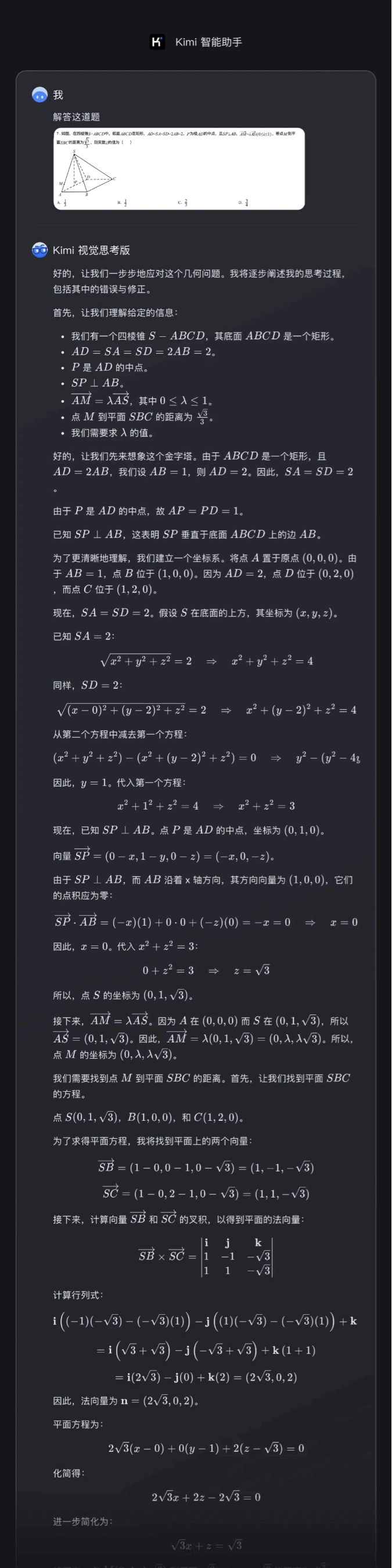
- Mathematical ability: The new k1 Visual Reasoning Model, with the help of end-to-end image understanding capability, unlocks more comprehensive mathematical abilities, including geometry figure problems.
- Interdisciplinary ability: The model's capabilities extend to other basic science fields such as physics and chemistry, enabling it to understand and solve complex problems in these fields.
- Adaptability to real-world scenarios: In real-world scenarios containing noise, such as dim photos, blurred images, and interference from handwriting, the k1 model has a more significant leading advantage compared with the visual language models of OpenAI and Anthropic.
- General problem-solving ability: The k1 Visual Reasoning Model demonstrates more general capabilities, such as explaining scientists' manuscripts, making application scenarios more extensive.
How to use the k1 Visual Reasoning Model
- Download or update the app: Make sure the latest version of theKimi Smart Assistant APPis installed on your phone or computer, or visitKimi's web version。
- Visit the Kimi Visual Reasoning version: The k1 Visual Reasoning Model has been gradually launched in thelatest versionof the "Kimi Smart Assistant" Android and iPhone mobile apps as well as the web version (kimi.com)。Find "Kimi Visual Reasoning Version" on the Kimi+ page of the latest mobile app or web version.
- Upload or take a photo: Use the photo function in the app or web version to directly capture the image you want to analyze, or upload an existing image from your device.
- Wait for analysis: After submitting the image, the k1 visual thinking model will begin processing the image information and conduct in-depth thinking and analysis.
- View results and reasoning process: Kimi Visual Thinking Edition will display the model's reasoning chain of thought (Chain of Thought, CoT), allowing users to see the entire process by which the model arrives at the answer.
- Interaction and feedback: If further explanation is needed or there are other questions, interact with Kimi, provide feedback, or ask new questions.

Challenges of the k1 visual thinking model
- Generalization ability: The k1 visual thinking model still has room for improvement in out-of-distribution generalization ability, and the model performs poorly when handling new types of problems not covered in the training data.
- Complex problem solving: When solving more complex problems, the success rate of the k1 visual thinking model is not as high as when handling simple problems.
- Accuracy in noisy scenarios: In real-world scenarios containing various kinds of noise, although the k1 visual thinking model has advantages over other models, its accuracy still needs improvement.
- Multi-turn question-answering performance: The performance of the k1 visual thinking model in multi-turn question-answering interactions needs improvement, involving the model's understanding of context and logical coherence in continuous dialogue.
Application scenarios of the k1 visual thinking model
- Educational assistance – math problem solving: Analyze images of math problems, provide solution steps and answers, and help students learn and understand mathematical concepts.
- Academic research – scientific literature analysis: Researchers interpret charts and data in scientific literature to obtain new research insights and discoveries.
- Image recognition and analysis – city or building recognition: Users identify unfamiliar city landmarks or architectural styles, increasing the depth and richness of the travel experience.
- Art and culture – calligraphy work analysis: Analyze the style and historical background of calligraphy works, providing in-depth learning resources for calligraphy enthusiasts.
- Social media – meme interpretation: Help users understand memes and popular culture phenomena on social media, crossing cultural and language barriers.
Example of the k1 visual thinking model solving a geometry problem