
What is k0-math
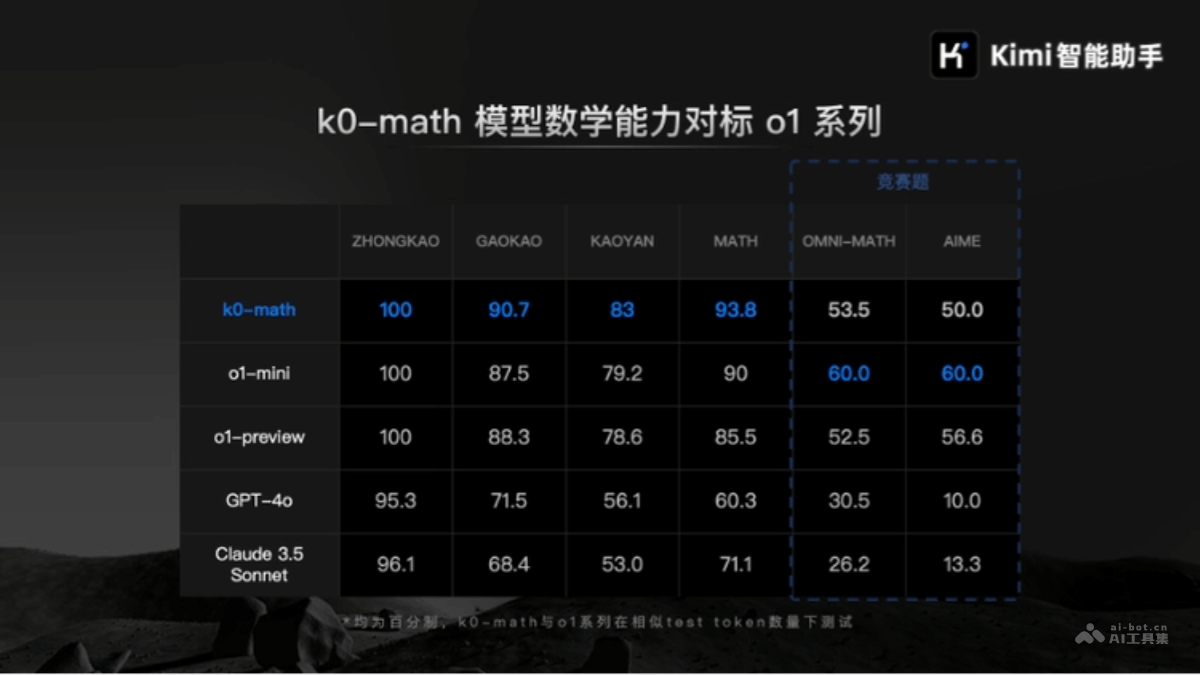
k0-math is the latest-generation mathematical reasoning model newly released by Moonshot AI's Kimi. The model performs excellently on multiple mathematical benchmarks, with mathematical capabilities comparable to the world-leading OpenAI o1 series models, benchmarked against the two publicly available models o1-mini and o1-preview. In four mathematical benchmarks at different levels—the high school entrance examination, college entrance examination, postgraduate entrance examination, and MATH, which includes introductory competition problems—k0-math's scores all surpassed o1-mini and o1-preview. In the more challenging OMNI-MATH and AIME competition-level math problem sets, k0-math also reached 90% and 83% of o1-mini's highest scores, respectively.
The k0-math model adopts reinforcement learning and chain-of-thought reasoning techniques. By simulating the human thinking and reflection process, it significantly enhances its mathematical reasoning ability. During problem-solving, the model spends more time on reasoning, including in-depth thinking and planning the solution approach, and when necessary, engaging in self-reflection and improvement, thereby increasing the success rate of answering questions.
Main features of k0-math
- Reinforcement learning technology: k0-math adopts reinforcement learning and chain-of-thought reasoning techniques. By simulating the human brain's thinking and reflection process, it greatly improves its ability to solve difficult math problems.
- Mathematical benchmark performance: In multiple mathematical benchmark capability tests, k0-math's performance can be benchmarked against OpenAI o1 series models o1-mini and o1-preview. In four mathematical benchmarks—the high school entrance examination, college entrance examination, postgraduate entrance examination, and MATH, which includes introductory competition problems—k0-math's scores exceeded these two models.
- Ability to solve highly difficult problems: In the industry-commonly-used mathematical capability benchmark MATH, k0-math's score exceeded o1-mini and o1-preview. In the more challenging OMNI-MATH and AIME competition-level math problem sets, k0-math's performance reached 90% and 83% of o1-mini's highest scores, respectively.
- In-depth thinking and planning: Unlike conventional models, k0-math spends more time on reasoning during problem-solving, including in-depth thinking and planning the solution approach, and when necessary, engaging in self-reflection and improvement, thereby increasing the success rate of answering questions.
- Problem-solving inspiration: k0-math's problem-solving thinking process can sometimes even inspire math experts. Through continuous exploration and trial and error, it can solve complex math problems.
- Limitations and continuous iteration: k0-math is good at solving most difficult math problems, but it may overthink overly simple math problems, and for difficult college entrance examination problems and IMO problems, it still has a certain probability of getting them wrong or guessing answers. The k0-math model will continue to iterate, improving its problem-solving ability and generalization ability for more difficult problems.
How to use k0-math
- Coming soon: In the coming weeks, the k0-math model will be launched onKimi Web versionand the Kimi Smart Assistant APP, stay tuned.
Application scenarios of k0-math
- Educational tutoring: As a teaching aid tool, it helps students understand and solve complex math problems and improves learning efficiency.
- Online education platforms: Integrated into online education platforms to provide personalized math problem solutions and learning suggestions.
- Competition training: Used in math competition training to help students master advanced mathematical concepts and problem-solving techniques.
- Academic research: As an auxiliary tool in mathematical research, it helps researchers explore and verify mathematical theories.
- Automated testing and grading: Automatically generate and grade mathematics questions in exams and assessments, improving efficiency and objectivity.