
What is JanusFlow
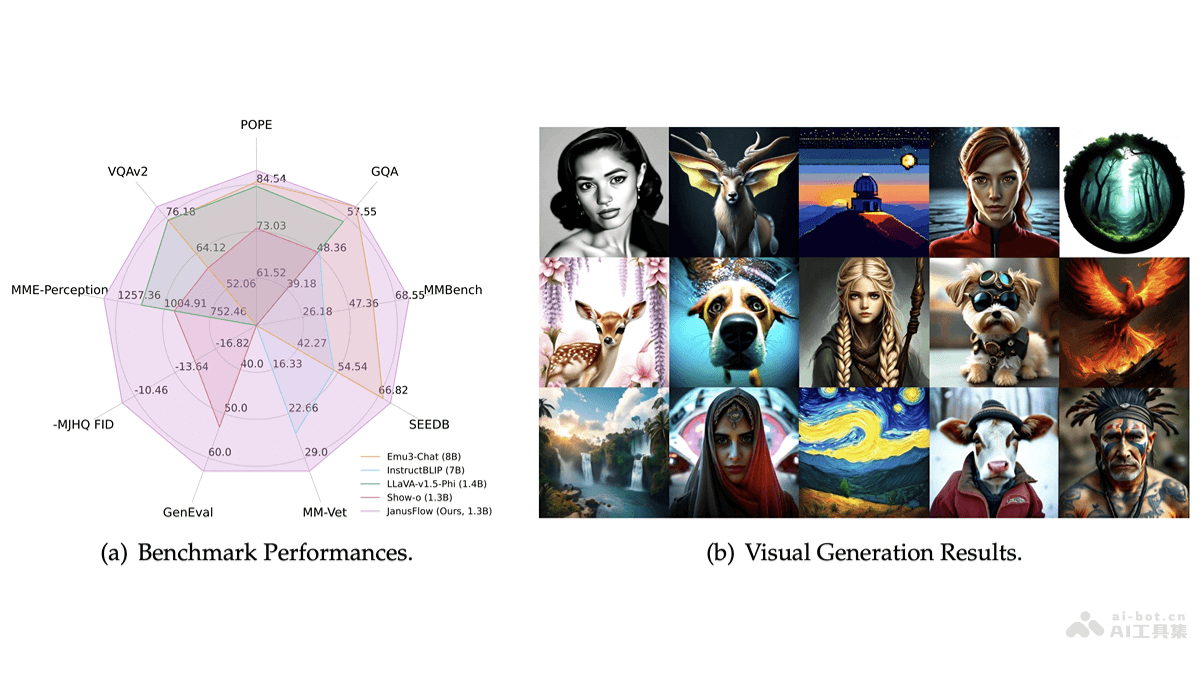
JanusFlow is the Janus series launched by DeepSeek, used for multimodal understanding and generation tasks. It integrates autoregressive language models with rectified flow technology to achieve image understanding and generation in a single model. The framework is based on decoupled visual encoders and a representation alignment strategy, improving model performance on different tasks, and shows results comparable to or better than specialized models on multiple standard benchmarks. In visual understanding, it surpasses LLaVA-v1.5 and Qwen-VL-Chat, and in image generation, it surpasses Stable Diffusion v1.5 and SDXL.
Main features of JanusFlow
- Multimodal understanding and generation: JanusFlow can handle image understanding and text-to-image generation tasks, unified in a single model framework.
- Autoregressive language model integration: Based on the capabilities of large language models (LLMs), JanusFlow learns and generalizes to new scenarios.
- Rectified flow technology: Based on rectified flow, JanusFlow provides a simple yet effective framework in generative modeling, achieving high-quality image generation.
- Decoupled visual encoders: Maintains different visual encoders separately for understanding and generation tasks, enhancing the model's task-specific performance.
- Representation alignment: Aligns the intermediate representations of the generation and understanding modules during training, enhancing semantic consistency in the generation process.
Technical principles of JanusFlow
- Architecture integration:
- Autoregressive language model: JanusFlow integrates an autoregressive language model to process text data, understand and generate natural language.
- Rectified flow: Introduces rectified flow technology, generating data based on ordinary differential equations (ODE) that learn the data distribution.
- Decoupled encoder design:
- Understanding encoder: Uses a pretrained visual encoder (such as SigLIP-Large-Patch/16) to extract semantic continuous features of images.
- Generation encoder: Uses independent ConvNeXt blocks as the visual encoder for generation tasks, improving the quality of generated images.
- Representation alignment strategy: During training, aligns the features of the understanding encoder with the intermediate features of the LLM, enhancing the model's semantic consistency in the generation process.
- Training strategy: Includes adaptation of randomly initialized components, unified pretraining, and supervised fine-tuning. Combines autoregressive objectives, rectified flow objectives, and representation alignment regularization to optimize model performance.
- Performance optimization: Uses CFG during generation to enhance the semantic alignment of images. Optimizes the quality and consistency of generated images based on tuning hyperparameters such as the CFG factor and sampling steps.
Project address of JanusFlow
- GitHub repository:https://github.com/deepseek-ai/Janus
- arXiv technical paper:https://arxiv.org/pdf/2411.07975
- Online experience Demo:https://huggingface.co/spaces/deepseek-ai/JanusFlow-1.3B
Application scenarios of JanusFlow
- Image generation:Generates corresponding images based on text descriptions, suitable for fields such as advertising, game development, and artistic creation.
- Multimodal content creation:Combines text and images to create new media content, used in the production of social media, news reports, and educational materials.
- Visual question answering (Visual QA):In education, museum tours, or intelligent assistants, answer image-related questions and provide richer information.
- Image understanding and analysis:In fields such as security surveillance and medical image analysis, understand and classify image content.
- Assisted design and planning:In architecture and urban planning, generate visual representations of design plans based on descriptions or requirements.