
What is ItiNera
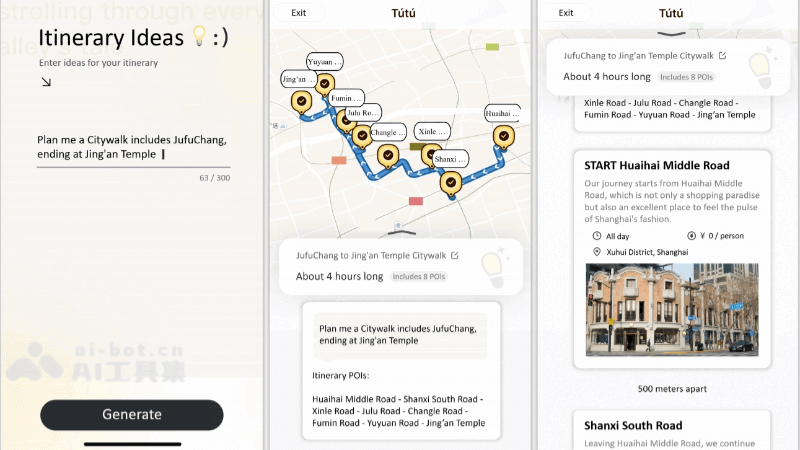
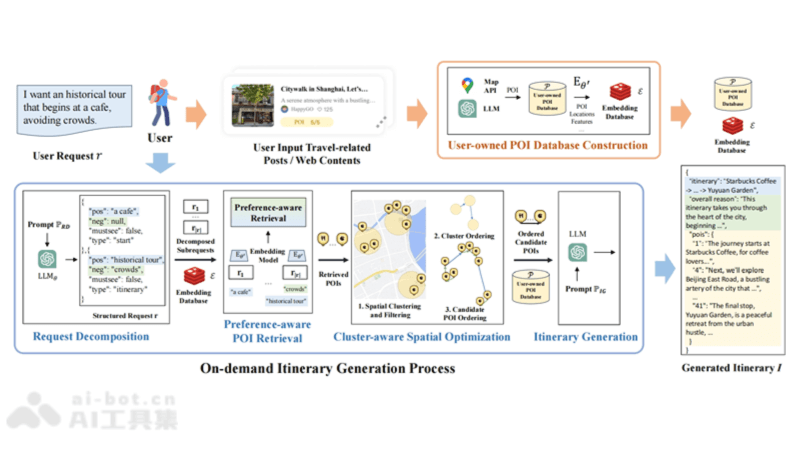
ItiNera is an intelligent urban itinerary planning system jointly developed by HKU and MIT. Based on large language models (LLMs) and spatial optimization techniques, it generates Citywalk routes with one click according to users' personalized needs, such as couples' bars, anime holy sites, and more. The system consists of five major modules: user point-of-interest database construction, request parsing, preference-aware point-of-interest retrieval, clustering-aware spatial optimization, and itinerary generation. ITINERA is trained on datasets from multiple cities and can provide real-time updated POI and activity information, ensuring that itineraries are spatially coherent and aligned with user preferences, outperforming traditional methods and direct use of LLMs.
Main Features of ItiNera
-
Personalized Itinerary Planning: Generates Citywalk routes based on personalized needs entered by users, such as specific locations, activity types, or themes.
-
Real-Time Dynamic Information: The system can update points of interest (POIs) and current popular activities in real time, ensuring the timeliness of itineraries.
-
Intelligent Spatial Optimization: Combines spatial optimization algorithms to ensure that generated routes are reasonable and efficient in geographic space, avoiding detours.
-
Handling Diverse User Needs: Flexibly handles complex and diverse user needs, including personalized preferences and specific conditions.
-
Structured Data Processing: Through the request parsing module, converts users' natural language requests into structured data for more accurate understanding and execution.
Technical Principles of ItiNera
-
User Request Decomposition: Uses the natural language processing capabilities of large language models (LLMs) to decompose users' natural language requests into multiple independent sub-requests. These sub-requests are classified as positive (what the user wants) and negative (what the user does not want) requirements, and further subdivided into specific location requests and itinerary-level requests.
-
User-ownedPOIDatabase Construction (User-owned POI Collection, UPC): Automatically collects and constructs a user point-of-interest (POI) database from travel content on social media platforms. Users can input links to travel posts, and the system uses LLMs to extract POIs and their descriptions and integrate this information into the user-owned POI database.
-
POIRetrieval (POI Retrieval, PR): Uses an embedding model to encode requests according to users' positive and negative preferences and retrieves the POIs most relevant to positive preferences. By calculating similarity scores between positive and negative preference embeddings and precomputed POI embeddings, the retrieved POIs are re-ranked.
-
Spatial Optimization (Spatial Optimization, SO): Solves spatial clustering and the selection of candidate POIs through the Hierarchical Traveling Salesman Problem (TSP). First, spatial clustering of the retrieved POIs is calculated, and then candidate POIs are selected based on geographic proximity and matching scores.
-
Itinerary Generation (Itinerary Generation, IG): Combines the ordered candidate POI set selected by the spatial optimization module and multiple constraints, and uses an LLM to generate travel routes and related descriptions that both meet user requests and are spatially reasonable.
-
Evaluation and Feedback: A series of rule-based evaluation metrics (such as POI recall rate, the difference between total travel distance and the theoretical shortest path, the number of intersections in the route, and the proportion of unknown POIs) and GPT-based evaluation metrics (such as POI quality, itinerary quality, and match degree) were designed to evaluate the generated itineraries.
-
Online Deployment and User Feedback: The ITINERA system has been deployed as the core algorithm of the TuTu online travel service, collecting user feedback to optimize system performance and user experience.
ItiNera's project address
-
arXivTechnical Paper:https://arxiv.org/pdf/2402.07204
ItiNera's application scenarios
- Personal Travel Planning: Provide users with travel routes customized according to personal interests and preferences, such as historical and cultural tours, food exploration, shopping routes, etc.
- City Walking: Provide dynamically generated itineraries for tourists walking around the city and exploring city streets and historical sites.
- Short Trips: Provide efficient and compact city short trip planning for tourists with limited time.
- Special Interest Travel: Meet travel needs for specific themes or interests, such as art exhibitions, music festivals, sports events, etc.
- Event and Festival Planning: During special events or festivals, provide users with customized itineraries, such as Spring Festival temple fairs, Christmas markets, etc.
- Accessible Travel: Provide itinerary planning that takes accessibility facilities into consideration for tourists with special needs (such as the elderly and people with disabilities).