
What is Iris
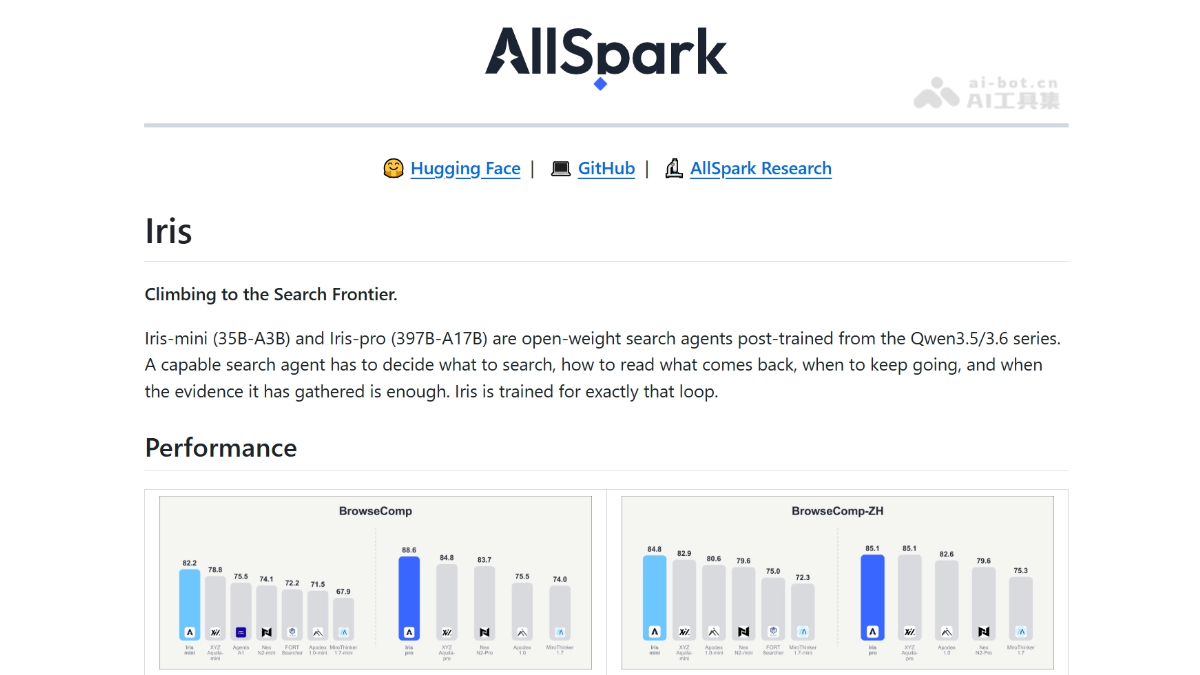
Iris is a search agent open-sourced by Xiaohongshu's AllSpark team, with two versions: 35B (Iris-mini) and 397B (Iris-pro). Iris can autonomously decide what to search for, how to read, and when to converge on an answer in the real web. By reverse-constructing sufficiently difficult and solvable training data from web hyperlinks, it adopts the SFT–RL Climbing training method that alternates between SFT and reinforcement learning. It achieves the strongest open-source results at the same scale on four major benchmarks including BrowseComp, DeepSearchQA, and HLE. The 35B version has approached trillion-parameter models, and its search capability can spill over to tasks such as general tool calling.
Iris's main features
-
Autonomous web search: It decides what to search for, how to read retrieval results, and when to continue or stop, reasoning while searching and answering.
-
Multi-step cross-page reasoning: It can progressively pin down a unique answer across multiple web pages, rather than taking shortcuts through keyword matching.
-
Complex Chinese and English retrieval: It achieves the strongest open-source performance at the same scale on Chinese and English web retrieval tasks such as BrowseComp and BrowseComp-ZH.
-
Evidence-covering question answering: When answering, it fully covers the evidence chain, leading in performance on DeepSearchQA.
-
Expert-level hard problem solving: It can handle highly difficult problems requiring expert-level reasoning, such as HLE.
-
Context management: It supports context management strategies such as truncation and compression, so long-chain searches are not interrupted, with small models benefiting especially明显.
-
Capability spillover: Without specialized training, it can handle tasks such as general tool calling and office collaboration.
Iris's technical principles
- Reverse question generation for data construction: Using seed pages as answers, it follows hyperlinks to aggregate an entity graph, generates questions on the graph that require multi-step cross-page reasoning, then rewrites entities other than the answer in the question text into descriptive references to erase matchable clues, and finally uses a reference model for double filtering. Only questions that cannot be answered closed-book but can be uniquely answered correctly when evidence is provided are kept. The whole process is automated and can scale with the corpus size.
- Alternating SFT–RL Climbing training: In the SFT stage, a strong teacher model generates trajectories on real search tools, which are used for training after result filtering and single-step filtering by a "judge"; in the RL stage, the model learns while searching on the real web. After each round, the trajectories that are hardest to get right and the most efficiently solved are fed back into the next round of SFT. As the model becomes stronger, the questions automatically become harder, forming an adaptive curriculum.
- Internalized training engineering: Scoring and summarization are completed inside the training cluster using self-built models, without relying on any external API, avoiding network fluctuations interfering with the training loop; at the same time, training and online use share the same summarizer, eliminating the mismatch between training and inference.
- Resume from checkpoints for ultra-long trajectories: The few ultra-long sessions that drag down progress are no longer discarded entirely; they are interrupted at the request level and continue from the committed prefix in the next step, keeping GPU utilization high under synchronous scheduling.
- Aligned evaluation protocol: All compared systems are evaluated under the same tools, context, scoring model, and the same context management strategy, using only a single ReAct agent, excluding framework tricks such as multi-agent and test-time self-verification, so that scores truly reflect the model's own capabilities.

Follow WeChat and reply "open source" to join theAI open-source project exchange group
How to use Iris
-
Clone the repository: Run
git clone https://github.com/AllSpark-Research/Iristo get the inference and evaluation code. -
Download model weights: Download the Iris-mini (35B) or Iris-pro (397B) weights from the HuggingFace collection huggingface.co/collections/AllSpark-Research/iris.
-
Configure the runtime environment: Install dependencies as required by the repository (such as inference frameworks like vLLM/SGLang), and configure the search tool interface (web search is a necessary prerequisite for the Search Agent).
-
Load the model and connect tools: Load the model in ReAct agent form, and register the search engine as a tool for the model to call.
-
Ask a question to run inference: Enter a question, and the model will automatically plan search queries, read web pages, perform multi-step reasoning, and converge to give an evidence-backed answer.
Iris's core advantages
- Strongest open-source results at the same scale: It comprehensively leads open-source models of the same scale on the four search benchmarks BrowseComp, BrowseComp-ZH, DeepSearchQA, and HLE, and the 397B Iris-pro surpasses trillion-parameter-level models on some items.
- Small size approaches super-large models: The 35B Iris-mini scores 82.2 on BrowseComp, already approaching models with dozens of times more parameters such as Kimi-K2.6, giving small models the ability to challenge super-large models in vertical domains.
- Automated and high-quality data construction: It reverse-engineers questions from web hyperlinks, erases matchable clues, and double-filters for "hard enough and solvable", requiring no manual question writing throughout, and can scale infinitely with corpus size.
- Robust and efficient training engineering: Scoring and summarization are internalized into the training cluster, completely eliminating external API dependencies; resuming ultra-long trajectories from checkpoints keeps GPUs continuously fully loaded, greatly reducing training uncertainty.
- Training and online are consistent: The summarizer that compresses retrieved content during training is the same one used in evaluation and online, so there is no mismatch between training and use.
- Capabilities spill over, strong generality: Search capabilities generalize to general tool calling and office collaboration and other tasks that were never specifically trained, and Search is a reusable atomic capability.
Iris's project addresses
- GitHub repository:https://github.com/AllSpark-Research/Iris
- HuggingFace model library:https://huggingface.co/collections/AllSpark-Research/iris
- arXiv technical paper:https://arxiv.org/pdf/2609.04304
Comparison of Iris with similar competing products
| Comparison dimension | Iris (Xiaohongshu AllSpark) | Kimi-K2.6(Moonshot AI) |
|---|---|---|
| Model positioning | Open-source Search Agent dedicated model | Trillion-parameter general large model (also with Agent capabilities) |
| Parameter scale | Iris-mini 35B (MoE activated 3B) / Iris-pro 397B (MoE activated 17B) | About 1T parameters |
| BrowseComp | mini 82.2 / pro 88.6 | Single agent 83.2 / Agent Swarm (300 sub-agents) 86.3 |
| Parameter efficiency | At 35B size, it already approaches the trillion-level single-agent level of K2.6 | Requires 1T parameters to reach a similar level |
| Openness | Weights, evaluation code, data construction, and training recipe are all open source | Open-source weights, but data and training details are not disclosed |
| Evaluation fairness | Unified tools/context/scoring model, single ReAct without framework shortcuts | Agent Swarm relies on multi-sub-agent bonuses, and different protocols are difficult to align directly |
| Capability spillover | Can perform BFCL, τ-bench, OfficeQA, and APEX without specialized training | General-purpose model; tool calling is a general capability rather than a specialized spillover |
Iris's application scenarios
-
Deep research/research reports: Automatic multi-round retrieval, cross-page reasoning, and complete evidence coverage, suitable for Deep Research-type products such as industry research, competitive analysis, and academic research.
-
Complex fact-checking: Answers need to be locked down in multiple steps across multiple web pages, suitable for scenarios such as debunking rumors, fact-checking, and due diligence where "the source must be found."
-
Bilingual Chinese-English search: Excels in both BrowseComp and BrowseComp-ZH, naturally suitable for cross-border information retrieval on mixed Chinese-English corpora.
-
General-purpose tool-calling agent: Capabilities spill over to General Tool Use tasks such as BFCL and τ-bench, and it can serve as a general foundation for Agent products.
-
Office collaboration (Cowork): It can get started on office tasks such as OfficeQA and APEX without specialized training, suitable for embedding into office assistants to handle document Q&A and workflow tasks.