
What is IP-Adapter
IP-Adapter (Image Prompt Adapter) is an adapter specifically designed for pre-trained text-to-image diffusion models (such as Stable Diffusion), with the goal of enabling text-to-image models to utilize image prompts to generate images. This method was proposed by researchers at Tencent AI Lab, aiming to address the complexity and challenges of generating ideal images using only text prompts.
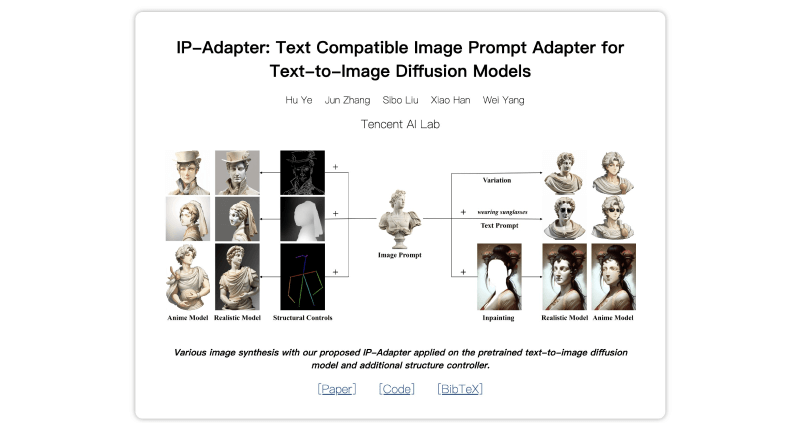
In traditional text-to-image diffusion models, users need to write text prompts to guide the model in generating images, which often requires complex prompt engineering. IP-Adapter, by introducing image prompts, enables the model to directly understand image content, thereby more effectively generating images that align with user intent. The core of this method lies in its use of a decoupled cross-attention mechanism, which separates the processing of text features and image features, allowing the model to better understand and utilize image information.
IP-Adapter Official Website Entry
- Official Project Homepage:https://ip-adapter.github.io/
- GitHub Code Repository:https://github.com/tencent-ailab/IP-Adapter
- Arxiv Research Paper:https://arxiv.org/abs/2308.06721
- Hugging Face Model Address:https://huggingface.co/h94/IP-Adapter
- Google Colab Demo Address:https://colab.research.google.com/github/tencent-ailab/IP-Adapter/blob/main/ip_adapter_demo.ipynb
- IP-Adapter-FaceID Demo:https://huggingface.co/spaces/multimodalart/Ip-Adapter-FaceID
Features of IP-Adapter
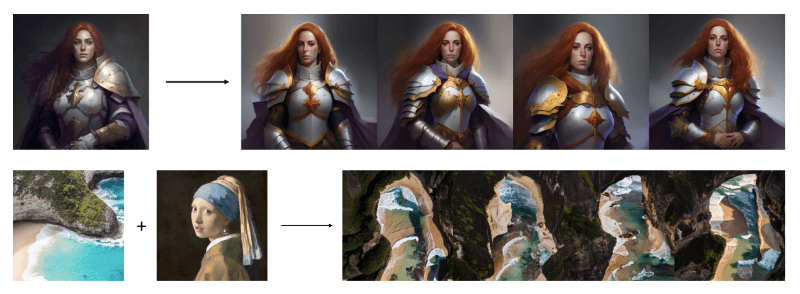
- Image Prompt Integration: IP-Adapter allows the model to receive images as input, along with text prompts, to guide the image generation process. This method leverages the rich information in images, making the generated images more accurately reflect the user's intent.
- Lightweight Adapter: Although IP-Adapter is powerful, its parameter count is relatively small (about 22M parameters), making it more efficient in terms of computational resources and easy to deploy and use.
- Generalization Ability: After training, IP-Adapter can be easily applied to other custom models fine-tuned based on the same base model, allowing flexible use in different application scenarios.
- Multimodal Generation: IP-Adapter supports using both text prompts and image prompts for image generation, providing users with more creative freedom and enabling the generation of richer and more diverse image content.
- Structural Control Compatibility: IP-Adapter is compatible with existing structural control tools (such as ControlNet), allowing users to incorporate additional structural conditions during image generation, such as user-drawn sketches, depth maps, semantic segmentation maps, etc., to achieve finer image control.
- No Fine-Tuning Required: The design of IP-Adapter avoids fine-tuning the original diffusion model, meaning users can directly use pre-trained models without the need for time-consuming fine-tuning processes.
- Image-to-Image and Inpainting: IP-Adapter not only supports text-to-image generation but can also be used for image-to-image translation and image inpainting tasks by replacing text prompts with image prompts.
How IP-Adapter Works
The working principle of IP-Adapter is based on a decoupled cross-attention mechanism, which allows the model to process both text and image information simultaneously without mutual interference.
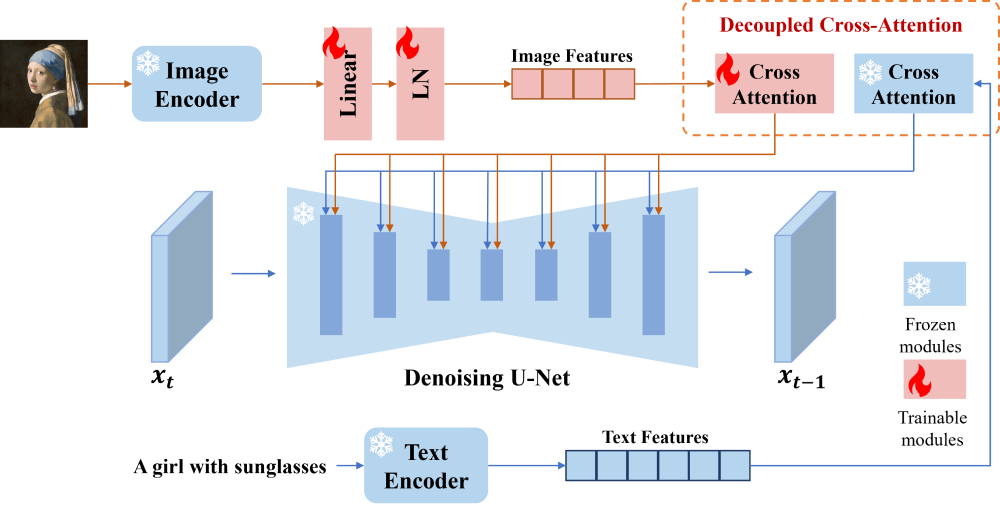
The following are the detailed steps of how IP-Adapter works:
- Image Encoding: First, IP-Adapter uses a pre-trained CLIP (Contrastive Language-Image Pre-training) image encoder to extract features from the image prompt. The CLIP model is trained on a large number of image-text pairs through contrastive learning, and is able to understand image content and generate text descriptions related to the image. In IP-Adapter, the CLIP encoder is used to convert the image into a series of feature vectors.
- Feature Projection: To align the dimensions of image features with text features, IP-Adapter includes a small trainable projection network that converts the global image embedding of the CLIP encoder into a feature sequence with the same dimensions as the text features.
- Decoupled Cross-Attention: In pre-trained text-to-image diffusion models (such as Stable Diffusion), text features interact with the model's internal state through cross-attention layers. IP-Adapter adds a new layer to each cross-attention layer specifically for processing image features. In this way, text features and image features can be processed separately through their own cross-attention layers, avoiding the information loss that could result from direct merging.
- Training Process: During the training phase, IP-Adapter only optimizes the parameters of the newly added cross-attention layers while keeping the original diffusion model parameters unchanged. In this way, IP-Adapter can learn how to incorporate image features into the image generation process without changing the original model structure.
- Generation Process: When generating images, IP-Adapter inputs the features of the text prompt and the image prompt into the model. The model first processes the text features through the text cross-attention layer, and then processes the image features through the image cross-attention layer. Finally, these features are merged and input into the diffusion model's denoising network to gradually generate the image.
- Structural Control: IP-Adapter is compatible with existing structural control tools (such as ControlNet), which means that users can add additional structural conditions during the generation process, such as sketches, depth maps, etc., to achieve more fine-grained image control.