
What is InvSR
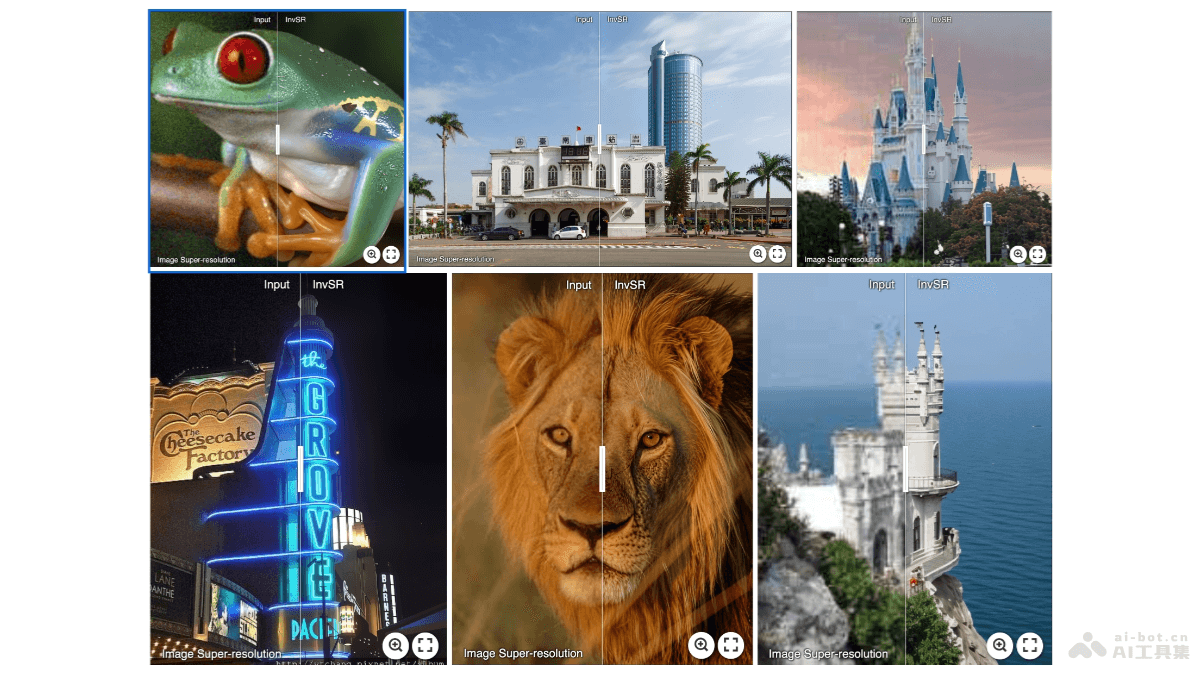
InvSR is an innovative image super-resolution model that restores high-resolution images based on the inverse process of diffusion models. It uses the rich image priors in large pre-trained diffusion models to improve super-resolution performance. The core of InvSR lies in the deep noise predictor, which can estimate the optimal noise map required in the forward diffusion process. This method can fully utilize the prior knowledge of diffusion models and provides a flexible and efficient sampling mechanism, allowing users to freely adjust the sampling steps according to the type of image degradation or specific needs.
Main Features of InvSR
- Image Super-Resolution Enhancement: The main function is to improve image resolution, restoring high-resolution images from low-resolution images.
- Flexible Sampling Mechanism: Supports any number of sampling steps from one to five, allowing users to adjust the sampling steps according to the type of image degradation or specific needs.
- Noise Prediction: The deep noise predictor estimates the optimal noise map, which is used to initialize the sampling process of the diffusion model.
- Utilization of Diffusion Models: Fully utilizes the image prior knowledge in pre-trained diffusion models to improve super-resolution performance.
- Efficient Computation: Even with reduced sampling steps, it can maintain or exceed the performance of existing methods, achieving improved computational efficiency.
Technical Principles of InvSR
- Diffusion Model Framework: Based on diffusion models (such as Denoising Diffusion Probabilistic Model, DDPM), gradually adding noise to transform high-resolution images into random noise maps of low-resolution images.
- Partial Noise Prediction Strategy: Constructs an intermediate state of the diffusion model as the starting sampling point, simplifying the inversion process from low resolution to high resolution.
- Deep Noise Predictor: One of the core components, used to estimate the optimal noise map in the forward diffusion process, thereby partially initializing the sampling process on the diffusion trajectory.
- Reverse Diffusion Process: Starting from the noise map, gradually removes noise through the reverse diffusion process to restore the high-resolution image.
- Flexible Sampling Steps: Selects different starting sampling points and combines existing sampling algorithms to achieve different numbers of sampling steps, adapting to different image degradation situations.
- Training and Optimization: Trains the noise predictor by minimizing the difference between the predicted high-resolution image and the true high-resolution image, using L2 loss, LPIPS loss, and GAN loss for training to optimize performance.
InvSR Project Address
- GitHub Repository:https://github.com/zsyOAOA/InvSR
- arXiv Technical Paper:https://arxiv.org/pdf/2412.09013
- Online Experience Demo:https://huggingface.co/spaces/OAOA/InvSR
Application Scenarios of InvSR
- Digital Media Restoration and Enhancement: Improves the resolution of old photos, historical documents, or damaged images, helping to restore and preserve cultural heritage.
- Video Surveillance and Security: Enhances the clarity of low-resolution videos or images captured by surveillance cameras, improving the recognition capability of security monitoring systems.
- Medical Imaging: In the field of medical imaging, such as MRI or CT scans, improving image resolution can help doctors diagnose conditions more accurately.
- Satellite and Aerial Photography: Improve the resolution of satellite imagery for geographic information systems (GIS), environmental monitoring, and urban planning.
- Mobile Devices and Photography: On smartphones and other mobile devices, enhance the resolution of captured photos and improve the user experience.