
What is Inverse Painting
Inverse Painting is an AI technology launched by researchers at the University of Washington that can reverse-engineer the painting process. By analyzing videos of artists painting, it learns painting techniques and sequences, then generates a series of painting instructions, progressively updating the canvas to simulate the artist's creative process. The process includes learning the painting process, defining painting instructions, generating images with diffusion models, text and region understanding, and progressive rendering. Inverse Painting can recreate famous paintings and helps people learn painting techniques. Inverse Painting provides people with a new way to understand and learn the art of painting.
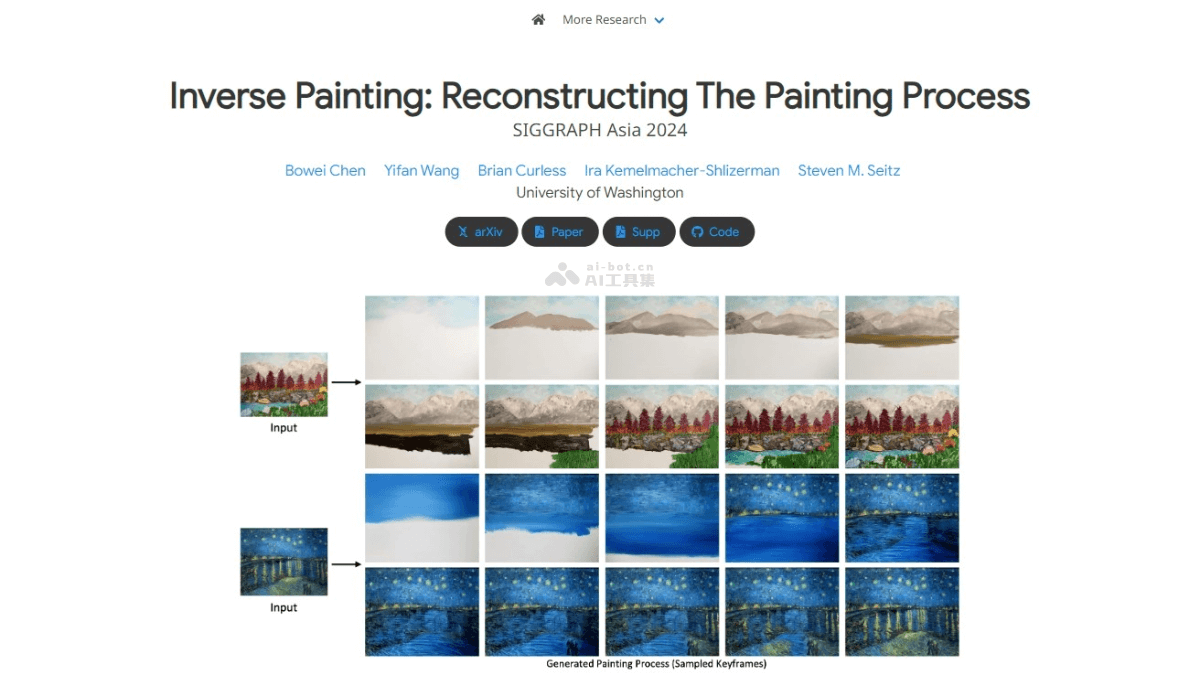
Inverse Painting's main features
- Painting process reconstruction: Given a completed painting, reverse-generate a time-lapse video of the possible painting process for that work.
- Autoregressive image generation: Starting from a blank canvas, progressively update the canvas until the target painting is completed.
- Learning from real artists: Analyze videos of real artists painting to learn painting techniques and styles.
- Generating painting instructions: Create text instructions and region masks to guide the order of painting and the focus areas.
- Simulating painting style: Simulate the painting style and process of human artists, including the painting order from background to foreground and layering techniques.
Inverse Painting's technical principles
- Diffusion-based inverse painting method: Use a diffusion model to progressively remove noise from a noisy image and generate continuous image frames.
- Text and region understanding: Combine text instructions and region masks to define the "instructions" for painting and update the canvas.
- Two-stage training + testing:
- Stage one: instruction generation: Generate text instructions and region masks, providing high-level guidance for the painting order.
- Stage two: canvas rendering: A diffusion-based renderer updates the canvas based on text instructions and region masks.
- Time control: Simulate the painting speed of real artists, taking into account the time intervals between each step.
Inverse Painting's project address
- Project website:inversepainting.github.io
- GitHub repository:https://github.com/ArmastusChen/inverse_painting(to be open-sourced soon)
- arXiv technical paper:https://arxiv.org/pdf/2409.20556
Inverse Painting's application scenarios
- Art education: As a teaching tool, help students understand the creative process of famous paintings and learn painting techniques and art history.
- Art creation assistance: For artists to explore different painting techniques, or as a source of inspiration during the creative process.
- Cultural heritage protection: Analyze and recreate the painting process of ancient artworks, helping to protect and pass on cultural heritage.
- Artwork authentication: Analyze the painting process of artworks to provide a reference for authenticity verification.
- Entertainment and gaming: In video games or film production, generate dynamic artistic effects or use them as plot elements.
- Interactive media: In interactive applications, allow users to create personalized artworks with AI.