
What is InternVLA·N1
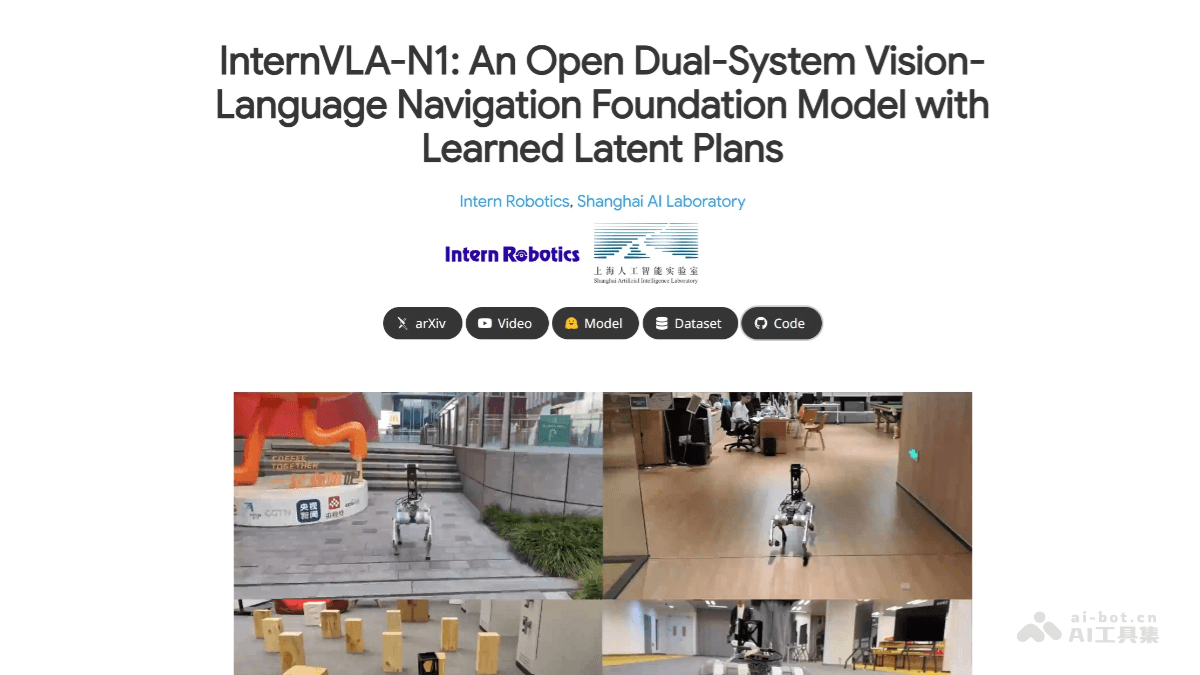
InternVLA·N1 is an open-source end-to-end dual-system navigation large model by Shanghai Artificial Intelligence Laboratory. It adopts a dual-system architecture, where System 2 is responsible for understanding language instructions and planning long-horizon paths, and System 1 focuses on high-frequency responses and agile obstacle avoidance. The model is trained entirely on synthetic data, achieving a low-cost and highly efficient training process through large-scale digital scene assets and massive multimodal corpora. In multiple mainstream benchmarks, InternVLA·N1 performs excellently, with scores reaching internationally leading levels, demonstrating strong zero-shot generalization ability. It can achieve instruction-following walking across buildings over long distances and agile obstacle avoidance among dense obstacles in real-world scenarios.
Main Features of InternVLA·N1
-
Language Understanding and Path Planning: System 2 can understand natural language instructions and predict the target pixel for the next execution step on the image based on visual observations, enabling long-horizon spatial reasoning and planning.
-
Agile Obstacle Avoidance and Execution: System 1 is responsible for high-frequency responses to environmental changes, enabling agile obstacle avoidance and ensuring accurate arrival at the target point.
-
Synthetic Data-Driven Training: Trained entirely on synthetic data, achieving a low-cost and highly efficient training process through large-scale digital scene assets and massive multimodal corpora.
-
Zero-Shot Generalization Ability: Trained only on synthetic data, yet able to achieve 60Hz instruction-following walking across buildings over long distances and agile obstacle avoidance among dense obstacles in real-world scenarios, demonstrating strong generalization ability.
-
Multi-Scenario Adaptability: Performs excellently in multiple mainstream benchmarks, with scores reaching internationally leading levels, suitable for various complex scenarios and task requirements.
Technical Principles of InternVLA·N1
-
Dual-System Architecture: Adopts a dual-system architecture with System 1 and System 2. System 2 is responsible for understanding language instructions and performing long-horizon spatial reasoning and planning, while System 1 focuses on high-frequency responses and agile obstacle avoidance. The two work collaboratively to achieve efficient navigation.
-
Asynchronous Inference Mechanism: System 1 and System 2 perform asynchronous inference. System 1 can respond more frequently to environmental changes and achieve agile obstacle avoidance, while System 2 focuses on long-horizon spatial reasoning and planning, avoiding the latency and complexity caused by synchronous inference.
-
Purely Synthetic Data-Driven: Trained entirely on synthetic data, achieving low-cost and highly efficient training through large-scale digital scene assets and massive multimodal corpora, combined with efficient data synthesis techniques.
-
Two-Stage Curriculum Training: Training is divided into a pre-training stage and a joint tuning stage. In the pre-training stage, System 2 undergoes supervised fine-tuning to accurately plan paths; in the joint tuning stage, System 1 and System 2 work collaboratively to optimize overall navigation performance.
-
Multimodal Fusion: The model can fuse visual and language information, enabling understanding of complex environments and execution of navigation tasks through a multimodal large model, improving the model's adaptability and accuracy in real-world scenarios.
Project Addresses of InternVLA·N1
-
Project Website:https://internrobotics.github.io/internvla-n1.github.io/
-
GitHub Repository:https://github.com/InternRobotics/InternNav
-
Hugging Face Model Hub:https://huggingface.co/InternRobotics/InternVLA-N1
- Technical Paper:https://internrobotics.github.io/internvla-n1.github.io/static/pdfs/InternVLA_N1.pdf
Application Scenarios of InternVLA·N1
-
Intelligent Robot Navigation: Provide efficient navigation capabilities for service robots, logistics robots, etc., enabling them to walk autonomously, avoid obstacles, and complete tasks in complex environments according to voice commands.
-
Autonomous Driving Assistance: In the field of autonomous driving, assist vehicles in path planning and obstacle avoidance, improving the safety and reliability of autonomous driving systems.
-
Virtual Reality and Augmented Reality: In virtual reality (VR) and augmented reality (AR) applications, provide users with a more natural and immersive interaction experience, for example, navigating in a virtual environment according to voice commands.
-
Intelligent Security Monitoring: In the field of intelligent security, through the fusion of visual and language instructions, achieve intelligent patrols of monitoring areas and rapid response to abnormal events.
-
Industrial Automation: In industrial environments, provide navigation and operation guidance for automated equipment, improving production efficiency and safety.
-
Intelligent Tour Guide Services: In museums, exhibition halls, and other venues, provide visitors with personalized navigation and explanation services, enhancing the visiting experience.