
What is InternVLA·M1
InternVLA·M1 is an embodied manipulation "brain" developed by Shanghai Artificial Intelligence Laboratory, and is a dual-system manipulation large model oriented toward instruction following. It builds a complete closed loop covering "thinking-action-autonomous learning," and is responsible for high-level spatial reasoning and task planning. The model adopts a two-stage training strategy: first, through spatial perception pretraining, it enhances spatial reasoning and planning capabilities; then, by means of implicit spatial reasoning, it achieves efficient action post-training. It only requires "spatial planning prompts" for efficient training, greatly reducing costs. In public manipulation benchmarks such as SimplerEnv, InternVLA·M1 reaches an internationally leading level, and its instruction following and generalization to unseen objects are significantly superior to other similar models. Relying on the self-developed simulation platform InternData-M1, it completes large-scale pretraining and is suitable for complex scenarios and long-horizon tasks.
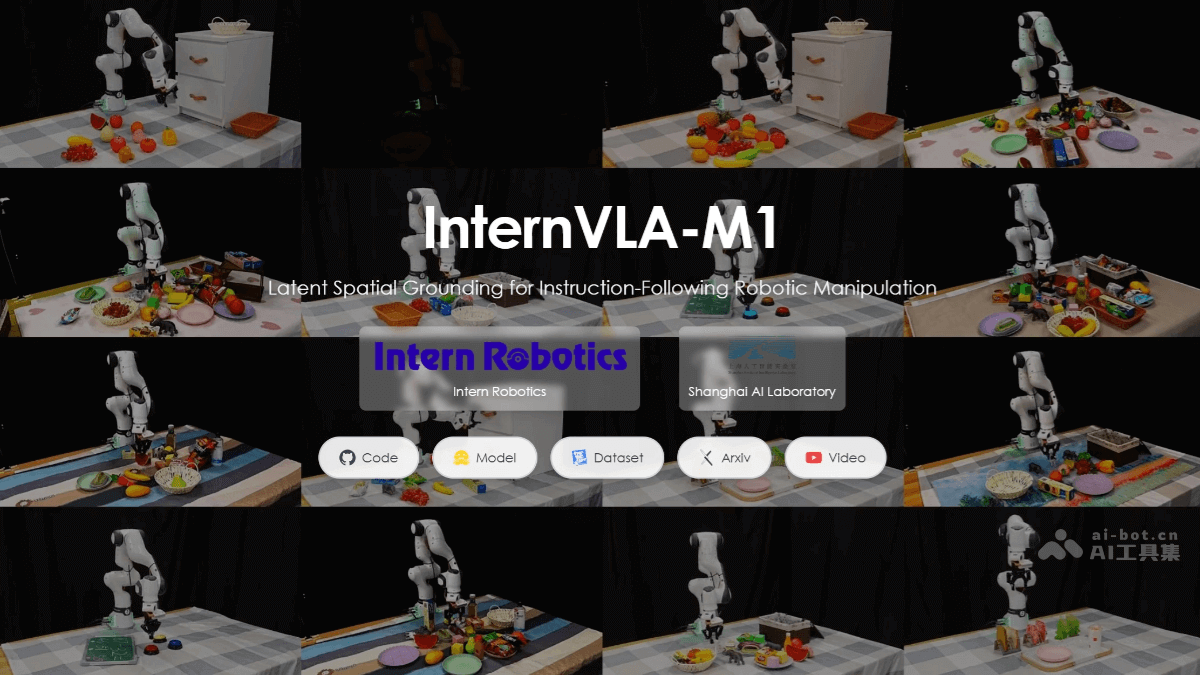
Main Features of InternVLA·M1
-
High-level spatial reasoning and task planning: Responsible for spatial reasoning and task planning in complex environments, able to understand instructions and generate corresponding operation sequences.
-
Dual-system manipulation architecture: Adopts a two-stage training strategy, first performing spatial perception pretraining, then action post-training, improving the model's reasoning and planning capabilities.
-
Efficient training and cost control: Achieves efficient training through "spatial planning prompts," greatly reducing training cost and time.
-
Instruction following and generalization capability: Performs excellently in various public benchmarks, especially outstanding in instruction following and generalization to unseen objects.
-
Autonomous learning and closed-loop control: Builds a complete closed loop of "thinking-action-autonomous learning," and can continuously optimize operation strategies through autonomous learning.
-
Adaptability to complex scenarios: Performs excellently in complex real-machine scenarios and long-horizon tasks, and is suitable for various practical application scenarios.
Technical Principles of InternVLA·M1
-
Dual-system architecture: Combines spatial perception pretraining and action post-training to enhance the model's understanding of spatial environments and manipulation capabilities.
-
Spatial perception pretraining: Through large-scale simulation data, trains the model's perception and reasoning capabilities for spatial relationships, laying the foundation for subsequent task planning.
-
Action post-training: Uses implicit spatial reasoning to enable the model to efficiently learn the execution of specific actions, improving manipulation precision.
-
Spatial planning prompts: Introduces a spatial planning prompt mechanism to help the model perform task planning and action generation more efficiently, reducing training complexity.
-
Closed-loop control: Builds a closed-loop system of "thinking-action-autonomous learning," enabling the model to continuously learn and optimize during actual operation and adapt to complex environments.
-
Large-scale simulation data: Relying on the self-developed simulation platform InternData-M1, generates large amounts of high-quality training data to support large-scale pretraining of the model.
-
Instruction-driven: The model can receive natural language instructions, parse instruction content, and generate corresponding operation sequences, realizing the instruction following function.
Project Address of InternVLA·M1
- Project official website:https://internrobotics.github.io/internvla-m1.github.io/
- Github repository:https://github.com/InternRobotics/InternVLA-M1
- HuggingFace model library:https://huggingface.co/collections/InternRobotics/internvla-m1-68c96eaebcb5867786ee6cf3
- HuggingFace data link:https://huggingface.co/datasets/InternRobotics/InternData-M1
- Technical paper:https://github.com/InternRobotics/InternVLA-M1/blob/InternVLA-M1/assets/InternVLA_M1.pdf
Application Scenarios of InternVLA·M1
-
Industrial Automation: In factory environments, used for complex tasks on automated production lines, such as parts assembly, material handling, and quality inspection, improving production efficiency and precision.
-
Logistics and Warehousing: Optimizes cargo sorting, handling, and storage operations in logistics centers, enabling automated warehouse management and improving logistics efficiency and accuracy.
-
Service Robots: In scenarios such as homes, hotels, and hospitals, provides people with services including cleaning, meal delivery, and care, improving quality of life and service efficiency.
-
Intelligent Security: Used for abnormal behavior detection, area patrol, and security inspection in security monitoring, enhancing the intelligence level of security systems.
-
Education and Research: As a teaching and research tool, helps students and researchers explore fields such as robotics, artificial intelligence, and automated control.
-
Disaster Rescue: At disaster sites such as earthquakes and fires, performs search, rescue, and material transport tasks, reducing casualties and improving rescue efficiency.
-
Agricultural Automation: Used in stages such as crop planting, harvesting, and irrigation, achieving automation and intelligence in agricultural production and improving agricultural productivity.