
What is InternVL3.5
InternVL3.5 is a multimodal large model open-sourced by Shanghai Artificial Intelligence Laboratory. The model has been comprehensively upgraded in general capabilities, reasoning ability, and deployment efficiency. It offers nine size versions ranging from 1 billion to 241 billion parameters, covering scenarios with different resource requirements, including dense models and Mixture-of-Experts (MoE) models. It is the first open-source multimodal large model to support a GPT-OSS language model base. InternVL3.5 adopts a Cascade RL framework, which significantly improves reasoning ability through a two-stage process of "offline warm-up and online fine-tuning." The flagship model InternVL3.5-241B-A28B achieved the highest score among open-source models, 77.7, on the multidisciplinary reasoning benchmark MMMU, surpassing GPT-5. With Dynamic Visual Resolution Routing (ViR) and Decoupled Deployment (DvD), the model's response speed under high-resolution input is greatly improved, and the throughput of the 38B model is increased by up to 4.05 times.
Main features of InternVL3.5
-
Multimodal perception: It performs excellently in multimodal perception tasks such as image and video question answering. The 241B-A28B model surpasses existing open-source models with an average score of 74.1, approaching the commercial model GPT-5 (74.0).
-
Multimodal reasoning: It scored 77.7 on the multidisciplinary reasoning benchmark MMMU, an improvement of more than 5 percentage points over the previous generation, ranking first among open-source models.
-
Text capabilities: On multiple benchmarks including AIME, GPQA, and IFEval, the model can achieve an average score of 85.3, leading among open-source models.
-
GUI agent: GUI agent capabilities are enhanced, enabling cross-platform automated operations. For example, it surpasses mainstream open-source models with a score of 92.9 on the ScreenSpot GUI localization task.
-
Embodied spatial reasoning: It has stronger grounding capabilities and can generalize to new complex embodied scenarios, supporting generalizable long-horizon object grasping operations.
-
Vector graphics processing: It set a new open-source record with a score of 70.7 on SGP-Bench and can be effectively applied to professional scenarios such as web graphics generation and engineering drawing parsing.
Technical principles of InternVL3.5
-
Cascade RL: Through a two-stage process of "offline warm-up and online fine-tuning," the offline stage uses the Mixed Preference Optimization (MPO) algorithm to quickly improve basic reasoning ability and provide high-quality samples for subsequent training; the online stage is based on the GSPO algorithm and uses samples generated by the model itself to dynamically adjust the output distribution, significantly improving training stability and reasoning performance.
-
Dynamic Visual Resolution Routing (ViR): It dynamically selects a compression rate for each image slice, preserving high resolution in semantically dense areas and adaptively compressing background areas, reducing visual tokens and significantly improving inference speed with almost no performance loss.
-
Decoupled Deployment (DvD): It places the visual encoder and the language model on different GPUs, combines BF16-precision feature transmission with an asynchronous pipeline design, enables visual computation and language generation to execute in parallel, greatly improves throughput, and solves the resource blocking problem of traditional serial deployment.
-
Full-scale model optimization: It provides nine size models ranging from 1 billion to 241 billion parameters, covering scenarios with different resource requirements, including dense models and Mixture-of-Experts (MoE) models. It is the first open-source multimodal large model to support a GPT-OSS language model base, meeting diverse application needs.
-
Multimodal collaborative reasoning: By integrating multi-dimensional information such as vision and language, it enables efficient processing of multimodal tasks, enhances the model's reasoning ability in complex tasks, and drives multimodal technology to leap from "understanding" to "action".
InternVL3.5 Project Address
- Github Repository:https://github.com/OpenGVLab/InternVL
- HuggingFace Model Address:https://huggingface.co/OpenGVLab/InternVL3_5-241B-A28B
- Technical Report:https://huggingface.co/papers/2508.18265
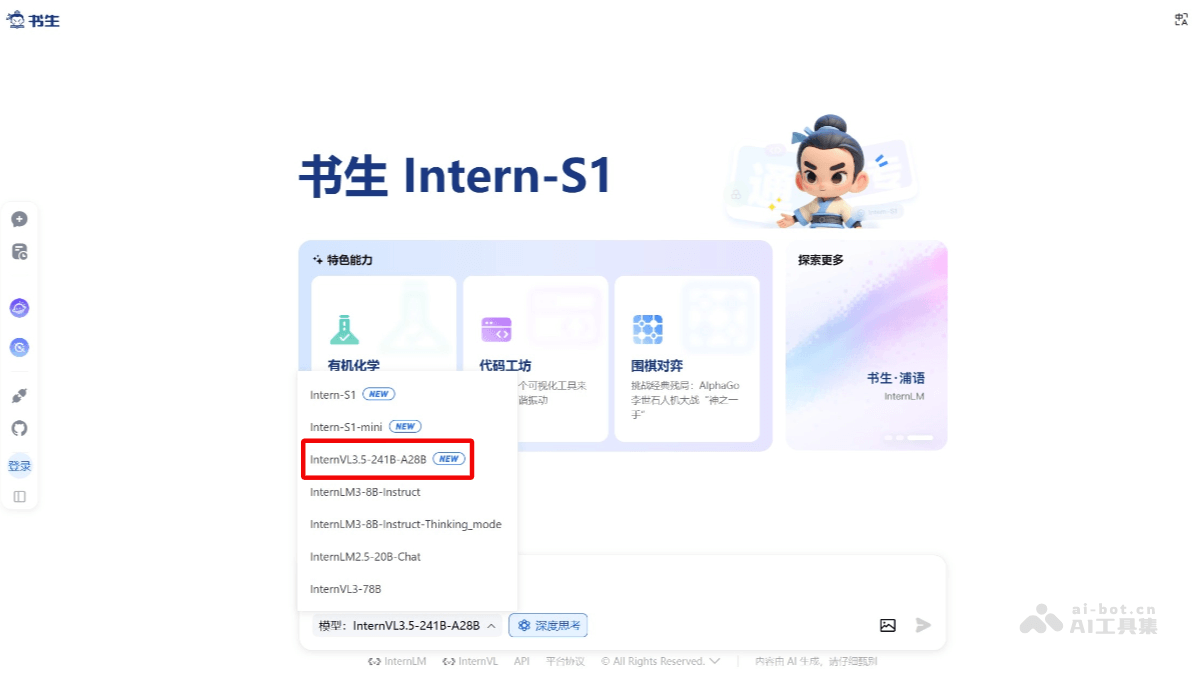
- Online Experience Address:Shusheng Large Model
InternVL3.5 Application Scenarios
-
Office Automation: Through GUI agent functionality, it enables cross-platform automated office operations, such as automatically handling Excel data entry, PPT design and layout, email sending, and other tasks, improving work efficiency.
-
Smart Home Control: Utilizing embodied spatial reasoning capabilities, it assists robots in completing object localization, path planning, and physical interaction tasks in home environments, for example, a smart cleaning robot autonomously planning cleaning paths based on the environmental layout.
-
Educational Tutoring: With the support of multimodal reasoning and text capabilities, it provides students with personalized learning tutoring and answers complex subject questions, such as solving mathematics and physics problems, logical reasoning training, and more, improving learning outcomes.
-
Content Creation: With the help of general multimodal perception capabilities, it automatically generates image descriptions, video subtitles, and more, helping creators quickly generate creative content and improving the efficiency and quality of content creation.
-
Web Design and Graphic Generation: Utilizing vector graphics processing capabilities, it generates or edits SVG vector graphics according to user instructions, suitable for web design, icon production, and more, improving design efficiency and personalized experience.