
What is InternLM-XComposer IXC-2.5
InternLM-XComposer IXC-2.5 is a new generation multimodal large model launched by Shanghai AI Laboratory, featuring a 7B-scale large language model backend. It can handle long contexts up to 96K, supports ultra-high-resolution images and fine-grained video understanding, and can conduct multi-turn multi-image dialogues. IXC-2.5 can also automatically write webpage code according to instructions and create high-quality graphic and text articles. It performs excellently on multimodal benchmarks, with performance comparable to OpenAI GPT-4V.
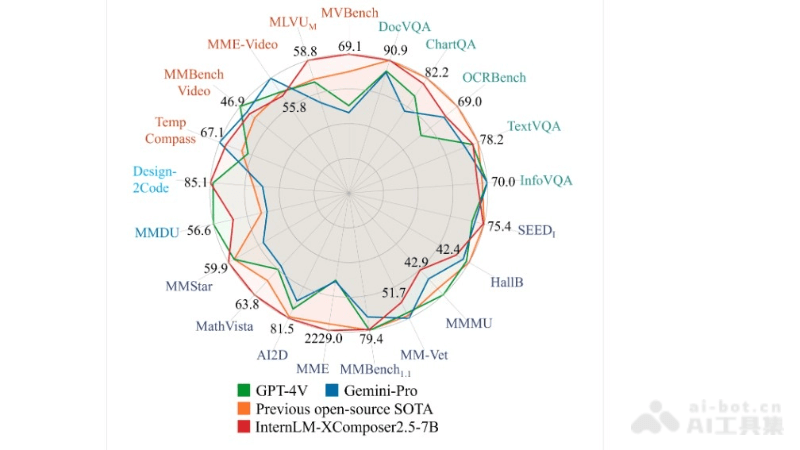
Main features of InternLM-XComposer IXC-2.5
- Ultra-high-resolution image understanding: IXC-2.5 has a built-in 560×560 ViT visual encoder, can process high-resolution images of any aspect ratio, and is more sensitive to detail capture.
- Fine-grained video understanding: Treats video as an ultra-high-resolution composite image composed of dozens to hundreds of frames, capturing the details of each frame through dense sampling and high resolution.
- Multi-turn multi-image dialogue: Supports free-form multi-turn multi-image dialogue, enabling machines to communicate with humans in multiple turns more naturally.
- Webpage creation: According to text and image instructions, automatically combines HTML, CSS, and JavaScript source code to create webpages.
- High-quality graphic and text article writing: Based on Chain-of-Thought and Direct Preference Optimization techniques, IXC-2.5 can significantly improve article quality when writing graphic and text content.
Technical principles of InternLM-XComposer IXC-2.5
- Multimodal learning: IXC-2.5 combines visual and language models, can simultaneously process and understand image and text data, and realizes the ability of mixed graphic and text creation.
- Large language model backend: Uses a 7B-scale large language model as the backend, providing powerful text generation and understanding capabilities.
- Ultra-high-resolution image processing: Through a 560×560 ViT (Vision Transformer) visual encoder, IXC-2.5 can process high-resolution images and capture subtle features in images.
- Fine-grained video understanding: IXC-2.5 treats video content as an ultra-high-resolution image composed of multiple frames, and through dense sampling and high-resolution analysis, achieves in-depth understanding of video content.
- Multi-turn multi-image dialogue capability: Supports processing and responding to multiple images in multi-turn dialogues, simulating human communication methods and providing a more natural interaction experience.
Project address of InternLM-XComposer IXC-2.5
- Github repository:https://github.com/InternLM/InternLM-XComposer
- HuggingFace Demo experience:https://huggingface.co/spaces/Willow123/InternLM-XComposer
How to use InternLM-XComposer IXC-2.5
- Environment preparation: Ensure that the computing environment meets the requirements for running the IXC-2.5 model, with sufficient memory and computing power, and install the necessary dependency libraries.
- Obtain the model: Visit the GitHub project page of InternLM-XComposer IXC-2.5, and according to the guidance, download or clone the model's code repository locally.
- Install dependencies: According to the project's README or documentation instructions, install the required dependencies, which may include Python libraries, deep learning frameworks, etc.
- Model loading: Load the pre-trained IXC-2.5 model into the application. This involves using the API of a deep learning framework to load model parameters.
- Data preparation: Prepare input data, including text, images, or videos, etc. Ensure that the data format meets the model's input requirements.
- Function invocation: Call different functions of the model according to requirements, such as image understanding, video analysis, multi-turn dialogue, or image-text creation, etc.
Application scenarios of InternLM-XComposer2.5
- Content creation: Automatically generate articles, stories, reports, etc., with both images and text, suitable for news media, blogs, educational material production, etc.
- Educational assistance: Provide learning materials that combine visuals and text in teaching, enhance the learning experience, and help students better understand and remember complex concepts.
- Marketing and advertising: Design attractive advertising content, combining images and copy, to improve the appeal and conversion rate of advertisements.
- Entertainment and gaming: In video games or interactive entertainment, generate storylines and visual content based on players' actions or choices.