
What is Intern-S1-mini
Intern-S1-mini is a lightweight open-source multimodal reasoning model launched by Shanghai Artificial Intelligence Laboratory. Built on the same technology as Intern-S1 . The model combines an 8B dense language model (Qwen3) and a 0.3B visual encoder (InternViT), and is further pre-trained on multimodal data containing 2.5 trillion scientific domain tokens. Intern-S1-mini possesses strong general capabilities and excels in specialized scientific fields such as interpreting chemical structures, understanding protein sequences, and planning compound synthesis routes, making it a powerful assistant in practical scientific research applications.
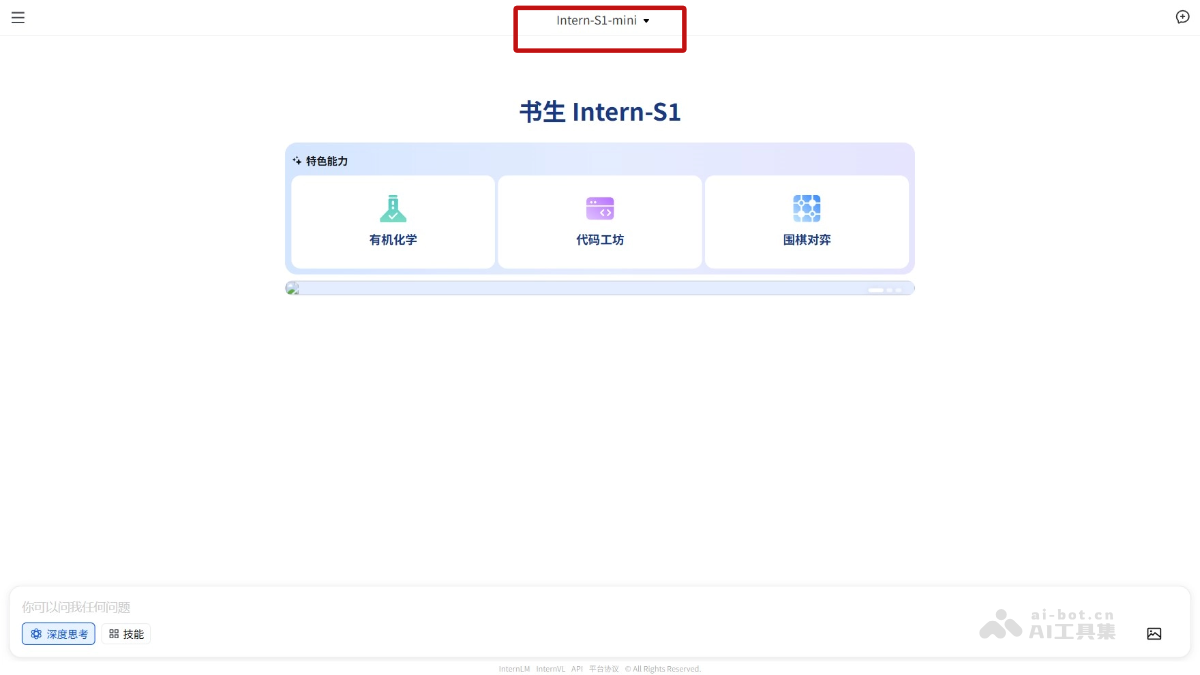
Main Features of Intern-S1-mini
- Multimodal Data Processing: Capable of processing data in multiple modalities such as text and images, enabling cross-modal understanding and generation.
- Scientific Domain Reasoning: Excels in scientific fields such as chemistry, materials science, and biology, for example interpreting chemical structures, understanding protein sequences, and planning compound synthesis routes.
- General Language Understanding and Generation: Possesses strong language understanding capabilities and can perform tasks such as natural language dialogue, text generation, and text summarization.
- Rapid Deployment and Secondary Development: Its lightweight design is suitable for rapid deployment on resource-constrained devices and supports secondary development to meet specific needs.
Technical Principles of Intern-S1-mini
- Base Architecture: Based on an 8B-parameter dense language model (Qwen3), providing strong language understanding and generation capabilities. Combined with a 0.3B-parameter visual encoder (InternViT), used for processing and understanding image data.
- Multimodal Fusion: Through specific training methods, text and image data are aligned, enabling the model to understand and generate cross-modal content. Joint training on multimodal data allows the model to process text and image inputs simultaneously.
- Pre-training Data: Further pre-trained on 5 trillion tokens of multimodal data containing over 2.5 trillion scientific domain tokens. The data covers a wide range of scientific fields, giving the model a rich background in scientific knowledge.
- Scientific Domain Optimization: Through optimization on scientific domain data, the model excels in tasks such as interpreting chemical structures, understanding protein sequences, and planning compound synthesis routes. Fine-tuned for specific scientific tasks to further improve the model's performance in these fields.
- Lightweight Design: Through model compression techniques, the number of parameters and computational resource requirements are reduced, making it more suitable for running on resource-constrained devices.
Intern-S1-mini Project Address
- Project Official Website:https://chat.intern-ai.org.cn/
- HuggingFace Model Repository:https://huggingface.co/internlm/Intern-S1-mini
Application Scenarios of Intern-S1-mini
- Scientific Research: In research fields such as chemistry, biology, and materials science, assists with compound synthesis planning, protein sequence analysis, and material performance prediction, facilitating scientific breakthroughs.
- Education: Provides interactive learning experiences for science teaching, generates teaching content, answers students' questions, and improves the teaching effectiveness of science courses.
- Industrial Applications: In the pharmaceutical and chemical industries, used for drug development, process optimization, and quality control, improving production efficiency and product quality.
- Data Analysis and Decision Support: Provide data analysis, market trend forecasting, and new technology assessment for scientific research project management and corporate decision-making, facilitating informed decisions.
- Public Services: Disseminate scientific knowledge through natural language dialogue, analyze environmental data, support ecological research, and enhance public scientific literacy and environmental protection awareness.