
What is Insight-V
Insight-V is a multimodal model jointly launched by researchers from Nanyang Technological University, Tencent, and Tsinghua University, capable of enhancing the long-chain visual reasoning abilities of multimodal large language models. Based on a scalable data generation pipeline, it produces high-quality reasoning data, adopts a multi-agent system to decompose visual reasoning tasks into two steps: reasoning and summarization, and combines a two-stage training process to significantly improve the model's performance on visual reasoning benchmarks. The design of Insight-V includes progressive data generation, multi-granularity evaluation, and an iterative DPO algorithm, enabling the system to demonstrate outstanding performance in complex visual reasoning tasks.
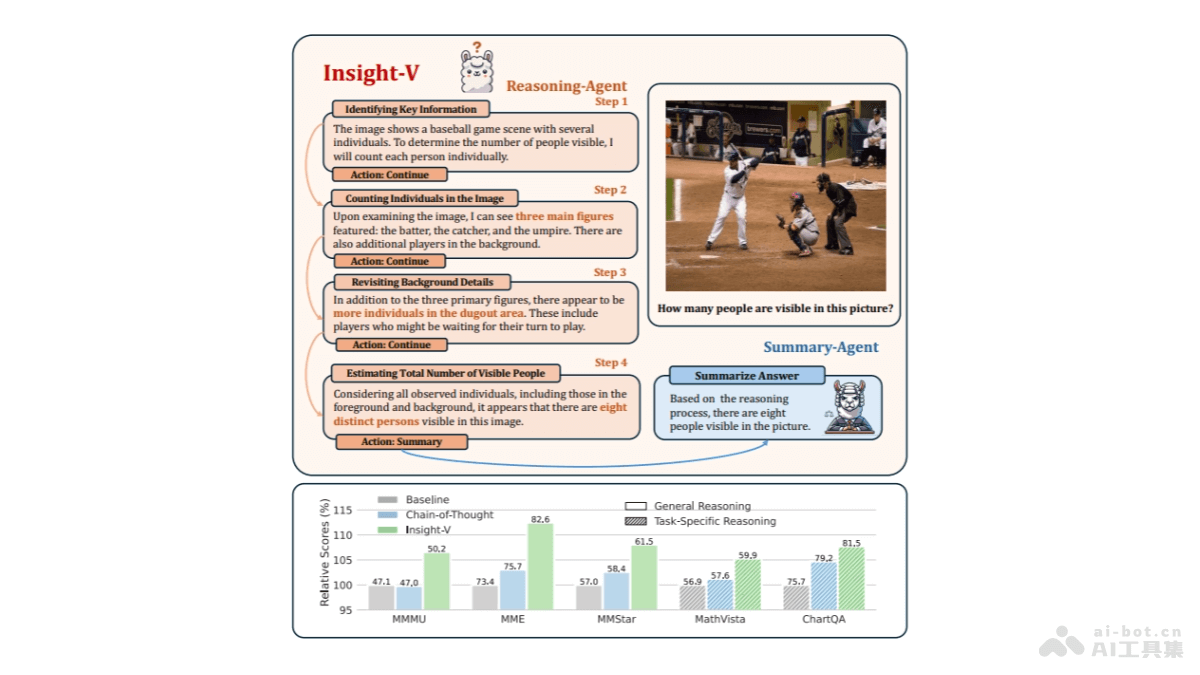
Main Features of Insight-V
- Long-Chain Visual Reasoning: Insight-V can handle complex visual reasoning tasks by generating detailed, step-by-step reasoning processes to solve problems.
- Data Generation Pipeline: The system has a scalable data generation pipeline used to produce long-chain, high-quality reasoning data, supporting complex multimodal tasks.
- Multi-Agent System: Insight-V adopts a multi-agent architecture, decomposing visual reasoning tasks into two independent steps, reasoning and summarization, handled by specialized agents.
- Two-Stage Training Process: The system implements a two-stage training strategy, including supervised fine-tuning and Direct Preference Optimization (DPO), to enhance the model's reasoning ability.
- Performance Improvement: In multiple visual reasoning benchmarks, Insight-V shows significant performance improvements, surpassing other advanced models.
Technical Principles of Insight-V
- Progressive Long-Chain Reasoning Data Generation: Based on powerful multimodal models, it collects single-step reasoning results and generates the next reasoning action based on historical reasoning results.
- Multi-Granularity Evaluation: It uses ground-truth answers to filter reasoning data, excluding data with incorrect final answers. A reasoning step scoring model scores the quality of the reasoning data and divides the data into subsets of different quality levels.
- Model Design: Specifically generating detailed, step-by-step reasoning processes. Adapting to inaccuracies in the reasoning path, selectively incorporating or ignoring certain elements.
- Training Strategy: Supervised fine-tuning of the two agents to cultivate step-by-step reasoning and summarization abilities. Based on multi-round DPO training and sampling, simulating an online environment to improve model performance.
Project Address of Insight-V
- GitHub Repository:https://github.com/dongyh20/Insight-V
- HuggingFace Model Library:https://huggingface.co/THUdyh/Insight-V
- arXiv Technical Paper:https://arxiv.org/pdf/2411.14432
Application Scenarios of Insight-V
- Autonomous Driving: In autonomous vehicles, I helps vehicles understand road signs, traffic signals, and the surrounding environment, making accurate driving decisions.
- Robot Vision: In robotics, it improves the robot's ability to understand the environment, enabling better navigation and object recognition.
- Intelligent Surveillance: In the field of security surveillance, it analyzes video streams, identifies abnormal behaviors or events, and issues timely alerts.
- Medical Imaging Analysis: It helps doctors analyze medical images, such as X-rays, CT scans, and MRIs, to identify diseases and lesions.
- Education and Training: In the field of education, as an auxiliary tool, it provides demonstrations and explanations for visual problem-solving, enhancing the learning experience.