
What is InftyThink
InftyThink is an innovative large model reasoning paradigm that breaks through the limitations of traditional models in long reasoning tasks. Through segmented iteration, it decomposes complex reasoning processes into multiple short segments, generating an intermediate summary after each segment to achieve chunked thinking. This "sawtooth" memory pattern, which periodically discards old details and retains new summaries, effectively reduces computational complexity, enabling the model to handle reasoning chains of theoretically infinite length.
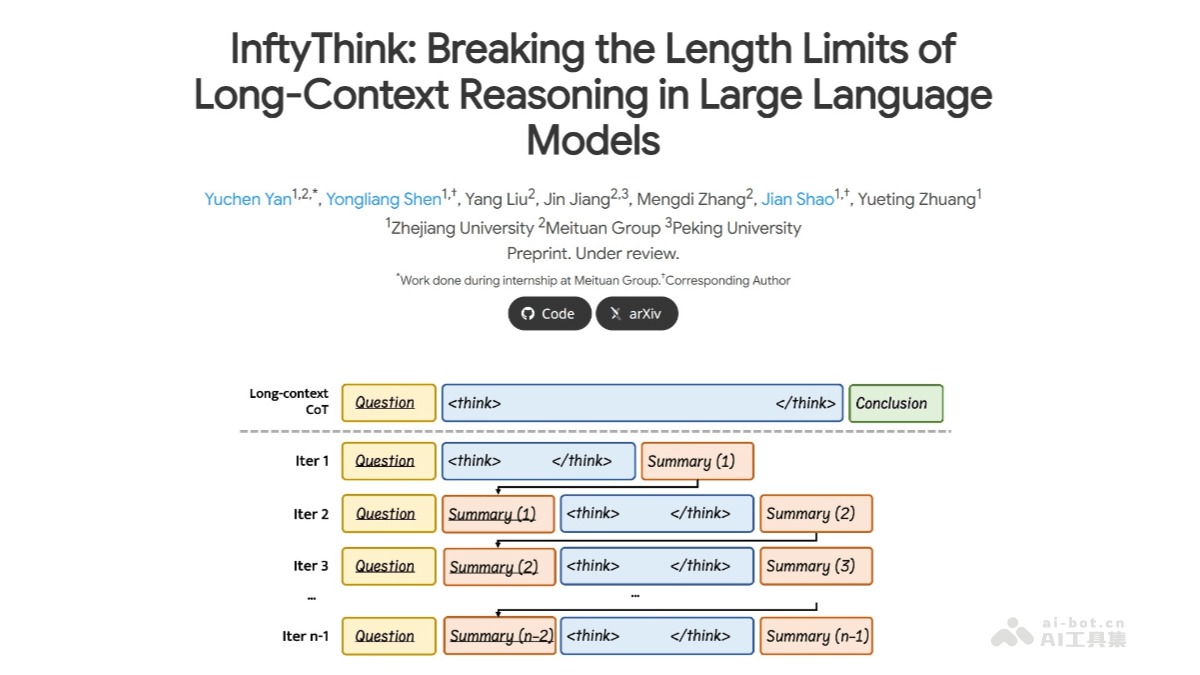
Technical Principles of InftyThink
-
Iterative Reasoning and Phased Summarization: InftyThink splits the traditional single continuous reasoning process into multiple short reasoning segments, generating a concise summary after each segment as context information input for the next stage of reasoning. This simulates the human cognitive process of gradual induction and summarization, enabling the model to perform reasoning of infinite depth while maintaining contextual coherence, solving the limitations of traditional long reasoning in terms of context length and computational complexity.
-
Fixed Computational Overhead and Context Window: InftyThink implements a "sawtooth" memory usage pattern, clearing the previous round's context after each round of short reasoning and retaining only the summary, significantly reducing the computational complexity during reasoning. Compared with traditional reasoning paradigms, InftyThink achieves a better balance between reasoning depth and computational efficiency.
-
Decoupled from the Original Architecture and Highly Compatible with Training Paradigms: InftyThink does not rely on adjustments to the model structure, but implements its paradigm by reconstructing training data into a multi-round reasoning format. It can be seamlessly combined with existing pretrained models, fine-tuning, and reinforcement learning processes, and has good engineering deployability.
-
Development of Data Reconstruction Technology: InftyThink has developed a method to convert existing long-text reasoning datasets into an iterative format. For example, it converted the OpenR1-Math dataset into 333,000 training instances, facilitating model training under this paradigm.
Core Advantages of InftyThink
-
Breaking Through Context Window Limitations: Through iterative reasoning and intermediate summarization, InftyThink can handle reasoning chains of theoretically infinite length, breaking through the context window limitations of traditional large models.
-
Reducing Computational Cost: Compared with traditional long reasoning methods, InftyThink reduces direct processing of long sequences during reasoning, significantly lowering computational cost.
-
Improving Reasoning Performance: In some complex reasoning tasks, InftyThink can better handle long-sequence information, improving reasoning accuracy and generation throughput.
Project Address of InftyThink
- Project Official Website:https://zju-real.github.io/InftyThink/
- Github Repository:https://github.com/ZJU-REAL/InftyThink
- arXiv Technical Paper:https://arxiv.org/pdf/2503.06692
Application Scenarios of InftyThink
-
Mathematical Problem Solving: InftyThink can handle complex mathematical problems, gradually solving long-chain mathematical problems through segmented iterative reasoning and intermediate summarization.
-
Logical Reasoning: In tasks requiring long-sequence logical reasoning, InftyThink can effectively improve reasoning accuracy and efficiency.
-
Code Generation: In code generation tasks, InftyThink can gradually generate complex code logic, maintaining code coherence and correctness.
-
Intelligent Tutoring: In intelligent tutoring systems, InftyThink can provide detailed solutions and explanations step by step based on students' questions, helping students better understand and master knowledge points.
-
Drug discovery: In the drug discovery process, InftyThink can be used to predict drug target 3D structures and binding affinity, accelerating the research and development process.