
What is Infinite Mobility
Infinite Mobility is an interactive object generation model launched by Shanghai AI Lab. Based on procedural generation technology, it efficiently generates high-quality interactive object data assets. Infinite Mobility supports the generation of 22 common categories of interactive objects, with a single object taking only about 1 second to generate, and no upper limit on the number generated. Compared with traditional datasets such as PartNet-Mobility, the objects generated by Infinite Mobility have higher structural complexity, better visual quality, and lower cost. The objects generated by Infinite Mobility have been applied to simulation training platforms such as Taoyuan 2.0 and Isaac Sim, helping robots conduct large-scale training in virtual environments and improve their manipulation capabilities in the real world.
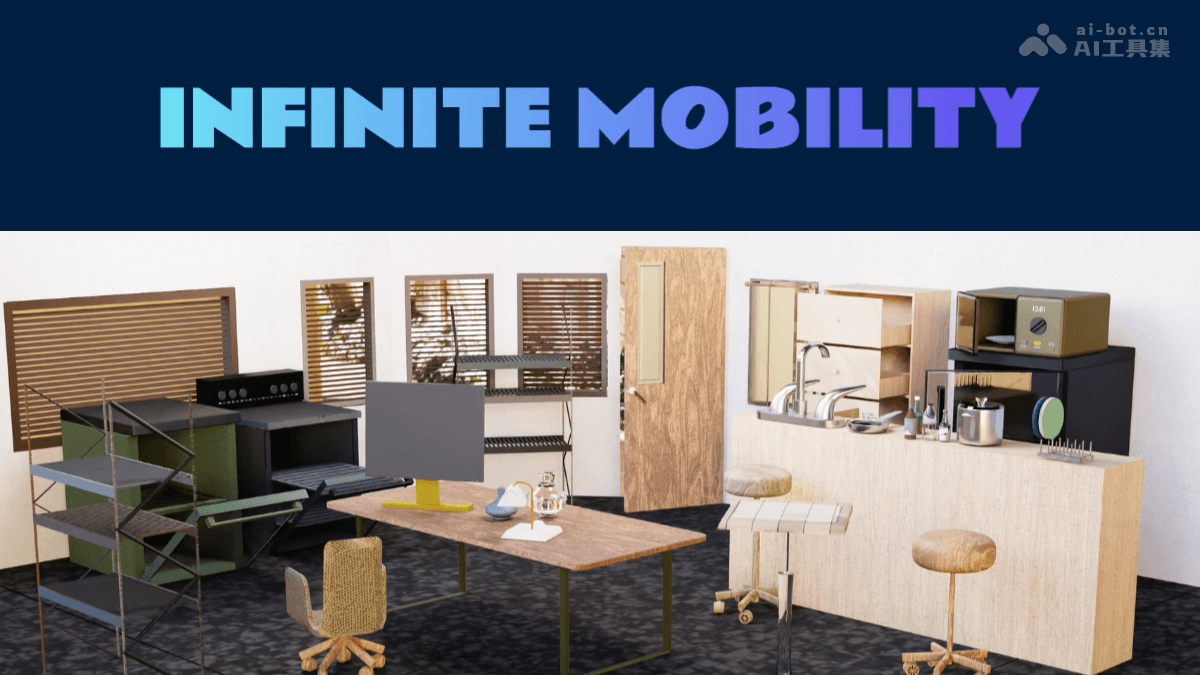
Main Features of Infinite Mobility
- Efficient generation of interactive objects: Supports the rapid generation of high-quality interactive objects, with a single object taking only about 1 second to generate, and no upper limit on the number generated.
- Support for diverse object categories: The model supports the generation of 22 common categories of interactive objects, covering furniture, home appliances, tools, and many other types, meeting the needs of different application scenarios.
- Provides high-quality geometry and materials: Supports realistic textures, metal oxidation marks, wood grain, and other effects, enhancing the realism of the simulation environment.
- Ensures physical plausibility: Based on procedural detection and adjustment, it avoids object self-collisions and unreasonable joint movements, ensuring that the generated objects can be directly used for simulation training.
- Low-cost data generation: The cost of a single generation by Infinite Mobility can be reduced to about 0.01 yuan, greatly lowering the cost of data acquisition.
Technical Principles of Infinite Mobility
- Procedural generation technology: Infinite Mobility uses procedural generation technology to dynamically generate the structure, geometry, and materials of objects based on preset rules and logic. This avoids the dependence of traditional data-driven methods on large-scale annotated data and reduces costs.
- Tree-structured growth strategy: The joint structure of an object is abstracted into a tree-like model similar to URDF. Starting from the root node, the complete object structure is dynamically "grown" based on semantic rules. By controlling the generation and combination of subtrees based on probability distributions, the model can generate diverse object forms.
- Geometry and material generation: The model combines procedural generation and a curated asset library to ensure that the dimensions, positions, and support points of components are precisely aligned. Based on procedural adjustment of physically based rendering (PBR) parameters, it generates realistic material effects.
Project Address of Infinite Mobility
- Project official website:https://infinite-mobility.github.io/
- GitHub repository:https://github.com/OpenRobotLab/Infinite-Mobility
- arXiv technical paper:https://arxiv.org/pdf/2503.13424
Application Scenarios of Infinite Mobility
- Robot simulation training: Provides interactive objects for robots in virtual environments to improve manipulation capabilities.
- Medical robot development: Generates medical device models to assist in medical robot training.
- Home service robot optimization: Provides models of household appliances and furniture to enhance the adaptability of home service robots.
- Virtual reality and augmented reality: Enriches interactive objects in virtual scenes to improve user experience.
- Artificial intelligence research: Provides diverse data to support research on object recognition and interactive learning.