
The carriage was never a match for the car.

Recently,Head AI received a lot of attention. It calls itself the "World's First AI Marketer." After Head AI received investment from Jinqiu and Jinshajiang, Zhu Xiaohu mentioned and recommended Head AI on multiple occasions, with his fondness for this team and product evident in his words.
Today, "Crossroads" conducted an in-depth interview with Kay Feng, the post-2000s founder of Head AI. From "How do you calculate your ARR?" to "What is your moat?", she responded to all the questions we raised.
👦🏻 Koji
If you had to recommend Head AI to everyone in one sentence, how would you introduce it?
👧🏻 Kay
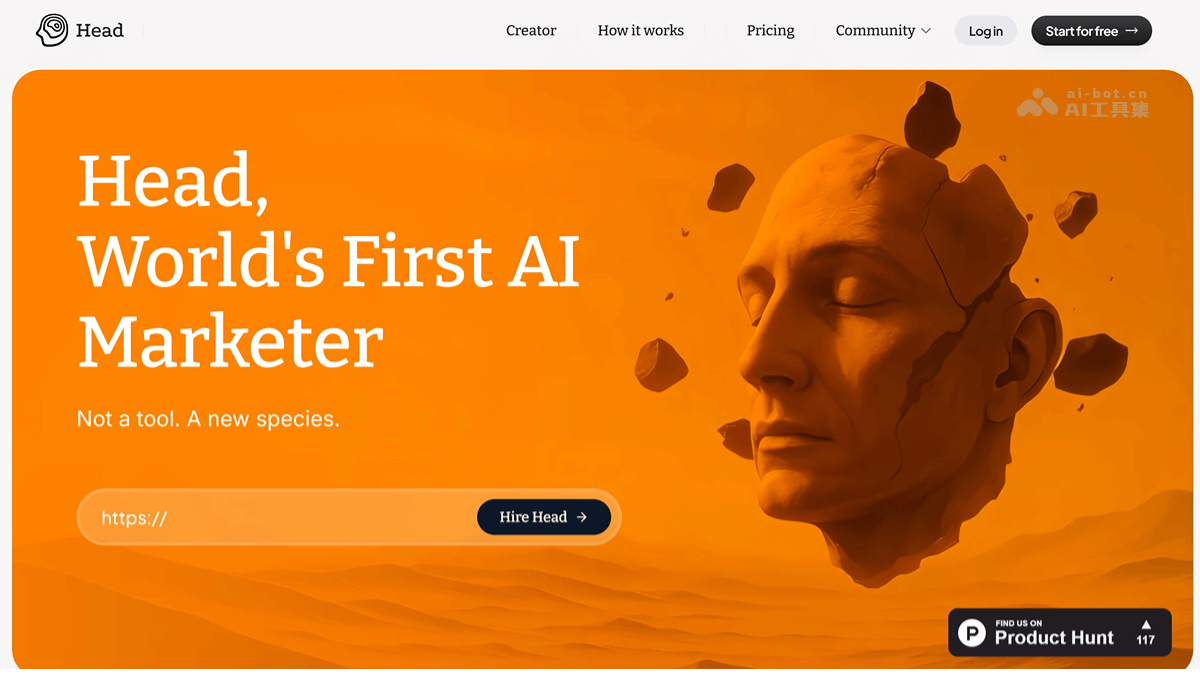
Just tell Head your budget and your website, and it can automatically handle influencer marketing, affiliate marketing, and Cold Email —like an AI growth lead who never sleeps, taking out an entire marketing department single-handedly.
👦🏻 Koji
Who are Head AI's target users? What problems does Head AI help them solve?
👧🏻 Kay
Head's target users fall into three categories:
The first category is startup teams, or early-stage brand founders.
They are very clear that they need to scale up, but they do not have the people on hand, nor much room for trial and error.
What we offer this group is an AI that can "deliver results for you." You just fill in the website and budget, and you do not need to worry about the rest — how to find resources, how to write content, how to negotiate with influencers, how to run placements; Head handles it all automatically. What used to require hiring several people on a team can now be handled with one person occasionally checking in.
The second category is big brands and companies that already have teams.
Their problem is not a lack of resources, but too many people and too heavy a process, so execution cannot get off the ground.
For a cold start on a new product, just going through the approval process takes a week. By the time people have coordinated everything, the traffic has already been taken by others.
We have them use Head to plug "content production," "influencer negotiation," and "cold-start distribution" directly into an automated pipeline. One campaign runs multiple versions in parallel, and in the end it automatically converges on the most effective strategy to scale up placements1.
The feedback from this type of customer after using it is very direct: "Head is not about improving efficiency; it directly does away with a department or an agency for me."
The third category is agencies, including service-oriented companies that previously relied on human delivery.
In the past, they relied on teams to manually negotiate with influencers for clients, launch campaigns, collect data, and produce reports — heavy, messy, and unprofitable.
Now they hand this entire stretch to Head to run, and focus only on doing well in "customer service" and "the part where human value is relatively heavier"
It is equivalent to outsourcing delivery to AI, while keeping the last mile where human value density is highest.
In the past, they delivered through manpower; today, they deliver through Head.
They have transformed from outsourcing into AI-driven intelligent service providers, with efficiency and profit both multiplying.
These three types of users look different, but in essence they are the same:
They are all transitioning from "relying on people" to "relying on systems," wanting growth to become lighter, faster, and more certain.
And what we do is make this AI growth system work, so that any brand, any service provider, any team can start from zero with an AI growth engine that automatically executes, automatically optimizes, and automatically scales.
👦🏻 Koji
Head AI received investment from Jinqiu, and it is also a company that Zhu Xiaohu invested in and often mentions with great attention. How did you pitch them to invest in you back then?
👧🏻 Kay
It's not so much about how we pitched; rather, they truly understood what we're doing.
This project isn't something you can invest in based on 'consensus'—understanding it has a threshold. In the marketing industry, there are indeed many pitfalls—if you don't see deeply and thoroughly, it's easy to step on landmines. Many institutions, after stepping on them, don't dare touch it again. But as Zhu Xiaohu said: Chinese investors never make money based on consensus.
We especially like our investors; we're very much on the same wavelength, and they've been extremely helpful to us.
Yang Jie, Tian Yu, and Zhi Yuan from Jinqiu—their entire team has a very deep understanding of influencers and monetization. In our first conversation, within less than 30 minutes, Yang Jie made the call and gave us a TS. It's also the accumulation from their previous company that allowed them to spot the opportunity behind it at a glance.
Teacher Zhu Xiaohu is even more formidable—he understands social media and marketing too well. Often, he's the first to forward trending industry posts to me. He surfs at high intensity and is always active on the front lines. Daisy is the same—accurate judgment, quick action, truly standing with entrepreneurs.
👦🏻 Koji
During the fundraising process, what was the most impressive or surprising question you encountered?
👧🏻 Kay
The two most surprising questions during fundraising were:
'You didn't go to college—will that affect your work?'
'You're so young—will the team not be convinced by you?'
To be honest, these two questions have never caused trouble in reality.
If 'being young' and 'not going to college' were truly thresholds, then the thresholds of this world would be too low.
These two things are exactly the choices I'm most proud of—I've always walked by my own judgment.
What's truly difficult is not writing a standard resume,
but producing results in an extremely short time, while also ensuring this direction still holds in 5 or 10 years.
A while ago, someone asked me:
In 'How to Spot a 20-Year-Old Worth Investing In,' is the post-00s person who worked as if they were a co-founder and started their own business a few years later you?
It's me. I know many people didn't understand me at the time. But I never expected to be understood from the start.
For a true entrepreneur, superficial 'disadvantages' are never a problem,
sometimes, they are actually your gift in this track.
We're used to carving a path through adversity, doing things others think are impossible.
I want to leave these words for young people still on the journey:
Many people have long grown old. They don't understand you—that's not your problem. You don't need to be understood from the start; you just need to keep running, and eventually someone will catch up and understand you.
Whether it's Wang Ning, us, or all those who were once underestimated,
as long as you truly do the right things, in the end, you will win.
The evaluation system of the masses in this world is—
not being popular is original sin; being popular makes everything right.
Finally, I want to give a passage from Teacher Yu Hua to those still on the journey:
At eighteen, you go out on a long journey, and ultimately you must contend with this world, even if you end up bruised and battered. In the dead of night, let your heart escape from your chest, mend it yourself, then sleep, and the next day you'll be full of confidence again. It's okay if no one asks; don't be afraid if you're inferior to others. Try to quiet down; the heart can sleep, but the hands cannot stop. Keep doing what needs to be done. True growth is not the absence of breakdown, but continuing forward amid breakdown.

Before getting busy, I often went rock climbing and ran Spartan races.
Not to beat anyone, but just to force myself to confirm again and again that I'm not someone who easily accepts fate.
My hands and feet are often injured, but every time it hurts more, I actually become more clear-headed.
What I'm addicted to isn't victory, but that feeling of being about to give up, yet still climbing upward.
👦🏻 Koji
In Sequoia America's latest trend discussion, they mentioned outcome-based pricing for toB products in the AI era, and Head AI has also adopted this approach. What considerations led you to this?
👧🏻 Kay
Head has adhered to 'Pay for Outcome' since day one. This is a strategic path we actively chose, and it also stems from my core demands as a former marketing lead.
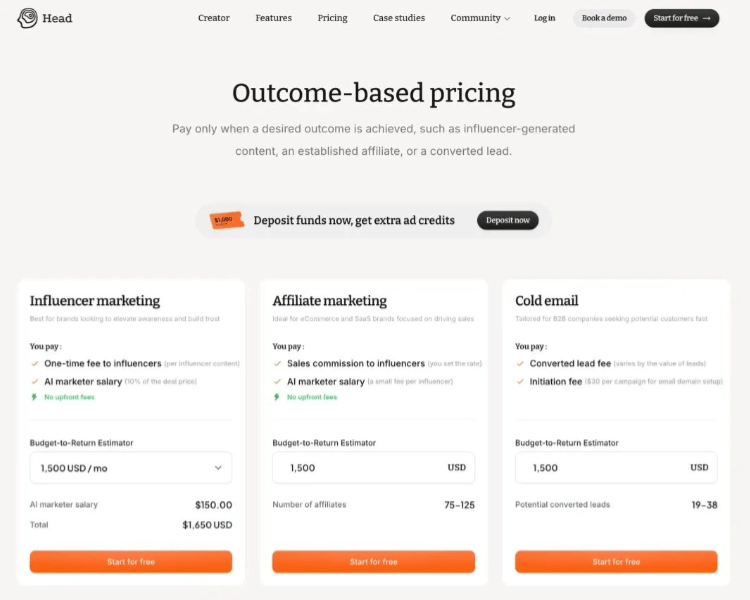
Head AI Pricing Model
Because I know the pain points of traditional SaaS tools all too well: you pay, but you have to assemble your own team, pull data, find resources, run campaigns, and the final results aren't even guaranteed to be good.
And what marketing leads care about most is actually just one thing—"Can you help me get results?"
So when we built Head, we set a standard:
Customers aren't here to rent a piece of software; they're here to hire an AI that can drive growth.
What we do is automated execution, not assisted operation. If we can truly run the whole chain, we should be responsible for the results.
If we can't, then we shouldn't charge this money.
Behind this is confidence—
We know what we've built is an AI marketing system that can complete the task.
It can truly automatically find creators, generate content, negotiate prices, and run campaigns to completion. We have this capability, so we dare to use results as the pricing anchor.
And from a business perspective, this model also binds us more tightly with customers:
The better the customer converts, the more we earn; if the customer can't produce results, we don't get paid.
This is the relationship we truly want to build—not 'service provider and buyer,' but 'growth partners who share responsibility for results.'
👦🏻 Koji
Regarding the outcome-based payment model, are customers more supportive or opposed?
👧🏻 Kay
The vast majority of customers are supportive, and it can even be said that this is one of the reasons they chose Head.
The core problem with the traditional SaaS model is:You pay, but you still have to produce the results yourself.
At Head, 'pay for outcome' actually makes customers feel reassured, because it means:
- You will be responsible for the results, with 100% refund if ineffective
- I don't need to extend trust in advance; I can see the results before paying
- You only dare to use this model if you're confident you can produce results
Especially brands with traditional advertising experience understand this better. They've experienced the pain of buying platforms, hiring teams, and finding KOLs without producing results, so they're actually more willing to try an approach like Head:I put up the budget, you run the results, and once results come out, we continue adding money.
👦🏻 Koji
In Head's pricing model, you emphasize that 'pay for outcome + public pricing' is a revolutionary breakthrough. I see that you clearly price specific actions, such as 'successfully triggering an automated task' and 'producing a qualified lead.' This is indeed very attractive to product-driven entrepreneurs.
But I'm also curious—Sierra chooses not to disclose pricing in order to accommodate enterprise customers, complex goal definitions, and high-value transaction processes. By contrast, is Head able to standardize because the product itself is more intelligent, or because it actively avoids those complex but high-value use cases?
👧🏻 Kay
Sierra does not disclose pricing because they only serve large clients, following a high-ticket, low-frequency, high-touch service model. Head's customer structure is completely different—we serve everyone from SMBs to publicly listed companies, from over 200 countries and regions around the world, and we are growing very fast.
At this scale and pace, if we didn't standardize, we simply couldn't keep up.
So we have to break down complex problems at the product level and truly go deep on "abstraction." This isn't because we avoid complex use cases, but because we proactively turn complex things into product capabilities.
Today, whether you're a small team of a few people, a fast-growing company like Lovart, or a publicly listed brand like Chagee, you can get satisfactory results on Head. Small clients can self-serve to get started, and KA clients have a VIP channel. We have tiering in our processes and services, but the pricing system is unified—all public, transparent, and pay-per-result.
We really dislike that kind of marketing that makes money through personal favors, relationships, and gray areas. It doesn't align with our values. I hope marketing becomes a bit more shallow-ended and a bit cleaner. As a platform company, this is our basic responsibility and commitment.
So we chose this pricing approach. This isn't just a strategy—it's our fundamental judgment and values about this industry.
Of course, this also means more people will criticize us. But we dare to make pricing public, and we dare to take the criticism, dare to be questioned, and even more, dare to keep optimizing.
👦🏻 Koji
Do you think Head's public pricing model can extend to Enterprise use cases like Sierra's? Or do you think future agents shouldn't take a customized approach at all?
👧🏻 Kay
We believe Enterprise does not equal "customization." Rather, it means "complex needs must be met through system capabilities." We have already achieved preliminary validation today—many publicly listed clients have chosen us long-term, and we place great importance on KA clients.
It's not that Head can't do the kind of Enterprise use cases Sierra does; rather, we choose to do them with a different approach: not just piling on human services, but relying on stronger product abstraction and the autonomous capabilities of AI agents.
Future agents should not be "customized tools" that require retraining and reconfiguration for every client. They should be "strategic entities" that can understand goals, automatically break down tasks, and execute flexibly within a general framework.
So even for the most complex Enterprise clients, Head can be started through a standardized entry point and pricing, and then their dedicated paths can be extended through APIs, VIP channels, and strategy rules—but the underlying logic is unified. This is the prerequisite for us to scale fast and serve users in 200+ countries globally.
We believe future intelligent agents will ultimately be like cloud computing—low barrier to entry, strong usability, with complexity absorbed inside the platform rather than passed on to clients.
👦🏻 Koji
I saw that Head AI reached $2.5 million in ARR within 14 days. Congratulations! But recently there has been a lot of controversy over how ARR is calculated. Can you elaborate on how Head AI calculates it?
👧🏻 Kay
Thank you! Indeed, many friends care about how this number is calculated.
Our ARR calculation is actually very conservative—our weekly revenue over the past few weeks has been stable at over $50,000, so we multiplied that by 52 weeks and estimated a conservative ARR of $2.5 million. We did not deliberately inflate it; it is revenue from real user spending.
We chose to disclose ARR because it represents the true value of the product better than metrics like daily active users or registered users—whether people are willing to pay and keep using it is a more fundamental judgment.
Of course, Head is still very early and still iterating rapidly. We believe that as long as the product can consistently help customers achieve results, growth will come naturally.
👦🏻 Koji
Who do you think Head AI's competitors are?
👧🏻 Kay
Head AI has no "competitors"; we are eliminating an old way of doing things.
We are not competing with a particular tool—at least today we haven't seen a company with the same vision as ours.
We are here to make the entire marketing organization evolve.
You could say we are in the same industry as well-known marketing tools like Jasper and Icon, and neighbors to influencer SaaS and Cold Email SaaS.
But essentially, we are not on the same path.
They are still helping humans "improve efficiency," while we are already letting AI directly "take over responsibilities."
Our opponent is the entire growth system that still relies on thousands of people pulling resources one by one, writing scripts, and watching ad campaigns.
It's not tool versus tool, but species versus species.
Just as the horse-drawn carriage was never the car's opponent.The car's opponent is: you still thinking you need a horse-drawn carriage.
So we are not fighting the SaaS war,
we are challenging a cognition, a way of organizing, a backward default mindset.
👦🏻 Koji
Last week I met an entrepreneur who mentioned that after using Head AI's product, not many of the KOL options for taking orders satisfied him. Currently, what proportion of the order-taking KOLs you recommend to clients are adopted by clients?
👧🏻 Kay
Actually, I'd really like to know which client mentioned it; we will look into it and optimize.
Head is a company less than a year old, and the product has only been online for 15 days, yet it already has tens of thousands of users, growing very fast and very viral.
As a general-purpose AI marketing product, it has to cross industries, cognitions, and languages, so making everyone satisfied from day one is unrealistic.
First, the conclusion: we indeed still have many imperfections.
Growing too fast has brought imbalance. Today not all customers are satisfied,
but as the founder, this is also the issue I care about most.
I still spend time reading every piece of user feedback; I know all the problems and take them very seriously.
As a ToB company, our foundation is not high-end technology, but whether customers actually achieve results.
To collect feedback and let more people criticize us, my email is sent to all customers, and everyone can directly schedule a meeting with me. We are truly using every possible way to listen: what users think, how they complain, and how they want changes.
When customers criticize us, I understand it very well, because growth and marketing are too important for a company. If it weren't important, people wouldn't criticize you at all. So we should do this important thing as well as possible.
We have messed up many things, especially with the earliest 100 customers; perhaps 80 of them were dissatisfied.
But it was precisely those "dissatisfactions" that helped us step through the pitfalls and find the right direction, enabling today's product to work. Today there may still be 30 dissatisfied customers, but we are improving. We iterate rapidly every week and solve problems every week.
We are especially grateful to our first 100 customers; without them, we wouldn't be where we are today. This includes public negative voices—I am grateful for those too.
I have always believed:
The best response is not to speak, but to do things right.
We even have some customers who gave us three or four chances in a year to keep trying and keep optimizing.
With this trust from people who truly understand innovation,I only hope we can run a little faster and not let down those who are always willing to give us time.
For example, regarding the influencer recommendation hit rate you mentioned, the current customer adoption rate averages 30%-50%, and there will indeed be bad cases; we will review each one and optimize quickly.
Preferences vary greatly across countries, industries, budget stages, and users, and we are continuously tuning the model, mechanisms, and response processes.
What we do is not 'search for influencers,' but let AI truly run a complete campaign end to end.
No one has truly pulled this off before; we have made initial progress, but it is still far from perfect.
Currently, the repurchase rate without optimization is 60%.
For a ToB product that has only been live for 15 days, this is not low,
but we are not satisfied; what we want to build is a long-term reusable, compounding system capability.
More importantly, many of our users are themselves CEOs, marketing heads, growth experts, and business owners.
They constantly give us feedback, challenges, and suggestions; the inspiration for some features and the correction of some judgments were all helped along by them.
We never feel we are 'serving' customers; more often,we are fighting side by side with a group of people who truly understand innovation.
This is also why we are willing to keep going—because although this is hard, it is worth it.

On our company wall hangs a photo of a SpaceX Raptor engine. That ignition failed, the engine didn't fully light, and it eventually exploded. We have kept this photo all along.
Not to commemorate failure, but to remind ourselves: the shame has never been in the explosion, but in never daring to ignite. Head started exactly like this.
Not foolproof, but igniting everything and facing loss of control head-on.
Because all true propulsion begins with losing control.
👦🏻 Koji
What is Head AI's moat? What aspects of this moat are related to AI?
👧🏻 Kay
1. Two-sided network structure (brands + KOLs)
We are not a tool company, but a platform driven bidirectionally by AI + network structure.
On one end is continuous spending and repeat purchases by brand customers; on the other end is a global resource of tens of millions of influencers and creators.
In the middle, AI plays the role of matchmaking, bidding, game theory, and delivery, continuously optimizing match quality, lowering customer acquisition costs, and improving campaign ROI.
This gives us a platform-type moat:
- More brands → more training → more accurate delivery
- More influencers → stronger game theory → lower prices
We are both a decision engine and a traffic entry point, and even more a game-theoretic dispatcher.
2. Decision closed-loop capability (AI can go from goals to results)
What most AI tools do is content generation or strategy assistance, and in the end it still relies on people to execute.
Head's AI can go all the way from "you provide a budget and a product link" to deciding "find creators, write scripts, set prices, and launch campaigns," truly forming a closed-loop execution entity.
The barrier behind this lies in:
- We have connected the information structure of people, goods, and venues
- Established a decision model adapted to campaign execution logic
- Introduced game theory and ROI optimization mechanisms
3. Data flywheel & self-evolution system
Every campaign execution brings real behavioral feedback data, such as:
Whether the creator accepts, whether the script passes, what the final conversion is like...
This data is not passively recorded, but directly enters our model training and matching optimization system, forming the internal loop of the decision engine.
This means:
- The model runs more and more accurately (recommendations and quotes fit the scenario better)
- The system runs faster and faster (less repetitive work, higher conversion rate)
And all of this can only be collected and learned by an AI system capable of completing "from decision to delivery."
👦🏻 Koji
You chose to drop out of high school to start a business. If you could do it all over again, would you still make the same choice?
👧🏻 Kay
I would.
I think entering the real world early has only benefits and no drawbacks for me.
While others were still memorizing textbooks, I was already on the front lines doing growth and earning my first pot of gold.
Many people think that if you don't go to school, you don't learn, but true learning never needs a classroom or supervision.
I learn faster than anyone because I want to produce real results.
Learning is not an obligation, but a personal interest.
So I never feel I gave anything up; I just chose a path of higher-intensity growth.
If I could do it again, I would choose the same path,
only this time, I would run faster and bet bigger.
👦🏻 Koji
Your WeChat signature is "A scholar should also ask whether it benefits the world." I understand this as expressing a sense of responsibility of "taking the world as one's own duty." I want to know when and because of what this vision was born?
👧🏻 Kay
Actually, it was not an idea that suddenly popped up at some moment.
Rather, it settled little by little during my entrepreneurial journey.
I have always felt that I am a very lucky person. Although the pressure on this path is enormous and I am always running at high speed and making breakthroughs, I truly saw the wind of the times with my own eyes, caught the dividend that belonged to me, and really benefited from it.
But I never think this is理所当然 luck.
So the luckier I am, the more I feel I should give more.
Since I have received it, I should do something valuable and return this reward to the world.
From the first year of my entrepreneurship, I often told people around me: "I hope what I do is meaningful."
At the time, many people did not understand and thought I was speaking too abstractly, too early.
Until one day, I came across a UP host talking about a saying by Liu Tongxun, the chief Grand Councilor of the Qing Dynasty: "A scholar should also ask whether it benefits the world."
In that instant I was truly shocked.
It was as if, across hundreds of years, someone had used one sentence to clearly explain the obsession I had been unable to articulate all these years.
"Will this world become a little better because of me?"
If the answer is "yes," then all this hardship and these choices, even loneliness, become worthwhile.
👦🏻 Koji
How many people are on Head AI's team? What is the composition?
👧🏻 Kay
Our team is fewer than 20 people.
Besides me and the co-founder, we have 11 engineers (covering AI, backend, frontend, and infrastructure), 3 product and design people, and 2 members responsible for growth, operations, and support.
The whole team is very lean, and everyone can independently build a complete module, from requirements to delivery.
Our company's attrition rate is very high. It's not meant to create pressure, but because we have very rigorous standards for whether a person can truly fight.
We look at two things:
Whether they have an entrepreneurial mindset, and whether they can get things done.
We don't look at résumés or titles, only whether you can solve problems.
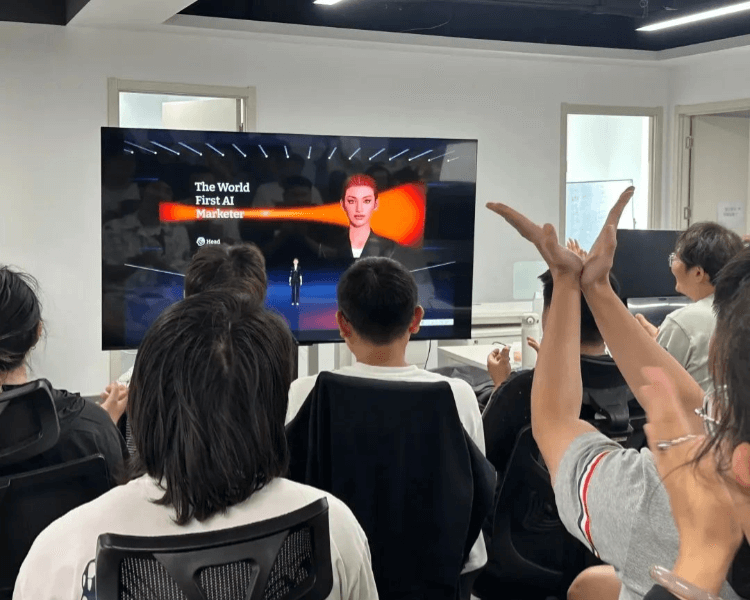
A while ago, we were sitting in the office, watching Head run its own launch event.
I sat in the corner and took a photo. That moment felt a little unreal—
It was like watching a life you created with your own hands step onto the stage alone for the first time.
That wasn't code; it was the continuation of human will.
Watching a group of young people in their early twenties sitting together, excited, focused, and shining,
standing at the crossroads of a rapidly changing world,
I just felt: it's so good to have a group like this walking together.
👦🏻 Koji
Do you think you are an AI Native company/organization? Why?
👧🏻 Kay
We are a company born for AI.
From day one, Head has not been about "letting AI assist humans in their work," but the opposite,
we are letting humans assist AI in getting things done.
AI decides the ad-buying strategy, AI leads candidate selection and price negotiation, AI executes campaigns, and humans do only one thing: set goals and budgets.
We don't treat AI as a tool, but as a new decision-making entity, a new species.
We released a promotional video overseas called "Think Beyond," and the core idea is exactly this:
AI is not a tool; it is a new species. Rather than having it take orders from humans, it is better to hand over power and see how far it can go.
This is the essential difference between us and the "AI-enhanced tools" on the market:
They are preserving old organizations; we are building the working methods of a new species.
This is what true AI Native means: not just using AI, but recognizing its independent intelligence at a fundamental level.
👦🏻 Koji
You became a founder and CEO at 20. I guess you should be the youngest in the team? How do you manage colleagues older than you?
👧🏻 Kay
At Head, no one earns respect through age and seniority. We have only one standard: who can get things done.
I never think "being older than me" is the difficulty in management. Instead, I've always felt it is a relationship of mutual choice.
People willing to join a 20-year-old CEO are not looking for a superior in the first place, but for direction and a battlefield.
They are not waiting for assignments, but charging forward on their own initiative, fighting together and winning together.
I won't "act mature," nor will I imitate any management playbook.
My role is not the person standing above giving orders, but the one who makes judgments in chaos and bears the results.
Actually, I have never been "managing people." I only attract people who don't need to be managed and only recognize results.
As for those who don't fit, I never hesitate either.
When I was 18 at my previous company, I was already carrying the pressure of leading the team forward, even though I didn't have the CEO title,
but I still had to push everything forward and motivate everyone. When you have no authority and can still influence others, that is true influence.
So today, this business card that says "CEO" is just putting an official stamp on responsibilities I had already taken on long ago.
Others win trust through their credentials; I prefer to rely on results.
I think I have an unhealthy craving for "getting it done."
It forces me to go all out, and it also forces others to believe in me.
👦🏻 Koji
In the AI field, what do you think will definitely happen in 2025?
Within 3 years?
Within 5 years?
👧🏻 Kay
What will definitely happen in 2025:
AI is no longer just a suggestion tool, but directly runs marketing.
Writing copy, negotiating with KOLs, running cold email, and placing ads—AI can already execute these in a closed loop. It is not "assisting humans," but "replacing actions." Within marketing departments, it can already replace multiple positions. Bosses will do the math: one AI agent runs the volume that a team used to do in a week, and it doesn't take leave, job-hop, or sit through inefficient meetings. For small and medium-sized companies, this is not a tech wave, but a survival necessity.
Within 3 years (by 2027):
Companies without an AI-native structure will face a life-or-death gap.
Just as brands that missed the social media era gradually fell behind, in the future, companies without an AI-native growth stack (automated decision-making + automated execution) will fall into the predicament of "low human efficiency + expensive budgets + slow decisions." AI is no longer an efficiency tool, but a "structural dividend" that raises the growth ceiling. This is not a question of whether to choose it, but a question of sooner or later being forced to restructure.
Within 5 years (before 2030):
Organizational structures will be completely restructured around AI.
Future companies will not be "one person per position," but "AI + a few humans as optimizers." One Head AI can replace a large number of repetitive actions in the marketing department, and the company will retain only the most critical roles: strategic judgment, quality control review, and model adjustment. AI is the main execution force, and humans are in supporting roles. Organizations will become flatter, faster, and more automated.

Original link:"One person takes down the entire marketing department" | Interview with Kay, founder of Head AI