
What is In-Context LoRA
In-Context LoRA is an image generation framework based on Diffusion Transformers (DiTs) launched by Alibaba Tongyi Lab. It uses the model's intrinsic in-context learning ability to minimize the adjustment of the activated model's context generation capability. This method requires no modification to the original model architecture; only fine-tuning on training data is needed to adapt to diverse image generation tasks, effectively simplifying the training process and reducing dependence on large amounts of annotated data, while maintaining high generation quality. In-Context LoRA performs excellently in multiple practical application scenarios, capable of generating coherent and highly prompt-compliant image sets, and supporting conditional image generation.
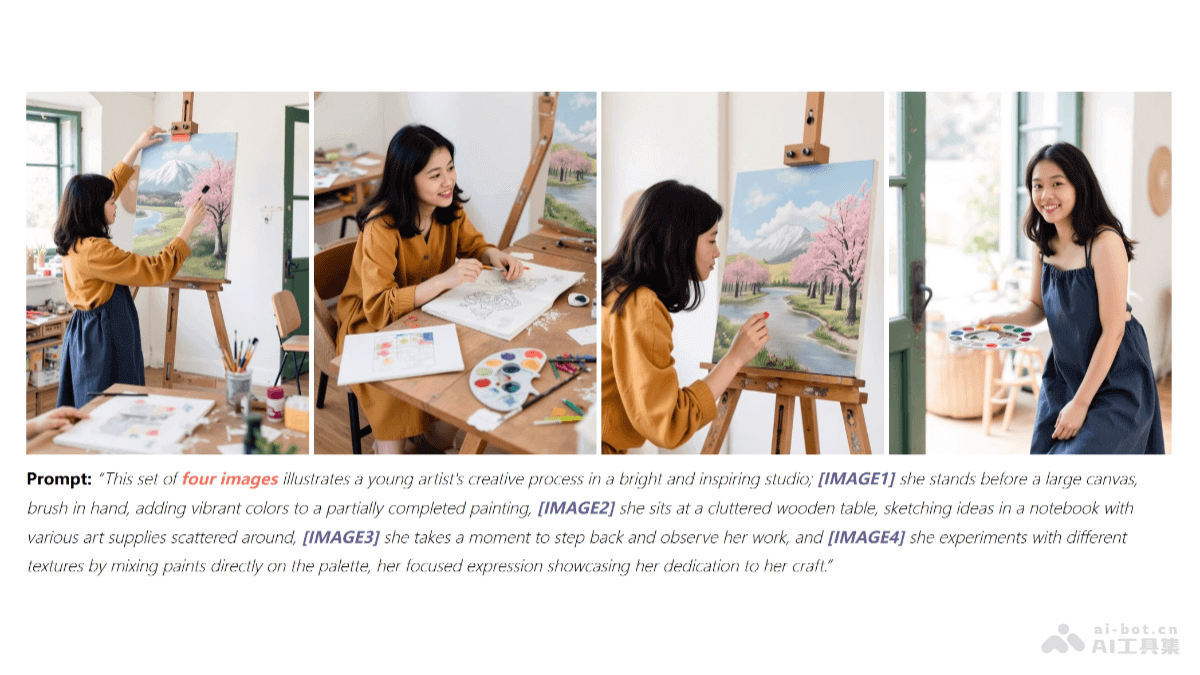
Main Features of In-Context LoRA
- Multi-task Image Generation: Adapts to various image generation tasks such as storyboard generation, font design, home decoration, etc., without training a specific model for each task.
- In-Context Learning Ability: Uses the intrinsic in-context learning ability of existing text-to-image models, adjusting, activating, and enhancing capabilities via LoRA on small datasets.
- Task Agnosticism: It is task-specific in data adjustment, but remains task-agnostic in architecture and process, allowing the framework to adapt to a wide range of tasks.
- Image Set Generation: Can simultaneously generate image sets with customized intrinsic relationships; the image sets are conditional or based on text prompts.
- Conditional Image Generation: Supports conditional generation based on existing image sets, using SDEdit technology for training-free image completion.
Technical Principles of In-Context LoRA
- Diffusion Transformers (DiTs): Based on Diffusion Transformers (DiTs), a model for image generation that simulates the diffusion process to gradually construct images.
- In-Context Generation Ability: This technology assumes that text-to-image DiTs inherently possess in-context generation ability, understanding and generating image sets with complex intrinsic relationships.
- Image Connection: Unlike connecting attention tokens, In-Context LoRA directly connects a set of images into one large image for training, similar to connecting tokens in DiTs.
- Joint Description: Merges the prompts of each image into one long prompt, enabling the model to process and generate multiple images simultaneously.
- LoRA Adjustment on Small Datasets: Uses small datasets (20 to 100 samples) for Low-Rank Adaptation (LoRA) adjustment, activating and enhancing the model's in-context capabilities.
- Task-specific Adjustment: In-Context LoRA's architecture and process remain task-agnostic, adapting to different tasks without modifying the original model architecture.
In-Context LoRA Project Address
- Project Website:ali-vilab.github.io/In-Context-LoRA-Page
- GitHub Repository:https://github.com/ali-vilab/In-Context-LoRA
- arXiv Technical Paper:https://arxiv.org/pdf/2410.23775
Application Scenarios of In-Context LoRA
- Storyboard Generation: Used in film, advertising, or animation production to quickly generate a series of scene images, showing the development of the story plot.
- Font Design: Designs and generates fonts with specific styles and themes, suitable for brand logos, posters, invitations, etc.
- Home Decoration: Generates images of home decoration styles, helping designers and clients preview decoration effects, such as wall colors, furniture layouts, etc.
- Portrait Illustration: Convert personal photos into artistic-style illustrations for personal portraits, social media avatars, or artworks.
- Portrait photography: Generate portrait photos with a specific style and background, for use in fashion magazines, advertisements, or personal artistic photos.