
What is ImBD
ImBD (Imitate Before Detect) is a method launched by Fudan University, South China University of Technology, Wuhan University, Fenzi AI, and other institutions for detecting machine-revised text. First, it imitates the style of text generated by large language models (LLMs), and adjusts the scoring model based on Style Preference Optimization (SPO) to make it better match the characteristics of machine-revised text. Then, it uses Style Conditional Probability Curvature (Style-CPC) to quantify the log-probability difference between the original text and text generated by conditional probability sampling, effectively distinguishing human writing from machine-revised content. ImBD performs well in a variety of scenarios, including text revision by different LLMs, multiple text domains, and various revision types, significantly improving detection performance, and it can achieve superior performance with only a small amount of data and a short training time.
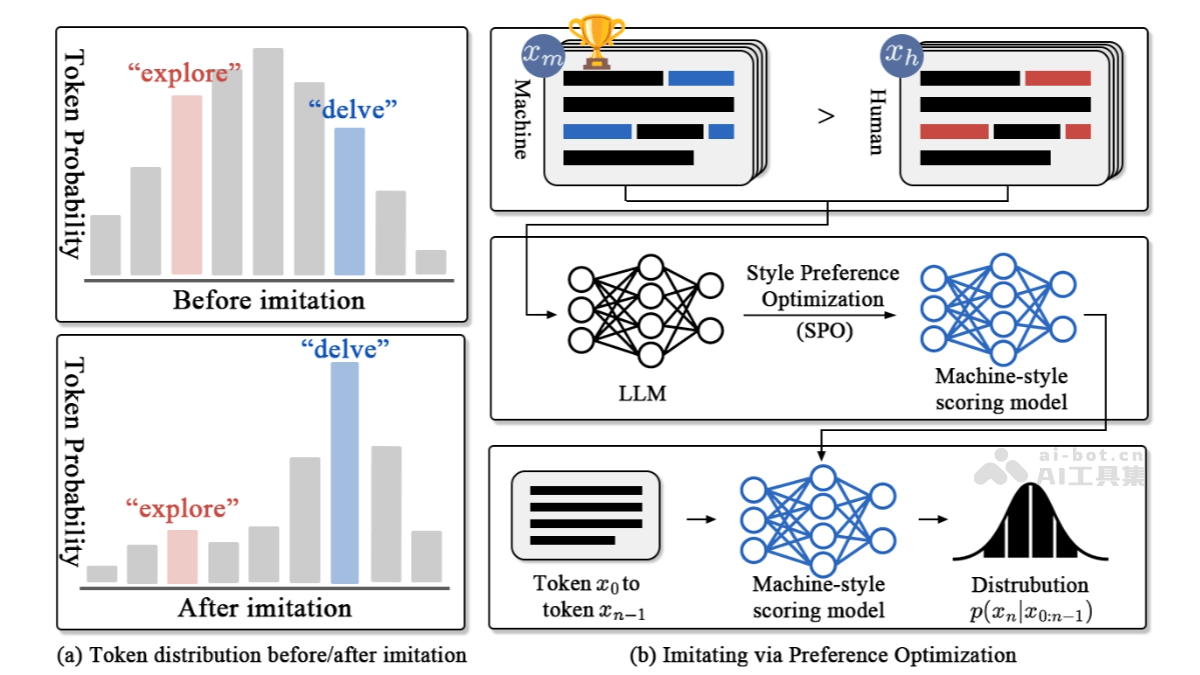
Main features of ImBD
- Detect machine-revised text: Effectively identifies text that has been revised by machines, including types such as rewriting, expansion, and polishing. It captures the unique machine-style features in the text, distinguishes human writing from machine-revised content, and improves detection accuracy.
- Adapt to multiple scenarios: Suitable for multiple text domains and different types of machine revision tasks. This includes different fields such as news, academic papers, and story creation. ImBD can accurately detect traces of machine revision and has good generalization ability.
- Efficient training and inference: During training, ImBD requires only a small number of samples and a short training time to achieve superior performance. In the inference stage, it quickly processes text data and provides detection results, meeting the efficiency requirements of practical applications.
Technical principles of ImBD
- Style Preference Optimization (SPO): Adjusts the scoring model based on SPO so that it better matches the style characteristics of machine-revised text. Based on paired human-written text and machine-revised text, it optimizes the model's token distribution to make it more inclined toward the style of machine-revised text, enhancing the model's ability to recognize machine-style features.
- Style Conditional Probability Curvature (Style-CPC): In the detection stage, I use Style-CPC to quantify the log-probability difference between the original text and text generated by conditional probability sampling. Based on calculating this difference, the model can effectively distinguish human writing from machine-revised content, because machine-revised text usually exhibits different characteristics from human writing in its probability distribution.
- Combining imitation and detection: The core idea of ImBD is to first imitate the machine's style and then perform detection. Based on imitating the machine's style characteristics, the model can better understand the features of machine-revised text, more accurately identify traces of machine revision during detection, and improve detection accuracy and robustness.
ImBD project address
- Project official website:machine-text-detection.github.io/ImBD
- GitHub repository:https://github.com/Jiaqi-Chen-00/ImBD
- arXiv technical paper:https://arxiv.org/pdf/2412.10432
- Online experience Demo:https://ai-detector.fenz.ai/ai-detector
Application scenarios of ImBD
- Academic field: Helps reviewers identify machine-revised parts in papers, ensuring originality and academic integrity.
- News media: Detects machine-polished content in news manuscripts, ensuring the authenticity and accuracy of reports.
- Publishing industry: Assists editors in proofreading book manuscripts, identifies machine-revised content, and ensures book quality.
- Education field: Detects machine-assisted parts in student assignments, accurately evaluates student abilities, and provides targeted feedback.
- Enterprises and business: Review marketing copy, etc., to ensure content originality and quality, and avoid copyright and brand issues.
- Cybersecurity and Information Verification: Identify machine-generated or revised content in online disinformation, and maintain cybersecurity and information authenticity.