
What is IMAGPose
IMAGPose is a unified conditional framework launched by Nanjing University of Science and Technology for human pose-guided image generation. It addresses the limitations of traditional methods in pose-guided person image generation, such as the inability to simultaneously generate multiple target images with different poses, the limited ability to generate target images from multi-view source images, and the loss of detailed information in person images caused by the use of frozen image encoders.
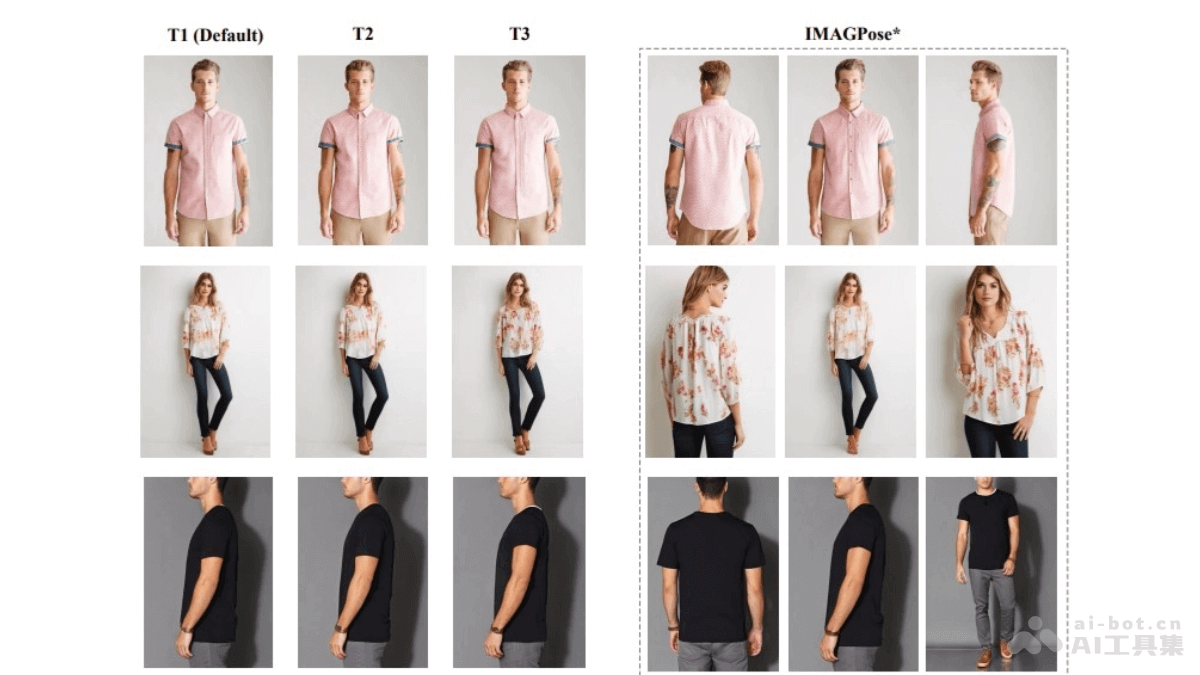
Main Features of IMAGPose
- Multi-scenario adaptation: IMAGPose supports a variety of user scenarios, including generating a target image from a single source image, generating a target image from multi-view source images, and simultaneously generating multiple target images with different poses.
- Fusion of details and semantics: Through the Feature-Level Condition module (FLC), low-level texture features are combined with high-level semantic features, solving the problem of loss of detailed information caused by the lack of a dedicated person image feature extractor.
- Flexible image and pose alignment: The Image-Level Condition module (ILC) achieves alignment between images and poses by injecting a variable number of source image conditions and introducing a masking strategy, adapting to flexible and diverse user scenarios.
- Global and local consistency: The Cross-View Attention module (CVA) introduces cross-attention mechanisms with global and local decomposition, ensuring local fidelity and global consistency of person images when prompted by multiple source images.
Technical Principles of IMAGPose
- Feature-Level Condition module (FLC): The FLC module solves the problem of loss of detailed information caused by the lack of a dedicated person image feature extractor by combining low-level texture features extracted by the Variational Autoencoder (VAE) encoder with high-level semantic features extracted by the image encoder.
- Image-Level Condition module (ILC): The ILC module achieves alignment between images and poses by injecting a variable number of source image conditions and introducing a masking strategy, adapting to flexible and diverse user scenarios.
- Cross-View Attention module (CVA): The CVA module introduces cross-attention mechanisms with global and local decomposition, ensuring local fidelity and global consistency of person images when prompted by multiple source images.
Project Address of IMAGPose
- Github Repository:https://github.com/muzishen/IMAGPose
- Technical Paper:IMAGPose
Application Scenarios of IMAGPose
- Virtual Reality (VR) and Augmented Reality (AR): IMAGPose can generate person images with specific poses, allowing users to present themselves in different poses in virtual environments, or generate multiple poses of virtual characters, enhancing immersion.
- Film Production and Special Effects: In film production, IMAGPose can be used to generate multiple poses of characters, helping special effects teams quickly generate person images in different scenes, reducing the time and cost of manual modeling and animation.
- E-commerce and Fashion: IMAGPose can be used to generate clothing display images in different poses. Merchants can generate renderings of models wearing clothing in different poses, providing consumers with a more comprehensive visual experience.
- Person Re-identification (Re-ID): Images generated by IMAGPose can be used to improve the performance of person re-identification tasks. By generating person images with different poses, the diversity of the dataset can be increased, improving the robustness and accuracy of the model.
- Virtual Photography and Artistic Creation: Artists and photographers can use IMAGPose to generate creative images of human poses for virtual photography or artistic creation, exploring more visual possibilities.