
What is ImageRAG
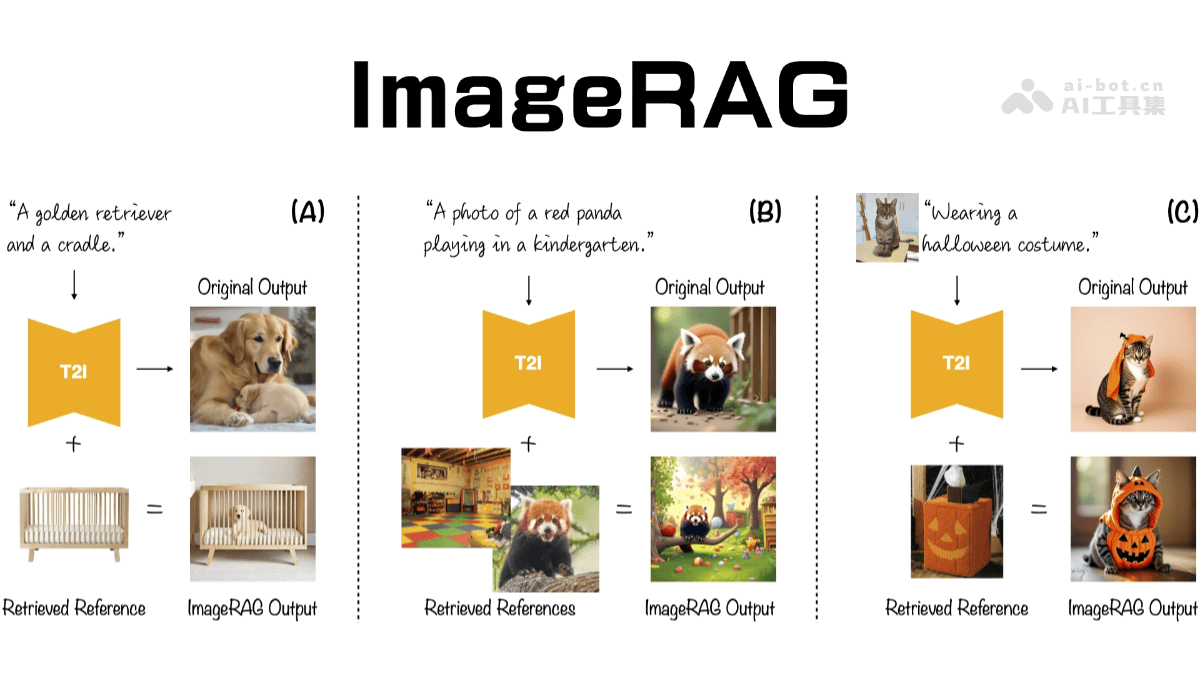
ImageRAG is based on Retrieval-Augmented Generation (RAG)image generationtechnology, which enhances the ability of text-to-image (T2I) models to generate rare or unseen concepts by dynamically retrieving relevant images. Built on existing image-conditioned models, it requires no specific RAG training and can improve the realism and relevance of generated images.
Main Features of ImageRAG
- Dynamic Image Retrieval: Dynamically retrieves images relevant to the text prompt and provides them as context to the base T2I model to guide the generation process.
- Improved Generation of Rare Concepts: By retrieving relevant images as references, it addresses the difficulty traditional models face when generating rare concepts.
- Multimodal Generation Capability: Combines text and image data to generate images that better fit the context.
- Personalized Generation Support: Supports personalized generation, for example, combining user-provided images with retrieved reference images to generate specific scenes.
- Improved Realism of Image Generation:Based on massive image resources, ImageRAG uses retrieval-augmented technology to make AI-generated images more realistic and detailed, avoiding the "hallucination" problem in traditional generative models.
- Flexibility and Scalability:The framework design of ImageRAG is highly flexible and scalable, allowing each module to be extended or upgraded as needed.
Technical Principles of ImageRAG
- Dynamic Image Retrieval-Guided Generation:ImageRAG dynamically retrieves images relevant to a given text prompt, provides these images as context to the base T2I model, and guides the generation process. Using external images as references helps the model better understand and generate the target concept.
- Identifying Missing Concepts:A vision-language model (VLM) is used to determine whether the initially generated image matches the text prompt. If there is a deviation, the VLM identifies the missing concept and generates a detailed retrieval caption for subsequent image retrieval.
- Image Retrieval and Guided Generation:Based on the generated retrieval description, images most similar to the description are retrieved from an external database (such as LAION). The retrieved images are provided as references to the T2I model to help it generate images that better match the text prompt.
- No Additional Training Required:ImageRAG does not require specialized RAG training for the base model. It directly uses the capabilities of existing image-conditioned models and is highly adaptable, so it can be applied to a variety of T2I models (such as SDXL and OmniGen).
ImageRAG Project Address
- Project Official Website:https://rotem-shalev.github.io/ImageRAG/
- Github Repository:https://github.com/rotem-shalev/ImageRAG
- arXiv Technical Paper:https://arxiv.org/pdf/2502.09411
Application Scenarios of ImageRAG
- Creative Design and Content Creation:ImageRAG can help designers and creative workers quickly generate images that fit specific concepts, such as illustrations, posters, or advertising materials with a particular style or scene.
- Personalized Image Generation:By combining user-provided images and personal concepts, ImageRAG can generate personalized image combinations. For example, it can place the user's pet in different creative scenes, such as printed on a mug, in a Lego model, or teaching a dog in a classroom.
- Brand Promotion and Marketing:Enterprises can use ImageRAG to generate visual content consistent with brand image, quickly adapting to different marketing campaigns and advertising needs.
- Education and training materials:In the field of education, ImageRAG can generate images for teaching, such as scientific illustrations, historical scene recreations, or virtual laboratory environments, helping students better understand and remember.
- Film, television, and entertainment:In film, television, and game production, ImageRAG can be used to quickly generate concept art, character designs, or scene backgrounds, accelerating the creative process.