
What is ImageBind
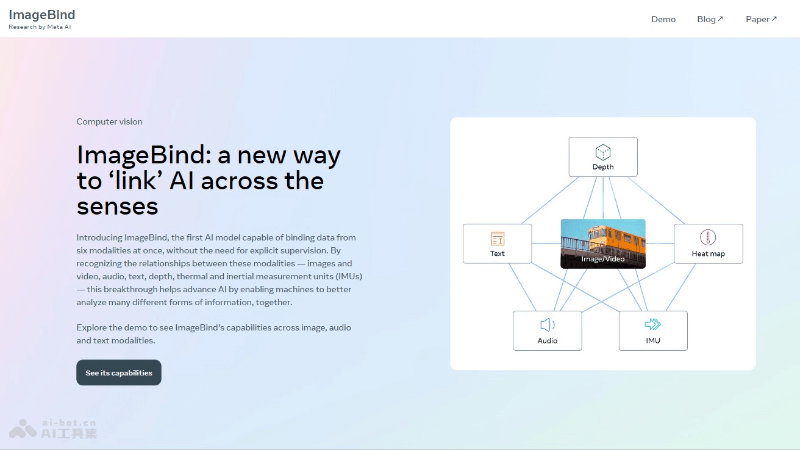
ImageBind is an open-source multimodal AI model launched by Meta that integrates six different types of information, including text, audio, visual, temperature, and motion data, into a unified embedding space. The model uses the image modality as a bridge to achieve implicit alignment of data from other modalities, without the need for direct inter-modal paired data. ImageBind demonstrates excellent performance in tasks such as cross-modal retrieval and zero-shot classification, providing new possibilities for creating immersive, multi-sensory AI experiences.
Main features of ImageBind
- Multimodal data integration: Integrates data from six different modalities, including images, text, audio, depth information, thermal imaging, and IMU data, into a unified embedding space.
- Cross-modal retrieval: Enables information retrieval between different modalities based on a joint embedding space, for example, retrieving relevant images or audio based on text descriptions.
- Zero-shot learning: The model learns new modalities or tasks without explicit supervision, which is especially useful in few-shot or zero-shot settings.
- Modality alignment: Through the image modality, data from other modalities is implicitly aligned, allowing information between different modalities to be mutually understood and transformed.
- Generation tasks: ImageBind is used for generation tasks, such as generating images based on text descriptions, or generating images based on audio.
Technical principles of ImageBind
- Multimodal Joint Embedding: ImageBind trains a model to learn a joint embedding space. The joint embedding space maps data from different modalities (such as images, text, audio, etc.) into the same vector space, allowing information between different modalities to be correlated and compared.
- Modality Alignment: Using images as a hub, data from other modalities is aligned with image data. Even if there is no direct paired data between certain modalities, effective alignment can be achieved through their association with images.
- Self-Supervised Learning: ImageBind adopts a self-supervised learning approach, relying on the structure and patterns of the data itself rather than on large amounts of manual annotation.
- Contrastive Learning: Contrastive learning is one of the core technologies in ImageBind. By optimizing the similarity of positive sample pairs and the dissimilarity of negative sample pairs, the model can learn features that distinguish different data samples.
ImageBind project addresses
- Project official website:imagebind.metademolab.com
- GitHub repository:https://github.com/facebookresearch/ImageBind
- arXiv technical paper:https://arxiv.org/pdf/2305.05665
Application scenarios of ImageBind
- Augmented Reality (AR) and Virtual Reality (VR): In virtual environments, ImageBind generates multi-sensory experiences that interact with users, such as generating corresponding visual and audio feedback based on user actions or voice commands.
- Content recommendation systems: By analyzing users' multimodal behavioral data (such as voice comments, text comments, and viewing duration when watching videos), ImageBind provides more personalized content recommendations.
- Automatic annotation and metadata generation: Automatically generates descriptive tags for image, video, and audio content, helping to organize and retrieve multimedia libraries.
- Technology assisting people with disabilities: Provide assistance for people with visual or hearing impairments, for example, converting image content into audio descriptions, or converting audio content into visual representations.
- Language learning applications: Combine text, audio, and images to help users obtain richer contextual information in language learning.