
What is ILLUME
ILLUME is a unified multimodal large model proposed by Huawei Noah's Ark Lab, integrating visual understanding and generation capabilities into a single framework. With a large language model (LLM) as its core, the model adopts a "continuous image input + discrete image output" architecture, combining the dual capabilities of multimodal understanding and generation, and deeply exploring the potential for synergistic enhancement of understanding and generation capabilities within a unified framework. ILLUME achieves efficient training through a semantic visual tokenizer and a three-stage training process, reaching performance comparable to existing unified multimodal large models with only 15M data.
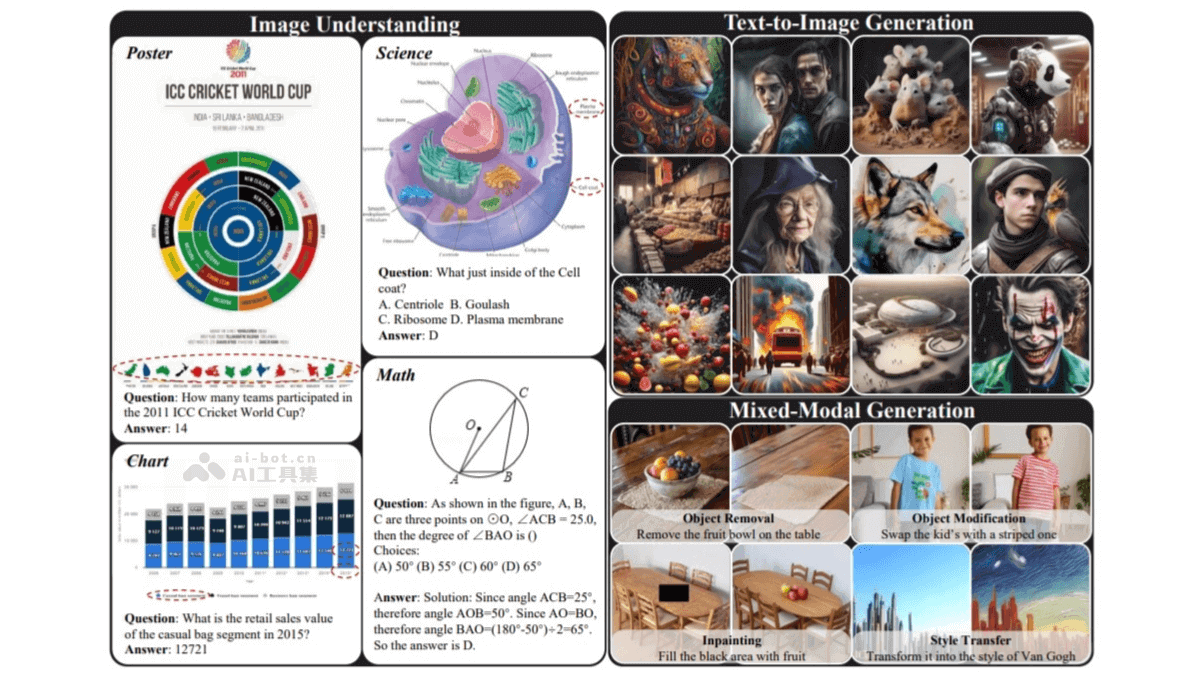
Main Features of ILLUME
- Integration of Multimodal Understanding and Generation: ILLUME can seamlessly integrate visual understanding and generation functions within a single large language model, achieved through a unified "next token prediction" formulation.
- Efficient Data Utilization: By designing a visual tokenizer that incorporates semantic information and a progressive multi-stage training procedure, ILLUME reduces the pre-training dataset size to only 15M.
- Self-Enhanced Multimodal Alignment Strategy: To promote synergistic enhancement between understanding and generation capabilities, ILLUME introduces a novel self-enhanced multimodal alignment scheme that supervises the MLLM in self-evaluating the consistency between text descriptions and automatically generated images, helping the model interpret images more accurately and avoid unrealistic and incorrect predictions in image generation.
- Broad Multimodal Task Processing Capabilities: ILLUME can handle diverse tasks including visual understanding (including natural images and document charts), generation, and editing, and demonstrates performance comparable to specialized single-task models on these tasks.
- Continuous Image Input and Discrete Image Output: The ILLUME model adopts continuous image input, allowing users to upload a series of continuous image frames, particularly suitable for application scenarios such as video analysis and dynamic scene recognition. With its discrete image output design, it can generate single or multiple independent images based on input text or other modal data.
- Synergistic Mechanism: The core of ILLUME lies in its synergistic mechanism under a unified framework, sharing the same set of neural network structures, making the information transfer between understanding and generation functions more efficient and smooth.
Technical Principles of ILLUME
- Unified Multimodal Large Model (MLLM): Through a unified "next token prediction" formulation, ILLUME integrates visual understanding and generation capabilities into a single large language model (LLM).
- Semantic Visual Tokenizer: To improve data efficiency, ILLUME designs a semantic visual tokenizer that quantizes images into discrete tokens embedded with semantic information, significantly accelerating the image-text alignment process.
- Three-Stage Training Process: ILLUME adopts a progressive multi-stage training procedure, including visual embedding initialization, image-text alignment, and multimodal task training, effectively reducing the amount of data required for pre-training to 15M, only a quarter of the traditional requirement.
ILLUME Project Address
- arXiv Technical Paper:https://arxiv.org/pdf/2412.06673
Application Scenarios of ILLUME
- Video Analysis and Dynamic Scene Recognition: The ILLUME model adopts continuous image input, particularly suitable for application scenarios such as video analysis and dynamic scene recognition. It can capture temporal changes and spatial relationships in image sequences, providing more detailed and comprehensive analysis results.
- Medical Diagnosis: By learning from large amounts of medical imaging and medical record text data, the ILLUME model can generate diagnostic images consistent with the actual condition, providing support for doctors. It can help doctors discover deep-level relationships hidden behind the data and provide new ideas and directions for medical research.
- Autonomous Driving: In autonomous driving systems, the ILLUME model can process data from multiple sensors such as cameras and radar, improving the system's response speed and reliability. It can analyze the dynamic situation around the vehicle in real time, predict potential risks, and take corresponding measures in a timely manner.
- Intelligent Customer Service: Through collaborative processing of users' voice and text input, the ILLUME model provides more personalized and precise services. It can generate more appropriate replies based on the user's tone, emotion, and question content, improving user satisfaction.
- Artistic Creation: The ILLUME model can generate multiple different illustration options based on a descriptive piece of text, allowing artists to choose the most suitable one. It can maintain a high degree of consistency and accuracy in the generated images, providing creators with an endless source of inspiration.