
What is iDP3
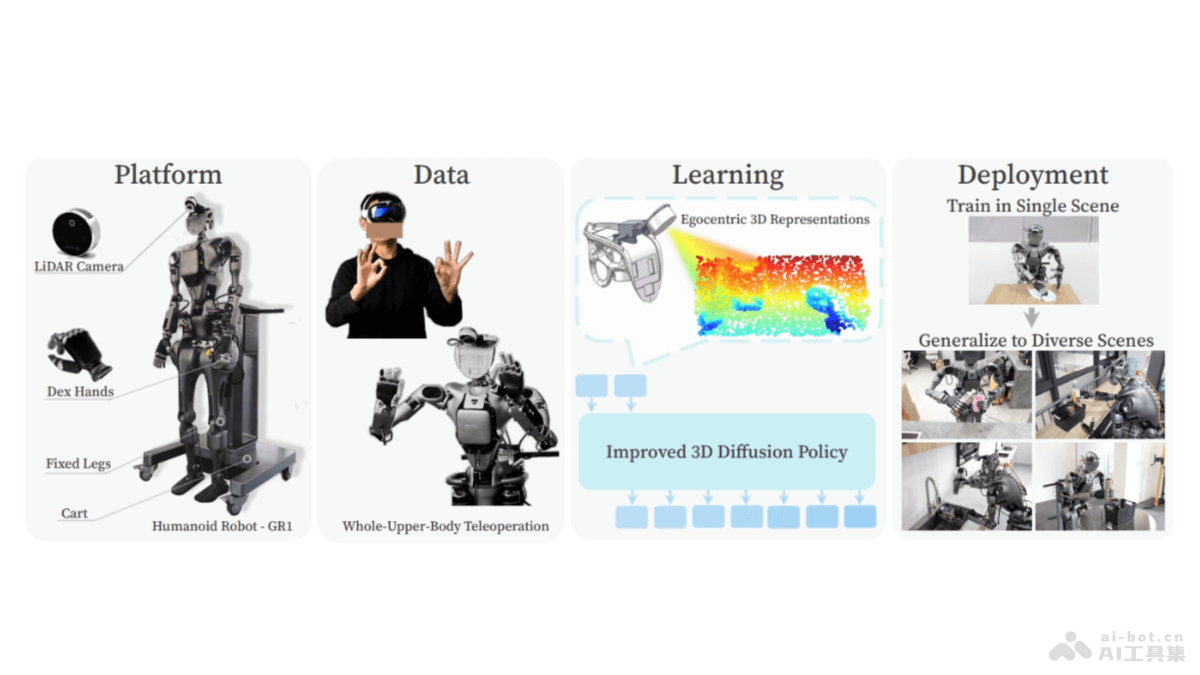
iDP3 (Improved 3D Diffusion Policy) is an improved 3D visuomotor policy (such as a three-dimensional diffusion policy) introduced by Stanford University in collaboration with multiple universities, enhancing the autonomous manipulation capabilities of humanoid robots in diverse environments. Unlike traditional 3D policies, iDP3 is based on egocentric 3D visual representations, eliminating the need for precise camera calibration and point cloud segmentation, allowing robots to flexibly perform tasks in the real world. iDP3 demonstrates excellent generalization capabilities in view changes, novel object recognition, and new scene adaptation, significantly improving the practicality and flexibility of humanoid robots in unseen environments.
Main Features of iDP3
- Egocentric 3D Visual Representation: Uses egocentric 3D visual representations to process 3D data directly in the camera frame, eliminating the need for camera calibration and point cloud segmentation.
- Generalization Capabilities:
- View Generalization: Accurately grasps objects even when views change significantly, without being limited to specific viewpoints seen during training.
- Object Generalization: Can handle objects not seen during training, thanks to the use of 3D representations, without relying on specific object features.
- Scene Generalization: Performs tasks in unseen environments, even when these environments differ from the training environment in complexity and noise levels.
- High Efficiency: Demonstrates high efficiency during training and deployment, reducing reliance on large datasets and quickly adapting to new environments.
Technical Principles of iDP3
- 3D Visual Input: Based on 3D point cloud data obtained from LiDAR cameras, the data provides detailed spatial information about the robot's surrounding environment.
- Egocentric Viewpoint: Unlike traditional 3D policies, iDP3 is based on an egocentric viewpoint, i.e., directly using 3D representations in the camera frame.
- Expanded Visual Input: Captures the entire scene by increasing the number of sampling points, improving comprehensive understanding of the scene.
- Improved Visual Encoder: Replaces the traditional multi-layer perceptron (MLP) visual encoder with a pyramid convolutional encoder, improving smoothness and accuracy when learning from human demonstrations.
- Longer Prediction Horizon: To cope with jitter from human experts and sensor noise, learning effectiveness is improved by extending the prediction horizon.
- Optimization and Inference: Uses the AdamW optimizer during training, and uses DDIM (Denoising Diffusion Implicit Models) for optimization and inference of the diffusion process.
iDP3 Project Address
- Project Website:humanoid-manipulation.github.io
- GitHub Repository:https://github.com/YanjieZe/Improved-3D-Diffusion-Policy
- arXiv Technical Paper:https://arxiv.org/pdf/2410.10803
Application Scenarios of iDP3
- Home Automation: Humanoid robots perform cleaning and organizing in the home.
- Industrial Automation: Humanoid robots perform fine assembly work on assembly lines.
- Medical Assistance: Humanoid robots assist with nursing in hospitals, helping to move patients.
- Search and Rescue: Humanoid robots conduct search and rescue at disaster sites.
- Education and Training: Humanoid robots serve as teaching assistants, demonstrating complex operation processes.