
What is IDM-VTON
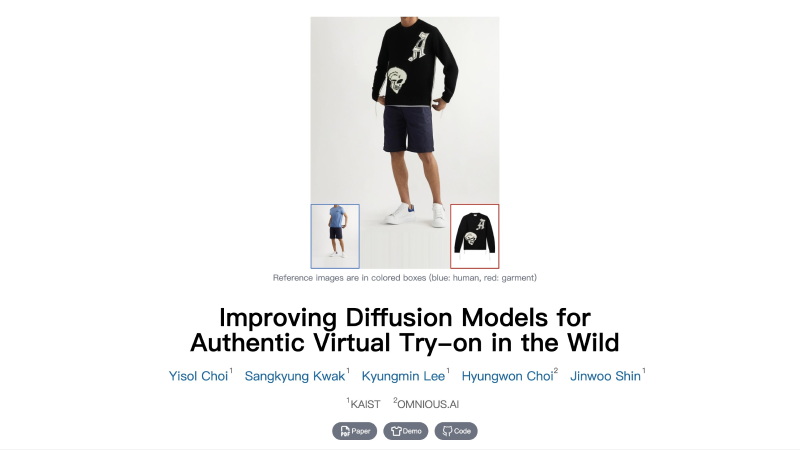
IDM-VTON (Improved Diffusion Models for Virtual Try-ON) is an advanced AI virtual try-on technology proposed by researchers from KAIST and OMNIOUS.AI. It generates realistic images of people wearing garments by improving diffusion models, achieving more realistic virtual try-on results. This technology contains two key components: first, a visual encoder used to extract high-level semantic information from garment images; second, GarmentNet, a parallel UNet network used to capture low-level detail features of garments. IDM-VTON also introduces detailed text prompts to enhance the model's understanding of garment features, thereby improving the realism of the generated images.
IDM-VTON's Features
- Virtual Try-On Image Generation: Based on images of the user and the garment, generate a virtual image of the user wearing the specific garment.
- Garment Detail Preservation: Extract low-level features of the garment through GarmentNet to ensure that details such as the garment's patterns and textures are accurately reflected in the generated image.
- Support for Text Prompt Understanding: Utilize the visual encoder and text prompts to enable the model to understand high-level semantic information of the garment, such as style, type, etc.
- Personalized Customization: Allow users to customize and generate try-on results that better match their personal characteristics by providing their own images and garment images.
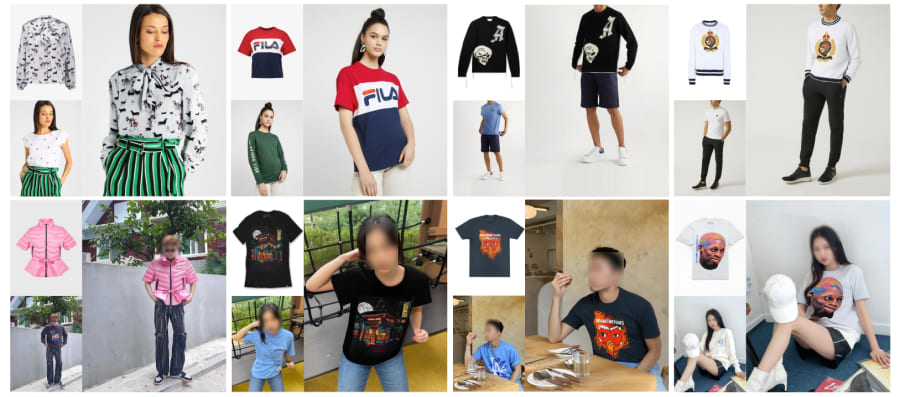
- Realistic Try-On Results: IDM-VTON can generate visually realistic try-on images that are not only visually consistent with the garment image, but also naturally adapt to the person's pose and body shape.
IDM-VTON's Official Website Entry
- Official Project Homepage:https://idm-vton.github.io/
- GitHub Source Code Repository:https://github.com/yisol/IDM-VTON
- Hugging Face Demo:https://huggingface.co/spaces/yisol/IDM-VTON
- Hugging Face Model:https://huggingface.co/yisol/IDM-VTON
- arXiv Research Paper:https://arxiv.org/abs/2403.05139
IDM-VTON's Working Principle
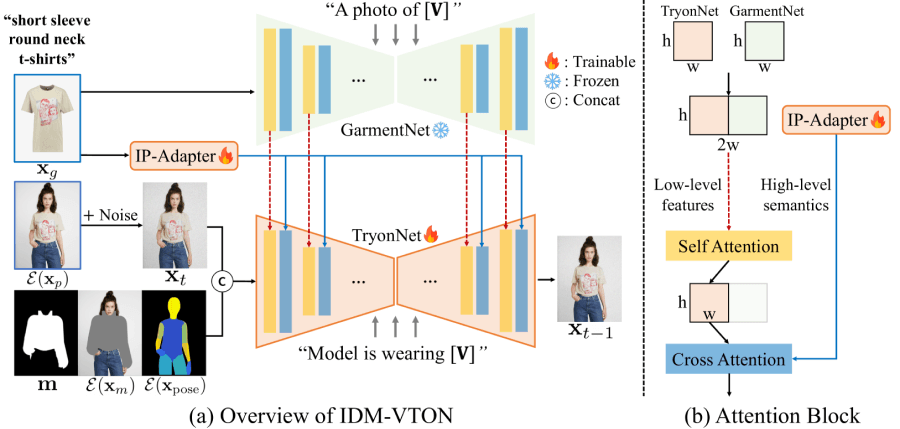
- Image Encoding: First, encode the images of the person (xp) and the garment (xg) into latent space representations that the model can process.
- High-Level Semantic Extraction: Use an image prompt adapter (IP-Adapter), which is a component that utilizes an image encoder (such as the CLIP model) to extract high-level semantic information from garment images.
- Low-Level Feature Extraction: Through GarmentNet, a specially designed UNet network, extract low-level detail features of garment images, such as textures, patterns, etc.
- Attention Mechanism:
- Cross-Attention: Combine high-level semantic information with text conditions and fuse them through cross-attention layers.
- Self-Attention: Combine low-level features with features from TryonNet and process them through self-attention layers.
- Detailed Text Prompts: To enhance the model's understanding of garment details, provide detailed text prompts describing the specific features of the garment, such as "short-sleeve crew-neck T-shirt".
- Customization: By fine-tuning the decoder layers of TryonNet, specific person-garment image pairs can be used to customize the model to adapt to different person and garment features.
- Generation Process: Utilize the reverse process of the diffusion model, starting from the latent representation with added noise, and gradually denoise to generate the final virtual try-on image.
- Evaluation and Optimization: Evaluate the model's performance on different datasets, using quantitative metrics (such as LPIPS, SSIM, CLIP image similarity score, and FID score) and qualitative analysis to optimize the model.
- Generalization Test: Test the model's generalization ability on the In-the-Wild dataset, which contains real-world scenarios, to verify the model's performance on unseen clothing and human poses.
Application Scenarios of IDM-VTON
- E-commerce: In online shopping platforms, IDM-VTON allows users to preview how clothing looks on them without actually trying it on, thereby improving the shopping experience and satisfaction.
- Fashion Retail: Fashion brands can use IDM-VTON to enhance customers' personalized experience, showcasing the latest styles through virtual try-on, attracting customers and driving sales.
- Personalized Recommendations: By combining users' body measurements and preference data, IDM-VTON can be used in personalized recommendation systems to recommend clothing that suits their body shape and style.
- Social Media: Users can use IDM-VTON on social media to try different clothing styles, share try-on results, and increase interaction and entertainment.
- Fashion Design and Display: Designers can use IDM-VTON to display their design works, showcasing clothing through virtual models without the need to produce physical sample garments.