
What is ID-Animator
ID-Animator is a zero-shot human video generation technology launched by researchers from Tencent Photon Studio, the University of Science and Technology of China, and the Hefei Institutes of Physical Science, Chinese Academy of Sciences. It can generate personalized videos based on a single reference facial image while preserving the person's identity features in the image, and can adjust video content based on text prompts. This framework achieves efficient video generation by combining a pre-trained text-to-video diffusion model with a lightweight face adapter, and does not require additional training for a specific identity. ID-Animator improves the identity fidelity and generation quality of videos by building a dedicated dataset and adopting a random facial reference training method.
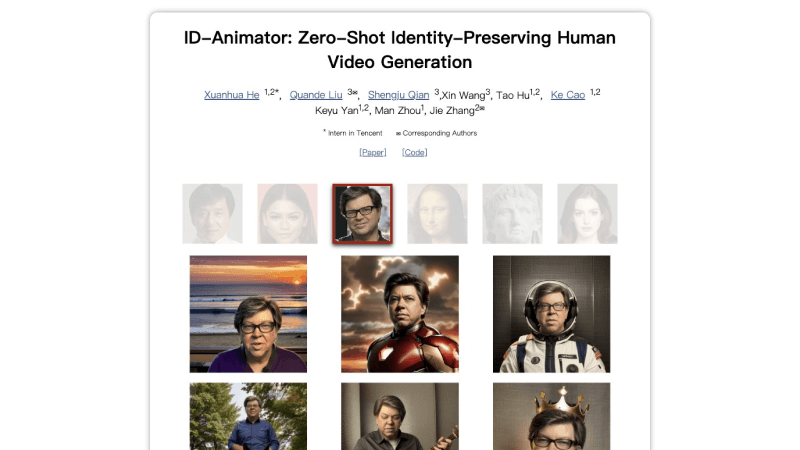
Main features of ID-Animator
- Modify video characters (Recontextualization): ID-Animator can change the contextual information of characters in a video based on the provided reference image and text. For example, text prompts can be used to adjust the character's hairstyle, clothing, background, or even perform specific actions, thereby creating a completely new character backstory.
- Age and Gender Alteration: The model can adjust the age and gender of characters in a video as needed to suit different video content and style requirements. For example, it can generate videos of young people growing old or boys turning into girls.
- Identity Mixing: ID-Animator can mix the features of two different identities and generate videos with combined features according to different proportions, which is very useful when creating new characters or mixing character features from reality.
- Combination with ControlNet: ID-Animator is compatible with existing fine-grained conditioning modules such as ControlNet. By providing single-frame or multi-frame control images, it can generate video sequences closely combined with the control images, which is very useful when generating videos of specific actions or scenes.
- Community model integration: ID-Animator can also be integrated with community models (such asCivitaimodels), and can work effectively even without having been trained on these models, maintaining the stability of facial features and dynamic generation.
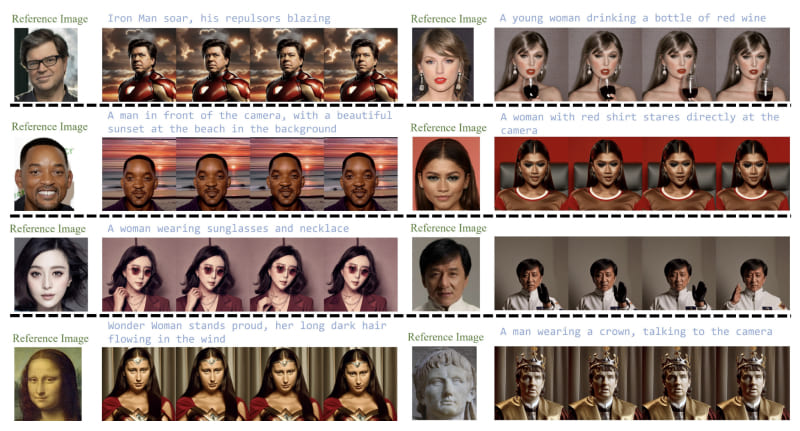
ID-Animator official website entry
- Official project homepage:https://id-animator.github.io/
- arXiv research paper:https://arxiv.org/abs/2404.15275
- GitHub source code:https://github.com/ID-Animator/ID-Animator
How ID-Animator works
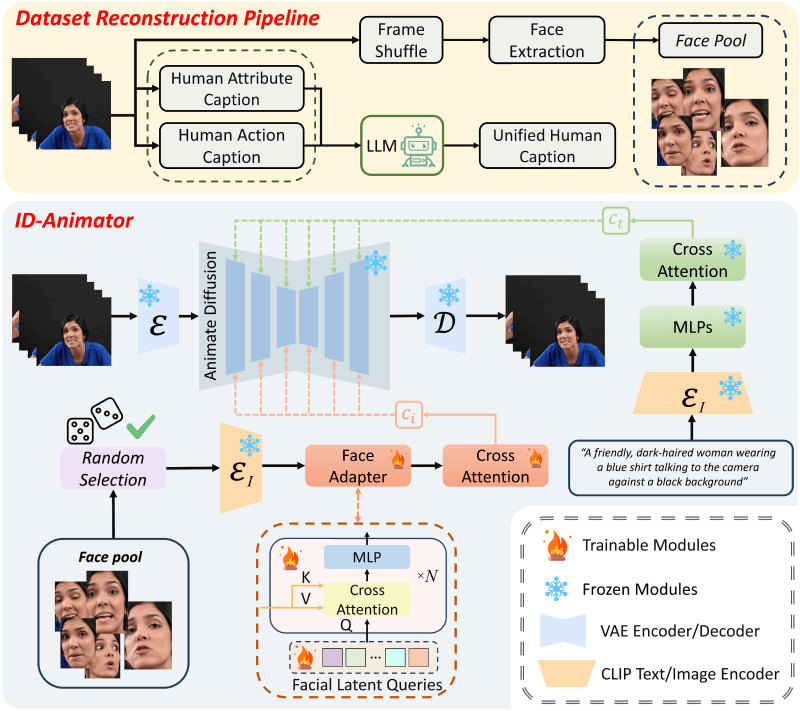
- Pre-trained text-to-video diffusion model: ID-Animator uses a pre-trained text-to-video (Text-to-Video, T2V) diffusion model as its foundation. This model can generate video content based on text prompts.
- Face Adapter: To generate videos consistent with a specific identity, ID-Animator introduces a lightweight face adapter. This adapter encodes identity-related embedding information by learning facial latent queries.
- Identity-oriented dataset construction: The researchers built an identity-oriented dataset, which includes decoupled human attribute and action captioning technology, as well as facial features extracted from a constructed facial image pool.
- Random facial reference training method: ID-Animator uses randomly sampled facial images for training. This method helps separate identity-irrelevant image content from identity-related facial features, enabling the adapter to focus on learning identity-related features.
- Fusion of text and facial features: ID-Animator combines text features and facial features, fusing them through an Attention Mechanism to generate videos that both match the text description and preserve identity features.
- Generation process: When generating a video, ID-Animator first receives a reference facial image and the corresponding text prompt. The facial adapter encodes the features of the reference image into embeddings, then feeds these embeddings together with the text features into the diffusion model to ultimately generate the video.
- Optimization and training: To improve the model's performance, ID-Animator's training process includes using random facial images as references to reduce the influence of identity-irrelevant features in the reference image, and optimizes video generation quality through techniques such as Classifier-Free Guidance.
- Compatibility and extensibility: ID-Animator is designed to be compatible with a variety of pretrained T2V models, such as AnimateDiff, which allows it to be easily integrated into existing systems and extended across different applications.