
What Is Bleaf
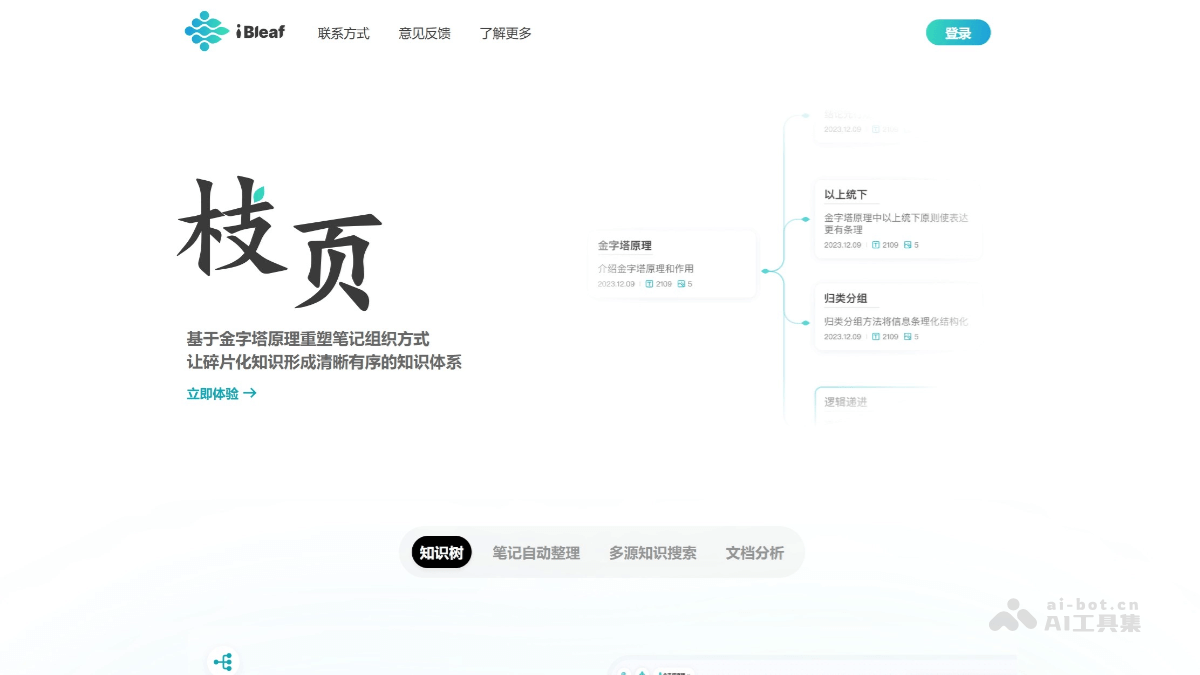
Bleaf (iBleaf) is an AI note-taking tool designed based on the Pyramid Principle, helping users organize fragmented knowledge into a clear and orderly knowledge system. Through the form of a knowledge tree, users can organize notes in a hierarchical structure, and each node can be further split into child nodes, forming a logically clear knowledge architecture. Users can create multiple knowledge trees, each corresponding to different fields or topics, facilitating personalized management and multi-dimensional exploration. Bleaf features AI-assisted search, supporting natural language search of local notes and online search of web knowledge. Search results are presented in the form of a knowledge tree, helping users quickly find the information they need and understand the connections between knowledge. It provides intelligent reminders and suggestions, reminding users to prune and supplement knowledge based on the growth status of the knowledge tree, and guiding new learning directions.
Main Features of Bleaf
- Based on the Pyramid Principle: Bleaf reorganizes notes based on the Pyramid Principle, integrating fragmented information into a clear and orderly knowledge structure. Graphical expression makes the knowledge system clear at a glance.
- Multiple Knowledge Trees: Supports creating multiple "knowledge trees," each with its own field and topic. Users can perform personalized management and multi-dimensional exploration according to their needs.
- Flexible Adjustment: Easily locate target documents by zooming and dragging, and double-click to view details. If a document card's position is not suitable, it can be dragged directly to a new position, or a new document card can be created at a certain position in the knowledge tree.
- Intelligent Reminders and Suggestions: Bleaf constantly monitors the growth status of the "knowledge tree." When a branch needs pruning, knowledge nutrients are insufficient, or growth stagnates, it promptly reminds and provides suggestions. By continuously tracking and analyzing changes in the knowledge tree, it helps users discover potential connections between knowledge and fill gaps and blanks in the knowledge system.
- Collection in Multiple Formats: Supports one-click collection of content in multiple formats such as web links, PDF/Word documents, and images, and can also automatically filter out interfering information such as web advertisements.
- One-Click Outline Organization: When recording new notes, it is necessary to clarify their connection with existing knowledge. This moderate level of thinking difficulty helps internalize knowledge and form long-term memory.
- AI-Assisted Search: Users can describe their needs in natural language, and the system will precisely locate relevant note fragments, accompanied by original note links.
- Online Search: Switch to online search mode with one click to obtain the latest knowledge from authoritative websites, meeting users' needs for explanations of professional terms or cutting-edge industry trends.
- Knowledge Sharing and Collaboration: Users can export their knowledge trees in Markdown format for easy sharing with others. Team collaboration is supported, and team members can jointly build and maintain knowledge trees, improving team knowledge management efficiency.
Bleaf Official Website Address
- Official Website Address:bleaf.cn
Bleaf Application Scenarios
- Knowledge System Construction: Students can use Bleaf to build knowledge trees for different subjects, integrating scattered knowledge points into a clear system for easy understanding and memory.
- Study Material Organization: Quickly record class notes, key points from reading books, etc. Through the one-click collection function, organize study materials such as web links and PDF documents into the knowledge tree for subsequent review and reference.
- Project Management: Professionals can create a knowledge tree for each project, integrating project-related documents, materials, meeting records, and more, making it convenient for team members to view and collaborate, and improving project management efficiency.
- Literature Management: Researchers can organize collected literature and materials into a knowledge tree, classifying them by research direction, topic, and more, making it convenient to search and cite.