
What is iAgents
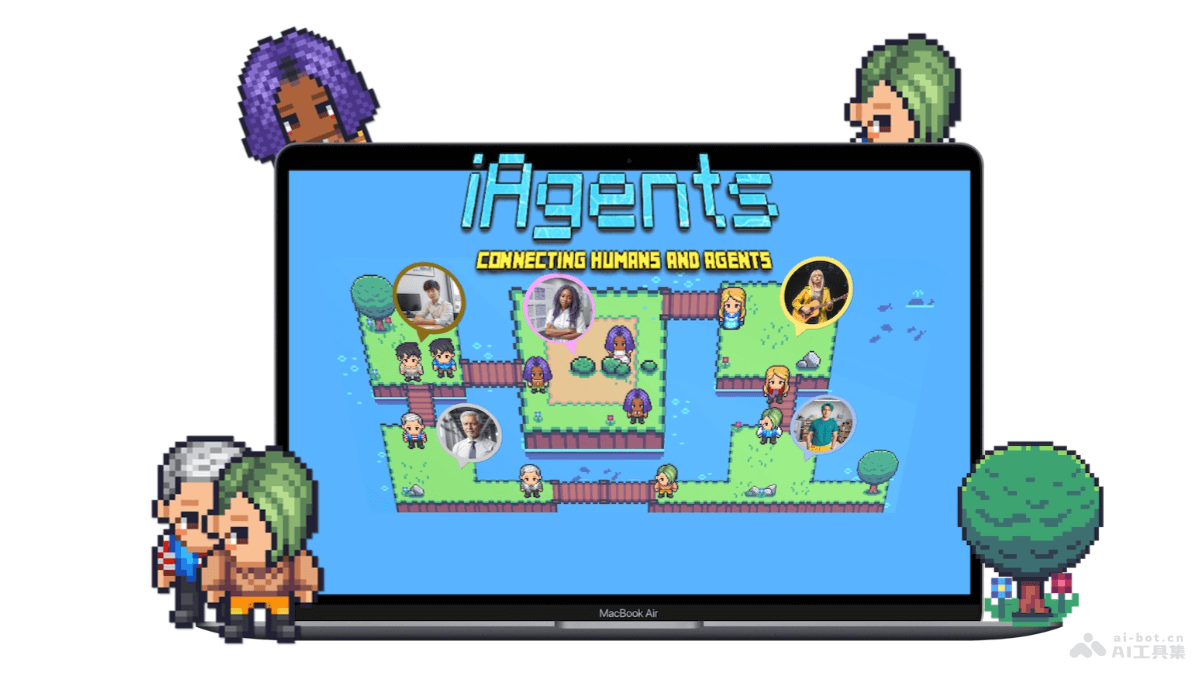
iAgents is a multi-AI agent collaboration framework launched by Tsinghua University, designed to facilitate collaboration and complete daily tasks by equipping each user with a personal AI agent. The agents can understand users' files and commands, learn from collaboration, and achieve automatic information exchange and task resolution. iAgents uses the infoNav reasoning mechanism to guide agents in effective communication under information asymmetry, improving team collaboration efficiency and advancing the frontier of AI technology. The system is fully open source and supports seamless integration with existing tools and platforms.
Main Features of iAgents
- Information Exchange and Collaboration:The iAgents system enables agents to simulate information exchange in human social networks, addressing the problem of information asymmetry among multiple agents.
- Task Resolution Capabilities:The system can handle complex collaborative tasks, such as finding specific information in large social networks (Needle-Oriented tasks) and performing algorithmic reasoning based on distributed information (Reasoning-Oriented tasks).
- Autonomous Communication:Agents can communicate autonomously on behalf of multiple human users, completing multi-turn dialogues and task resolution.
- Information Retrieval and Memory:The system is designed with a hybrid memory mechanism, including Clear Memory and Fuzzy Memory, to store and retrieve human information.
Technical Principles of iAgents
- Information Navigation Mechanism (InfoNav): Helps agents plan and track required information under information asymmetry, guiding agents on what to ask and what to answer.
- Hybrid Memory Mechanism: iAgents is designed with a hybrid memory mechanism, including Clear Memory and Fuzzy Memory, to organize and retrieve human information.
- Clear Memory: Stores information in a structured format for precise retrieval.
- Fuzzy Memory: Stores summaries of conversation text, retrieved using embedding-based approximate nearest neighbor (ANN) search.
- Multi-Agent Collaboration: iAgents simulates human social networks, where agents can autonomously communicate and exchange information to solve tasks.
- Natural Language Processing: Agents can understand and process natural language, engaging in natural communication with users.
iAgents Project Address
- Project Official Website:thinkwee.top/iagents
- GitHub Repository:https://github.com/thinkwee/iagents
- arXiv Technical Paper:https://arxiv.org/pdf/2406.14928
Application Scenarios of iAgents
- Meeting Coordination: Agents can automatically schedule and coordinate meetings on behalf of users, determine the free time of all participants, and automatically book meeting rooms.
- Project Management: In project management, agents help assign tasks, track progress, and synchronize information among project members.
- Customer Service: Agents can automatically handle customer inquiries, provide instant feedback, and escalate issues to human handling when necessary.
- Procurement and Supply Chain Management: Agents can automatically contact suppliers for price comparison, coordinate purchase orders, and manage communication in the supply chain.
- R&D Collaboration: In the R&D field, agents help coordinate the work of different teams, such as requirement alignment and iterative development between product managers and engineers.