
What is I2V3D
I2V3D is an image-to-video generationframework from City University of Hong Kong and Microsoft GenAI Innovation. It supports converting static images into dynamic videos and achieves precise animation control based on 3D geometric guidance. I2V3D combines the precise control capabilities of traditional computer graphics (CG) pipelines with the visual fidelity of generative AI models, using a two-stage generation process: 3D-guided keyframe generation and video interpolation, to achieve high-quality, controllable video generation. I2V3D supports complex 3D animations and camera movements, allowing users to start animation from any initial point and generate video sequences of arbitrary length. I2V3D lowers the creative barrier, simplifies the video generation process, and provides an efficient and flexible solution for fields such as animation production, video editing, and content creation.
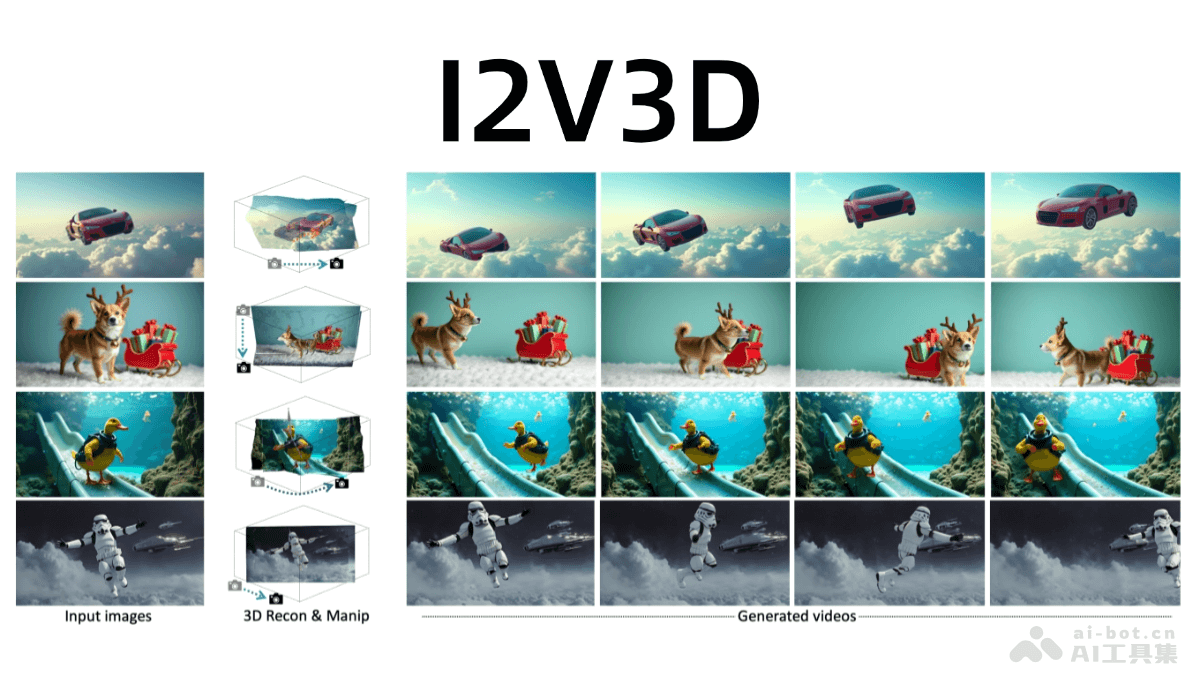
Main features of I2V3D
- Conversion from static images to dynamic videos: Converts a single static image into a video with dynamic effects, supporting complex animations and camera movements.
- Precise 3D control: Achieves fine-grained control over animation based on 3D guidance, including object rotation, translation, scaling, and camera movements (such as rotation, translation, zooming, etc.).
- Flexible animation starting point: Supports freely defining the starting frame of the animation and generating videos of arbitrary length.
- Support for complex scene editing: Users can add, copy, replace, or edit objects in a 3D scene to generate new video content.
Technical principles of I2V3D
- 3D geometry reconstruction: Reconstructs the complete 3D scene geometry from a single image, including foreground objects and background. Foreground objects are extracted and converted into 3D meshes, while the background is completed using multi-view generation and 3D mesh reconstruction.
- Two-stage video generation process:
- 3D-guided keyframe generation: Uses a customized image diffusion model, guided by rough rendering results, to generate high-quality keyframes. Multi-view enhancement and extended attention mechanisms improve the model's generalization ability and temporal consistency.
- 3D-guided video interpolation: Generates smooth, high-quality video frames between keyframes. Training-free, it ensures the temporal coherence of the video based on bidirectional guidance (forward and backward).
- Depth guidance and feature control: During video generation, depth maps and rendering features (such as self-attention features and convolutional features) are used as control signals to ensure that the generated video remains consistent with the 3D rendering results.
- Extended attention mechanism: Based on an extended attention mechanism, it enhances spatiotemporal consistency between frames during the keyframe generation stage, avoiding flickering or incoherence in the generated video.
Project address of I2V3D
- Project official website:https://bestzzhang.github.io/I2V3D/
- arXiv technical paper:https://arxiv.org/pdf/2503.09733
Application scenarios of I2V3D
- Animation production: Quickly generates dynamic videos from static images, supports complex 3D animations, and is suitable for short animation production such as advertising and games.
- Video editing and creation: Adds, replaces, or modifies objects in a 3D scene to generate creative video content, suitable for short videos and special effects previews.
- VR/AR content generation: Generates realistic 3D dynamic content for interactive demonstrations in virtual environments, enhancing immersion.
- Education and training: Convert static instructional illustrations into dynamic videos to help students understand complex concepts more intuitively.
- Game Development: Quickly generate game cutscenes or virtual character animations, saving development time and costs.