
What is HyperEyes
HyperEyes is a parallel multimodal search agent jointly launched by Xiaohongshu and the University of Cambridge. It pioneers the UGS paradigm, integrating visual grounding and retrieval into a single atomic action to achieve single-turn multi-entity concurrent search. HyperEyes adopts a dual-granularity efficiency-aware reinforcement learning framework. Across 6 benchmarks, the 30B version surpasses the strongest open-source models of the same scale by 9.9% in accuracy and reduces the number of tool-calling rounds by 5.3 times, achieving Pareto optimality in both accuracy and efficiency.
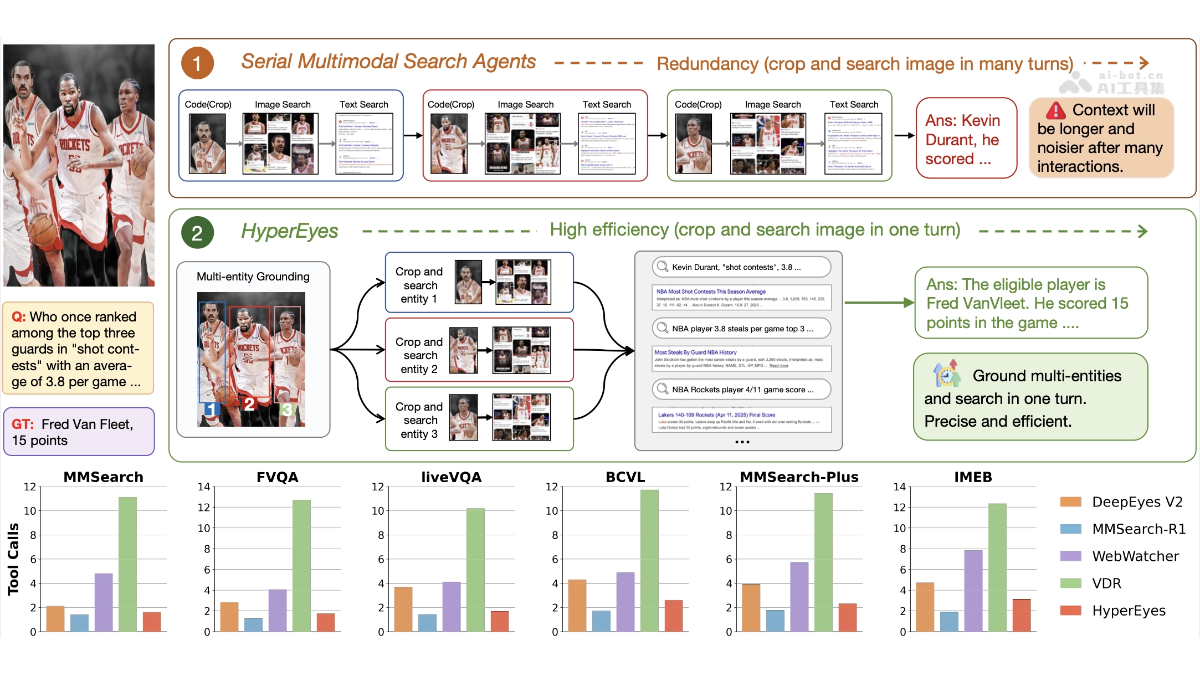
Main Features of HyperEyes
-
Parallel Multimodal Search: Concurrently grounds and retrieves multiple entities in an image within a single turn, replacing the traditional serial crop-then-search pipeline.
-
Unified Grounded Search: Embeds visual grounding boxes directly into the retrieval action parameters, with a single function call carrying multiple target boxes.
-
Progressive Rejection Sampling: Purifies efficient trajectories under increasing round budgets, constructing 30,000 zero-redundancy parallel seed data.
-
Dual-Granularity Efficiency-Aware RL: TRACE dynamically tightens the trajectory-level efficiency bar, while OPD injects token-level correction signals on failed trajectories.
-
IMEB Benchmark Evaluation: Releases a 300-instance multi-entity visual evaluation set, paired with the CAS score to jointly quantify accuracy and search efficiency.
-
Multi-Tool Collaboration: Integrates image search and text search tools, supporting concurrent acquisition of visual evidence and textual evidence.
Technical Principles of HyperEyes
- UGS Action Space Reconstruction: Transforms visual grounding from an independent preceding step into an embedded parameter of the retrieval action, physically opening up a single-turn multi-target concurrent pathway.
- Parallel Data Synthesis Pipeline: Synthesizes multi-entity queries by splicing multiple types of images, constructs multi-constraint intersection problems based on random walks on graphs, and eliminates shortcut solutions.
- TRACE Dynamic Reference Reward: Uses the current best trajectory as a dynamic bar, giving rewards only when the model is more efficient than the bar, automatically tightening the standard each round.
- OPD Asymmetric Policy Distillation: Activates a 235B teacher model when a trajectory's final answer is wrong, providing dense token-level supervision for failed trajectories and protecting efficient concurrent instincts.
- Joint Optimization Objective: GRPO combines trajectory-level efficiency rewards with token-level distillation loss to simultaneously optimize the accuracy and efficiency of the policy network.
- CAS Cost-Aware Scoring: Uses the formula Acc²×100/(N_tok+2N_tool+1) to unify accuracy, token consumption, and tool rounds into an efficiency metric.
How to Use HyperEyes
- Obtain Open-Source Resources: Visit the GitHub repository https://github.com/DeepExperience/HyperEyes 。
- Prepare the Base Model: Download and deploy Qwen3-VL-30B or 235B as the vision-language model backbone, ensuring GPU memory meets inference requirements.
- Configure External Retrieval Tools: Integrate image search and text search APIs (such as Bing Image Search, Google Custom Search) as external tools for the Agent to execute UGS parallel search.
- Input Multi-Entity Queries: Upload complex images containing multiple entities and input natural language questions. HyperEyes will automatically execute UGS unified grounded search, concurrently grounding and retrieving all targets in a single turn.
- View Parallel Search Results: The model returns structured retrieval results and the final answer, including visual evidence and textual evidence for each entity.
- Evaluating search efficiency: Quantitatively evaluate the combined efficiency of accuracy, token consumption, and tool invocation rounds through the CAS (Cost-Aware Score) metric
Core advantages of HyperEyes
-
Efficiency leap: The 30B version averages only 2.2 tool invocation rounds, 1/5 that of the strongest open-source model of the same scale, achieving a 5.3x efficiency improvement.
-
Leading accuracy: Surpasses the strongest open-source model of the same scale by 9.9% on 6 benchmarks, and the 235B version approaches Gemini-3.1-Pro with a 1.1% gap.
-
Robust to noise: The parallel strategy avoids over-retrieval hallucinations, improving accuracy by 3.7%-5.8% in mixed true-false evidence tests.
-
Eliminating error cascades: UGS eliminates serial pruning dependencies, so earlier localization bias no longer contaminates subsequent search results.
-
Pareto optimal: Comprehensively dominant on the joint accuracy-efficiency frontier, with a CAS score 7.6 times that of the second-best open-source model.
-
Full-stack efficiency reshaping: Performs底层 reconstruction from action space, data synthesis to RL training, systematically solving the serial dilemma.
HyperEyes project address
- GitHub repository:https://github.com/DeepExperience/HyperEyes
- arXiv technical paper:https://arxiv.org/abs/2605.07177
Comparison of HyperEyes with similar competitors
| Comparison dimension | HyperEyes-30B | DeepEyes-V2 | VDR |
|---|---|---|---|
| Development team | Xiaohongshu/University of Cambridge | Xiaohongshu | Not disclosed |
| Search paradigm | Parallel concurrency (UGS) | Serial pruning-search | Serial deep search |
| Average tool rounds | 2.2 | 3.6 | 11.6 |
| Average accuracy on 6 benchmarks | 64.0% | 39.1% | 54.1% |
| IMEB accuracy | 46.7% | 18.0% | 21.2% |
| CAS efficiency score | 0.910 | 0.119 | 0.014 |
| Core mechanism | TRACE + OPD dual-granularity RL | Tool reward incentives | Multi-round deep reasoning |
| Error cascade risk | Immune (atomic actions) | High risk | Medium risk |
Application scenarios of HyperEyes
-
Multi-person visual reasoning: Identify the identity, occupation, and historical events of specific people in group photos, and concurrently retrieve biographical information about multiple people.
-
E-commerce product comparison: Concurrently search complex scene images containing multiple products to obtain price, brand, and review information.
-
Cross-modal knowledge question answering: Answer complex queries involving relationships among multiple objects, landmarks, and artworks in images.
-
News fact-checking: Concurrently retrieve news images containing multiple people and scenes to verify event authenticity and background information.
-
Academic chart parsing: Perform parallel localization and content retrieval on paper screenshots containing multiple charts, formulas, and citations.
-
Social media moderation: Concurrently search multiple entities in complex images to quickly determine violating or misleading content.