
What is HY-WU
HY-WU (Hunyuan Wuxiang) is a functional neural memory framework launched by Tencent Hunyuan that enables AI to generate personalized parameters in real time during inference. Through a Transformer parameter generator, the framework synthesizes personalized LoRA weights in real time based on the input during inference and dynamically injects them into a frozen base model, achieving instance-level adaptation without fine-tuning. The framework reaches leading open-source model levels in more than 60 tasks, including image editing, opening a new path for the personalization and continual learning of general AI.
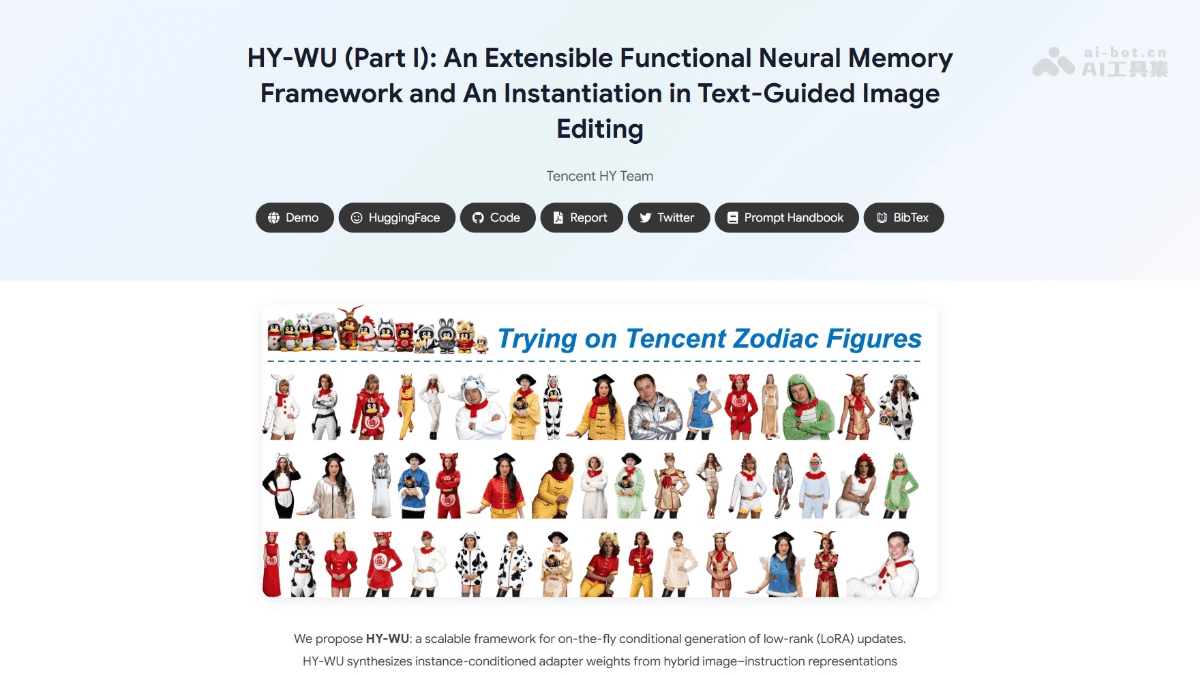
Main Features of HY-WU
-
Real-Time Parameter Generation: HY-WU can synthesize a dedicated set of LoRA adaptation parameters in real time during model inference based on the current input image and editing instruction, without the need for pre-training or storing a large number of fixed weights.
-
Instance-Level Personalization: The system dynamically generates customized operator parameters for each specific sample or task, achieving true "thousands of people, thousands of faces" personalized adaptation.
-
Zero-Forgetting Adaptation: By dynamically injecting the generated parameters into a frozen base model, HY-WU avoids direct modification of shared weights, completely solving the catastrophic forgetting problem of "learning the new and forgetting the old" caused by traditional fine-tuning.
-
Functional Decoupling: When faced with mutually conflicting task objectives, HY-WU routes different requirements to different regions of the parameter update family, eliminating the performance seesaw effect of traditional models and avoiding trade-offs that favor one at the expense of another.
-
End-to-End Training: Unlike traditional hypernetworks that rely on a large number of pre-trained checkpoints, HY-WU adopts an end-to-end training approach, directly optimizing the parameter generator without the need to collect and store massive fine-tuning weights.
-
Large-Scale Compatibility: Through structured parameter chunking and Factorized Self-Attention optimization computation, HY-WU can efficiently support base models at the 80B parameter scale, and the inference generation process is completed in only a few seconds.
Technical Principles of HY-WU
- Functional Neural Memory Paradigm: HY-WU redefines the "memory interface" for model adaptation. Traditional methods treat adaptation as finding a fixed point in a static parameter space, while HY-WU transforms it into learning a parameter generation function—that is, synthesizing in real time the mapping relationship of a specific operator according to input conditions. Under the paradigm of "memory as a neural network," the model can perform dynamic routing within the weight space according to different instances, fundamentally avoiding repeated erasure and conflicts on shared parameters and realizing a conditionalized parameter update family as non-isolated operators.
- Hybrid Condition-Aware Encoding: The system first extracts hybrid condition features of the current input image and editing instruction through a multimodal encoder, fusing visual content and language instructions into a unified semantic representation. This condition encoding captures the task intent of "what to do" and perceives the instance characteristics of "to whom to do it," providing fine-grained contextual basis for subsequent parameter generation and ensuring that the generated parameters can precisely match the unique needs of the current sample.
- Transformer Parameter Generator: HY-WU introduces a Transformer architecture-based parameter generation network (8B parameter scale), which receives hybrid condition features as input, models the complex interactions between conditions through a self-attention mechanism, and outputs structured LoRA weight parameters. To address the computational challenges of large-scale parameter generation, the team designed the Factorized Self-Attention mechanism, which significantly reduces time complexity by factorizing the attention computation, making real-time parameter generation (Rank-16, about 720 million parameters) feasible on 10-billion-level base models.
- Dynamic Parameter Injection and Frozen Base Model Synergy: The generated LoRA parameters are immediately injected into the linear modules of the frozen base model (80B parameters, 13B activated), forming temporary, instance-specific computational paths. Keeping the base model frozen ensures the complete preservation of its original capabilities, while the dynamically attached personalized parameters are responsible for executing specific editing transformations. This "backbone + plugin" architecture achieves the decoupling of generality and adaptability; the model can maintain strong foundational capabilities while flexibly handling diverse downstream tasks.
- Structured Parameter Manifold and Semantic Routing: During training, HY-WU induces a parameter manifold with geometric structure, where functionally similar editing operations (such as animal deformation and style transfer) automatically cluster in the weight space. The semantic consistency of the weight space indicates that functional memory successfully captures the transformation rules underlying the tasks. When faced with conflicting objectives, the system can resolve interference by routing to different regions of the manifold instead of being forced to compromise performance on a single parameter point, achieving true functional modularity and decoupling.
HY-WU Project Address
- Project Website:https://tencent-hy-wu.github.io/
- GitHub Repository:https://github.com/Tencent-Hunyuan/HY-WU
- HuggingFace Model Hub:https://huggingface.co/tencent/HY-WU
- Technical Paper:https://github.com/Tencent-Hunyuan/HY-WU/blob/main/assets/report.pdf
HY-WU Application Scenarios
- Image Editing: HY-WU can accurately understand complex instructions and achieve high-quality personalized generation while keeping the person's identity, pose, and background unchanged, meeting the diverse visual content production needs of social sharing, advertising creativity, and more.
- Game Character Customization: In the fields of gaming and digital entertainment, HY-WU can achieve high-fidelity facial identity transfer and cross-domain clothing fusion, allowing players to transform real photos into game character images with one click, greatly enhancing the immersion of virtual role-playing and creative cosplay as well as the efficiency of UGC content creation.
- E-commerce Virtual Try-On: For fashion retail scenarios, HY-WU can naturally and fittingly transfer target clothing onto models of different body types and poses, maintaining texture detail and lighting consistency, providing a low-cost and high-efficiency visualization solution for online product displays and accelerating the entire process from design to listing.
- Film and Advertising Production: In professional content production workflows, HY-WU supports rapid iteration of multiple visual solutions, helping designers achieve high-quality texture synthesis and scene fusion effects, significantly lowering the technical threshold for post-production and shortening the conversion cycle of ideas from concept to final film.