
What is Hunyuan 3D World Model 1.0
Hunyuan 3D World Model 1.0 (Hunyuan World 1.0) is the industry's first world generation model officially released and open-sourced by Tencent at the World Artificial Intelligence Conference, capable of immersive roaming, interaction, and simulation. The model integrates panoramic visual generation and layered 3D reconstruction technologies, and supports generating a 360-degree immersive 3D scene within minutes through text or image input. Users can freely roam within the generated world and experience an interactive feel similar to games or virtual reality. The model supports physics simulation and secondary editing, and the generated scenes can be imported into mainstream engines such as Unity and Unreal Engine for further development.
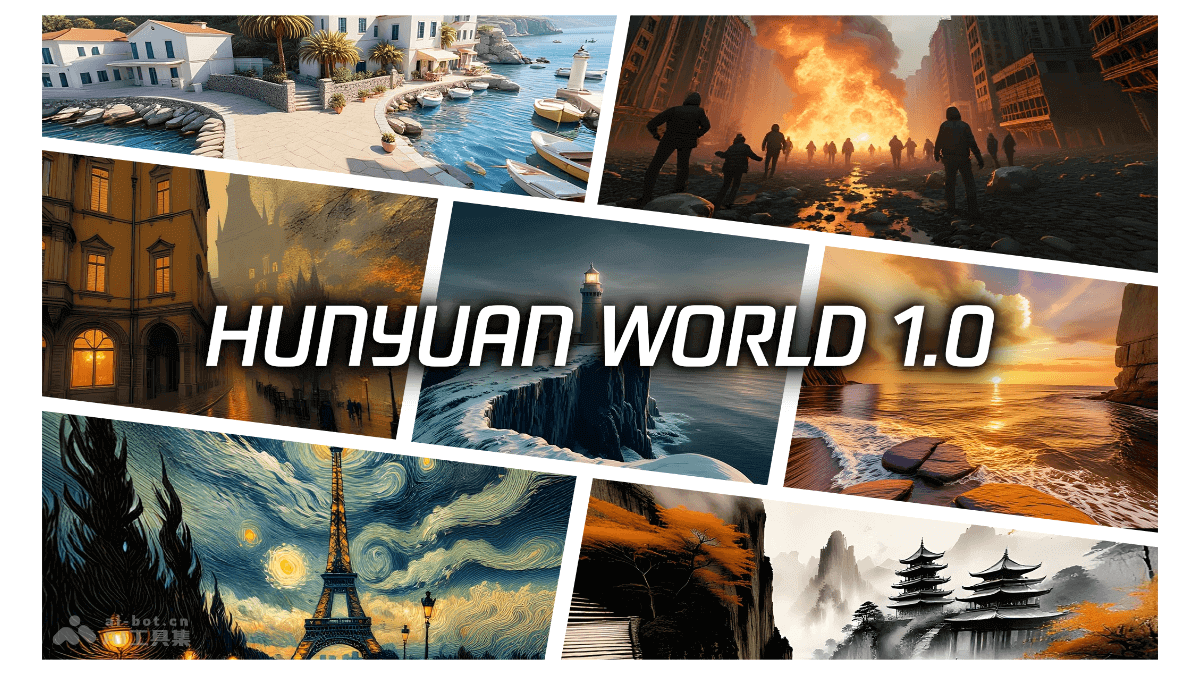
Main Features of Hunyuan 3D World Model 1.0
- One-Click Generation of 360-Degree Panoramic Worlds: Users can quickly generate a complete 360-degree immersive 3D scene through a simple text description or by uploading an image. For example, by inputting "a run-down gas station, raining at night, with neon lights in the distance," the model can construct a complete space containing the main body of the gas station, the environment, sky lighting, lightning, and other elements.
- Roamable and Interactive 3D Worlds: The generated 3D scene not only supports 360-degree viewpoint switching, but also supports users freely roaming within the scene, experiencing an interactive feel similar to games or virtual reality. Users can use the WASD keys to control the character's movement and drag the mouse to switch viewpoints, exploring the generated virtual world.
- Supports Physics Simulation and Secondary Editing: The scenes generated by the model support physics simulation and independent editing. Users can select foreground objects, bind skeletons, or add behavioral logic, and can also replace or personalize the rendering of elements such as the sky and terrain. The generated scenes can be exported as standard Mesh files and seamlessly compatible with mainstream tools such as Unity, Unreal Engine, and Blender, directly usable in scenarios such as game development, film and television special effects production, and educational simulation.
- High-Quality Generation Capability: Hunyuan 3D World Model 1.0 comprehensively surpasses the current SOTA open-source models in aesthetic quality and instruction-following capability for text-to-world and image-to-world generation. It adopts a "semantic hierarchical 3D scene representation and generation algorithm," deconstructing complex 3D worlds into different semantic levels such as foreground, midground, and background to achieve intelligent separation. The generated scenes not only have realistic visual effects, but also possess a high degree of flexibility and scalability.
- Multimodal Input Support: The model supports multiple input methods, including natural language descriptions and image input. Users can choose the appropriate input method according to their needs to quickly generate the desired 3D scene.
Technical Principles of Hunyuan 3D World Model 1.0
- Two-Stage Generation Paradigm
-
Compression and Representation of 3D Worlds (3D-aware VAE):The model first uses a specially designed3D-aware Variational Autoencoder (VAE), to encode complex 3D scene data into low-dimensional but information-dense latent space representations.
-
Diffusion Generation in Latent Space (Diffusion Transformer):After obtaining a high-quality latent space, the model uses aDiffusion Model, whose backbone network adopts the powerfulTransformer architecture (i.e., Diffusion Transformer, DiT)Starting from a random noise latent code, under the semantic guidance of a text or image prompt, the noise is gradually sculpted into a 3D world latent code that meets the user's requirements.Finally, the generated latent code is restored into a concrete 3D world through the VAE decoder.
-
-
Semantic Hierarchical 3D Scene Representation and Generation Algorithm:The algorithm deconstructs complex 3D worlds into different semantic levels, achieving intelligent separation of foreground and background, and ground and sky.It ensures the visual realism of the generated scenes, supports independent editing and physical simulation of elements within the scene, and is compatible with mainstream tools such as Unity, Unreal Engine, and Blender.
-
Powerful Generation Engine (Diffusion Transformer):The model adopts a Diffusion Transformer with approximately 2 billion parameters, whose self-attention mechanism excels at capturing long-range dependencies, ensuring the global consistency of the scene.Through the cross-attention mechanism, the semantic information of text or image prompts is precisely injected into the generation process, achieving precise and controllable generation.
Project Address of Hunyuan 3D World Model 1.0
- Project Official Website:https://3d-models.hunyuan.tencent.com/world/
- Github Repository:https://github.com/Tencent-Hunyuan/HunyuanWorld-1.0
- HuggingFace Model Library:https://huggingface.co/tencent/HunyuanWorld-1
- Official Website Usage:Tencent Hunyuan 3D
Application Scenarios of Hunyuan 3D World Model 1.0
- Game Development: Game developers can quickly generate complete 3D scenes containing elements such as buildings, terrain, and vegetation through simple text instructions or image input.
-
Immersive Visual Space Generation: Ordinary users without modeling experience can quickly generate a 360° immersive visual space with just one sentence or one image through the Hunyuan 3D creation engine.
- Digital Content Creation: The model supports text and image input, and can quickly generate high-quality, diverse-style explorable 3D scenes, suitable for fields such as animation production and film and television special effects.
-
Physical Simulation Support: The scenes generated by the model support physical simulation, and can be used for embodied intelligence simulation, helping robots or agents train in virtual environments.
-
Agent Development: Supports zero-code construction of Multi-Agent, allowing even beginners to get started quickly, and is suitable for building complex agent interaction scenarios.