
What is HunyuanVideo-Avatar
HunyuanVideo-Avatar is a voice-driven digital human model jointly developed by the Tencent Hunyuan team and Tencent Music Lyra Lab. Based on a multimodal diffusion Transformer architecture, it can generate dynamic, emotion-controllable, and multi-character dialogue videos. The model features a character image injection module that eliminates the condition mismatch between training and inference, ensuring character consistency. The Audio Emotion Module (AEM) can extract emotional cues from emotion reference images to achieve emotional style control. The Face-Aware Audio Adapter (FAA) enables independent audio injection in multi-character scenarios. It supports multiple styles, species, and multi-person scenarios, and can be applied to short video creation, e-commerce advertising, and more.
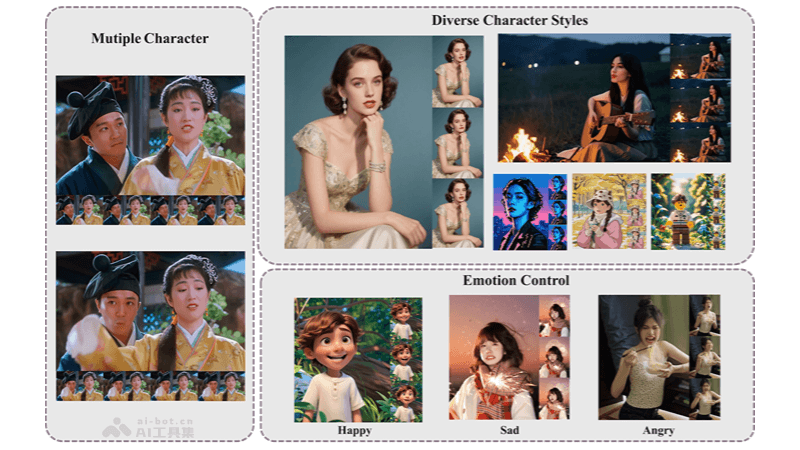
Main Features of HunyuanVideo-Avatar
- Video Generation: Users only need to upload a character image and the corresponding audio, and the model can automatically analyze the emotions in the audio and the environment the character is in, generating a video with natural expressions, lip synchronization, and full-body movements.
- Multi-Character Interaction: In multi-person interaction scenarios, the model can precisely drive multiple characters, ensuring that each character's lip movements, expressions, and actions are perfectly synchronized with the audio, achieving natural interaction and generating dialogue, performance, and other video clips in various scenarios.
- Multi-Style Support: Supports multiple styles, species, and multi-person scenarios, including cyberpunk, 2D anime, and Chinese ink painting. Creators can easily upload cartoon characters or virtual avatars to generate stylized dynamic videos, meeting the creative needs of fields such as anime and gaming.
Technical Principles of HunyuanVideo-Avatar
- Multimodal Diffusion Transformer Architecture (MM-DiT): The architecture can simultaneously process data from multiple modalities, such as images, audio, and text, achieving highly dynamic video generation. Through a "dual-stream to single-stream" hybrid model design, video and text data are first processed independently and then fused, effectively capturing the complex interactions between visual and semantic information.
- Character Image Injection Module: Replaces the traditional additive character conditioning method, solves the condition mismatch problem between training and inference, and ensures the dynamic movement and consistency of characters in generated videos.
- Audio Emotion Module (AEM): Extracts emotional cues from emotion reference images and transfers them to the target generated video, achieving fine-grained control of emotional style.
- Face-Aware Audio Adapter (FAA): Isolates audio-driven characters through latent-level facial masks, enabling independent audio injection in multi-character scenarios, allowing each character to generate independent actions and expressions based on their own audio.
- Spatiotemporal Compressed Latent Space: Based on Causal 3D VAE technology, compresses video data into latent representations and then reconstructs them back to the original data through a decoder, accelerating the training and inference process and improving the quality of generated videos.
- MLLM Text Encoder: Uses a pre-trained multimodal large language model (MLLM) as the text encoder. Compared with traditional CLIP and T5-XXL, MLLM performs better in image-text alignment, image detail description, and complex reasoning.
Project Address of HunyuanVideo-Avatar
- Project Website:https://hunyuanvideo-avatar.github.io/
- Github Repository:https://github.com/Tencent-Hunyuan/HunyuanVideo-Avatar
- HuggingFace Model Library:https://huggingface.co/tencent/HunyuanVideo-Avatar
- arXiv Technical Paper:https://arxiv.org/pdf/2505.20156
Application Scenarios of HunyuanVideo-Avatar
- Product Introduction Video: Enterprises can input prompts based on product features and goals to quickly generate high-quality advertising videos. For example, cosmetics advertisements can showcase product effects and increase brand awareness.
- Knowledge Visualization: Present abstract knowledge in video form to enhance teaching effectiveness. For example, in mathematics teaching, videos of rotating and deforming geometric figures can be generated to help students understand; in Chinese language teaching, the artistic conception of a poet's creation can be presented.
- Vocational Skills Training: Generate simulated operation videos to help trainees master key operating points.
- VR Game Development: Generate realistic environments and interactive scenes in VR games, such as exploring ancient ruins.