
What is Hunyuan3D-PolyGen
Hunyuan3D-PolyGen is the industry's first art-level 3D generation large model launched by Tencent Hunyuan Team. Combined with the self-developed high-compression representation technology (BPT), it can generate complex geometric models with up to tens of thousands of faces, supports triangle faces and quad faces, and meets the needs of different professional pipelines. The model adopts an autoregressive mesh generation framework. Through three steps: mesh serialization, autoregressive modeling, and sequence decoding, it generates high-quality 3D models that conform to art specifications. After introducing a reinforcement learning post-training framework, it improves the stability of generation and art specifications. Hunyuan3D-PolyGen mainly solves the difficulties of topology quality and complex object modeling in 3D asset generation, significantly improving the modeling efficiency of artists, and can be applied to UGC game asset generation.
Main Features of Hunyuan3D-PolyGen
-
High-Quality 3D Model Generation: Can generate complex geometric models with up to tens of thousands of faces, supports triangle faces and quad faces, and meets the needs of different professional pipelines.
-
Improved Modeling Efficiency: After integration into multiple Tencent game pipelines, artists' modeling efficiency increased by over 70%.
-
Adaptive Face Count Allocation: Can adaptively allocate face counts according to geometric structure, achieving better detail representation under low face count conditions.
-
Reinforcement Learning Optimization: Through a reinforcement learning post-training framework, it improves the stability of the generated model and art specifications.
-
Multiple Input Methods: Supports generating 3D models through text prompts or uploaded images, and users can also adjust generation parameters to meet specific needs.
Technical Principles of Hunyuan3D-PolyGen
- Autoregressive Mesh Generation Framework
-
Mesh Serialization: Converts the vertices and faces of a 3D mesh into a Token sequence to represent the Mesh structure. This enables the model to process complex 3D mesh data in a sequence modeling manner.
-
Autoregressive Modeling: Uses point clouds as input Prompt and generates the Token sequence of the Mesh based on an autoregressive model. The autoregressive model gradually constructs the complete 3D mesh structure by predicting Tokens one by one.
-
Sequence Decoding: Decodes the generated Token sequence back into vertices and faces to reconstruct the 3D mesh. This ensures the completeness and accuracy of the generated mesh in geometric structure.
-
- High-Compression Representation Technology (BPT): To solve the problem of expression redundancy in existing mesh autoregressive methods, Hunyuan3D-PolyGen self-developed the high-compression mesh representation technology BPT (Blocked and Patchified Tokenization). Through Block indexing and Patch compression, it greatly reduces the number of Tokens required to represent the same mesh, improving the model's modeling capability for complex meshes.
- Reinforcement Learning Post-Training Framework: To improve the stability of mesh autoregressive generation, Hunyuan3D-PolyGen introduces a reinforcement learning post-training framework. Post-training is performed on the basis of the pre-trained model, and rewards for stable generation and art specifications are designed to guide the model to generate higher-quality results. Reinforcement learning can effectively increase the probability of the model generating "good results" and reduce the probability of generating "bad results," significantly improving the stability of model generation.
- Transformer Architecture: The autoregressive modeling part of Hunyuan3D-PolyGen adopts the Transformer architecture. Through the attention mechanism, Transformer can capture long-range dependencies in mesh data and handle the complex relationships between vertices and faces. The model is divided into two parts: the vertex model and the face model. The vertex model is responsible for generating the vertex sequence of the mesh, and the face model generates the face sequence of the mesh given the vertex sequence.
How to use Hunyuan3D-PolyGen
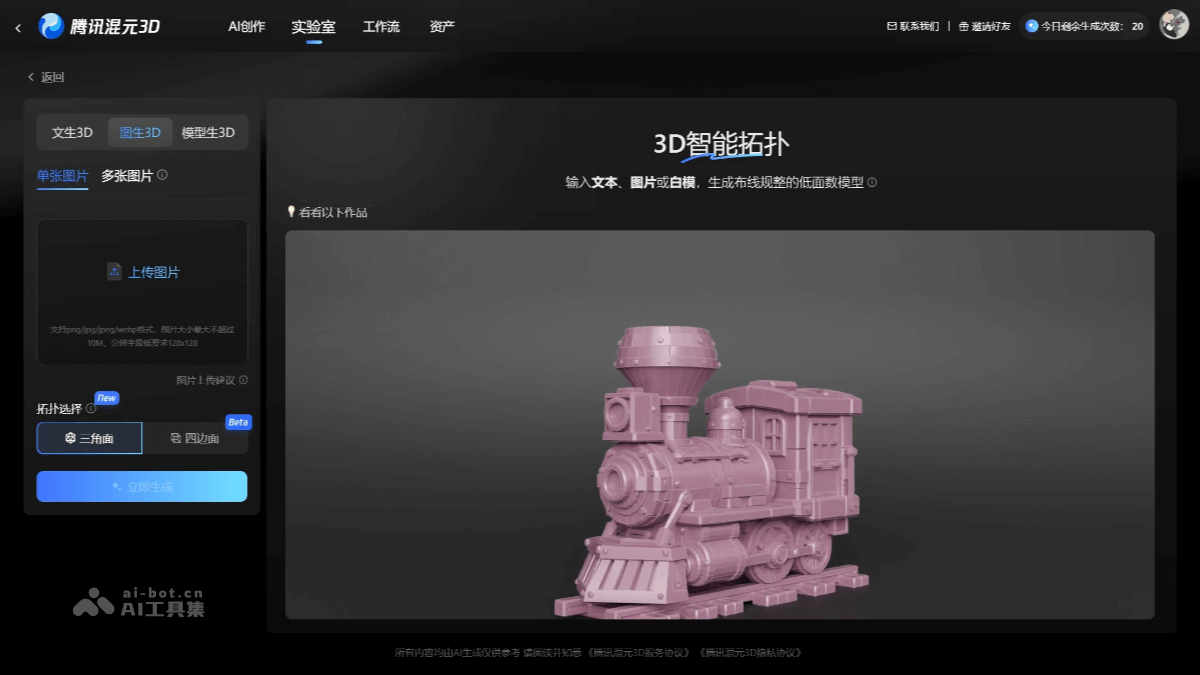
- Access the creation platform: VisitTencent Hunyuan 3D AI creation engine official platform.
-
Feature entry:
-
Select the "3D Smart Topology" feature on the homepage.
-
The "3D Smart Topology" feature in the lab.
-
For the "Text-to-3D" or "Image-to-3D" feature on the homepage, select "staged geometry and texture"; after generating the geometry model, you can select "Smart Topology".
-
- How to use
-
Text-to-3D:
-
Select the "Text-to-3D" feature on the homepage.
-
Enter a text prompt describing the features of the 3D model you want to generate.
-
Click "Generate" and wait for the model generation to complete.
-
-
Image-to-3D:
-
Select the "Image-to-3D" feature on the homepage.
-
Upload an image (an image with a non-transparent background is recommended).
-
Click "Generate", and the model will generate the corresponding 3D model based on the image.
-
-
3D Smart Topology:
-
Select the "3D Smart Topology" feature on the homepage or in the lab.
-
Upload a 3D model file (such as .obj format).
-
The model will automatically optimize the topology structure and generate a higher-quality 3D mesh.
-
-
- Adjust parameters: During the generation process, you can adjust the following parameters:
-
Face count: Adjust the face count of the generated model according to your needs.
-
Texture details: Choose whether to generate texture mapping.
-
GIF animation: Choose whether to generate a GIF animation showing the rotation effect of the 3D model.
-
- View and download results: After generation is complete, you can view the generated 3D model. If needed, you can download the generated model file (such as .obj format) or GIF animation.
Application scenarios of Hunyuan3D-PolyGen
-
UGC game asset generation: Hunyuan3D-PolyGen can quickly generate high-quality 3D models and is suitable for UGC (user-generated content) game development scenarios. Artists can use the model to quickly generate complex geometric models, significantly improving modeling efficiency, with modeling efficiency increased by over 70%.
-
Game scene and character modeling: The model supports generating high-resolution, detail-rich 3D models and can meet the high requirements for scene and character modeling in game development.
-
Virtual scene and prop generation: Hunyuan3D-PolyGen can generate complex geometric models and supports triangles and quads, meeting the high-precision requirements for virtual scenes and props in film and television production.
-
Animation production: By generating high-quality 3D models, the model can provide efficient modeling support for animation production and reduce the time and cost of manual modeling.
-
Product prototype design: Hunyuan3D-PolyGen can quickly generate high-fidelity 3D models, suitable for product prototyping in industrial design, helping designers quickly validate design concepts.
-
Virtual Assembly and Display: The generated 3D models can be directly used for virtual assembly and display, improving design communication efficiency.