
What is Hunyuan3D-Buffalo 1.0
Hunyuan3D-Buffalo 1.0 is a unified 3D multimodal framework launched by Tencent Hunyuan. Through a shared Hunyuan3D-VLM backbone, it integrates 3D question answering, spatial grounding, text-to-3D, instruction editing, and part generation into a single pipeline. The framework supports understanding 3D model structures via natural language, grounding parts, modifying local geometry according to instructions, and extracting semantic-level parts. It aims to close the loop between 3D understanding, generation, and editing, providing a composable 3D asset production solution for games, animation, and industrial design.
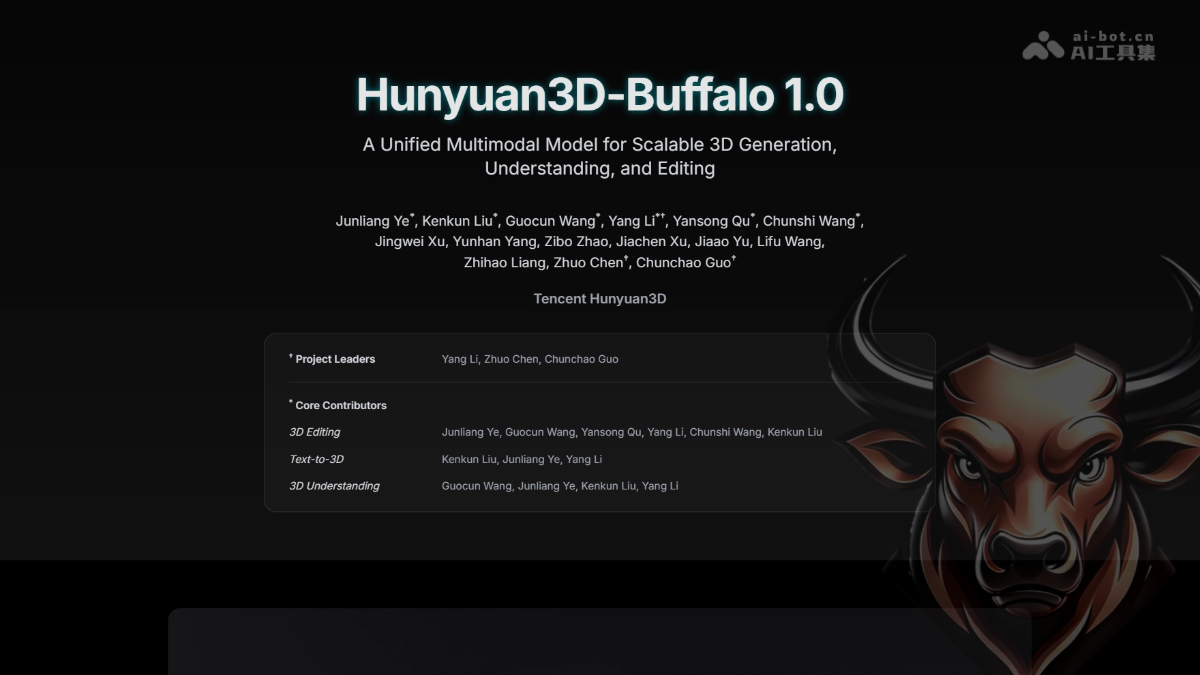
Main features of Hunyuan3D-Buffalo 1.0
-
3D understanding: Supports 3D question answering and spatial grounding, can answer what a model is composed of and ground specific parts.
-
Text-to-3D: Directly generates high-quality 3D assets based on text descriptions.
-
Instruction editing: Replaces, deletes, or redesigns local object structures through natural language.
-
Part generation: Extracts semantic parts from a complete mesh according to language instructions and splits and reassembles them.
-
Unified pipeline: The four types of 3D tasks share the same 3D semantic representation and processing pipeline.
Technical principles of Hunyuan3D-Buffalo 1.0
-
Unified architecture: Uses a shared Hunyuan3D-VLM backbone as the unified understanding foundation for multiple tasks, connecting text, vision, and 3D representations.
-
3D encoding and tokenization: Processes point clouds and normal information through a 3D Encoder, and converts them into unified semantic tokens via a Tokenizer.
-
Generation module: Completes high-quality 3D generation, local editing, and part generation based on the Hunyuan3D DiT module.
-
Multimodal connection: The Connector layer bridges the VLM understanding representation and the DiT generation module to achieve cross-modal alignment.
-
Part semantic parsing: Uses language instructions to drive semantic decomposition of 3D structures, enabling editable part-level representations.
How to use Hunyuan3D-Buffalo 1.0
- Visit the project website: Visit the Hunyuan3D-Buffalo 1.0 official website https://tencent-hunyuan.github.io/Hunyuan3D-Buffalo1.0/ to browse the technical architecture and feature demonstrations.
- Try instruction editing: In the "Instruction-Guided 3D Editing" section, select a preset case and enter a natural language instruction to view the comparison between the source model and the edited model.
- Browse generated assets: Go to the "Generated 3D Assets" page to view text-to-3D results and click "View details" to learn about the text description and geometric details of each asset.
- Test part extraction: In the "Part-Extraction with Language" module, enter a part description instruction and switch between the "Combined" and "Exploded" views to see the overall mesh and the split parts.
Core advantages of Hunyuan3D-Buffalo 1.0
-
Task unification: Integrates understanding, generation, editing, and part splitting into a single framework, avoiding switching between multiple models.
-
Local editing: Supports semantic-level local modifications while keeping the overall geometric structure unchanged, improving asset reuse.
-
Part semanticization: Can understand and extract semantically meaningful parts, fitting real production workflows.
-
Language-driven: The entire process is interactive through natural language, lowering the professional barrier to 3D creation.
-
Composable production: Generated parts can be independently edited and recombined, adapting to the iterative needs of game and industrial design.
Project address of Hunyuan3D-Buffalo 1.0
- Project official website:https://tencent-hunyuan.github.io/Hunyuan3D-Buffalo1.0/
Comparison of Hunyuan3D-Buffalo 1.0 with similar competing products
| Dimension | Hunyuan3D-Buffalo 1.0 | Meshy-4 |
|---|---|---|
| Core positioning | Unified 3D multimodal framework (understanding + generation + editing) | Focuses on AI 3D generation and texture tools |
| Editing capability | Supports local structural editing via natural language instructions | Mainly provides overall generation and basic editing |
| Part processing | Semantic-level part extraction, splitting, and recombination | Mainly focuses on overall model generation, with limited part-level capability |
| Understanding capability | Has 3D question answering and spatial grounding capabilities | No native 3D understanding question answering function |
| Workflow | Part-level composable production, suitable for iteration | Tends toward one-time generation of complete assets |
Application scenarios of Hunyuan3D-Buffalo 1.0
-
Game asset iteration: Retain the confirmed character or prop body, and modify only local equipment or parts according to planning instructions.
-
Animated character editing: Replace character clothing, weapons, or expression parts according to director feedback, without remodeling.
-
Industrial product design: Adjust the local structure of mechanical parts as needed, and quickly validate multiple version plans.
-
3D content review: Automatically understand model composition and locate parts, assisting in checking compliance and structural completeness.
-
Educational demonstration: Analyze 3D model structures through natural language question answering, assisting teaching demonstrations and knowledge explanation.