
What is Hume AI
Hume AI is an AI product focused on developing technology that can understand human emotions and expressions, providing real-time, customizable voice intelligence APIs. Its flagship product, Hume EVI, is the world's first empathic AI voice interface. EVI combines the language understanding of large language models with the emotion perception capabilities of expression measurement technology, enabling it to understand and respond to user emotions and provide a realistic conversation experience. Hume AI's technology allows developers to easily integrate emotionally intelligent AI into applications, suitable for fields such as healthcare, AR/VR, and customer service, using technology to improve human emotional experience and well-being.
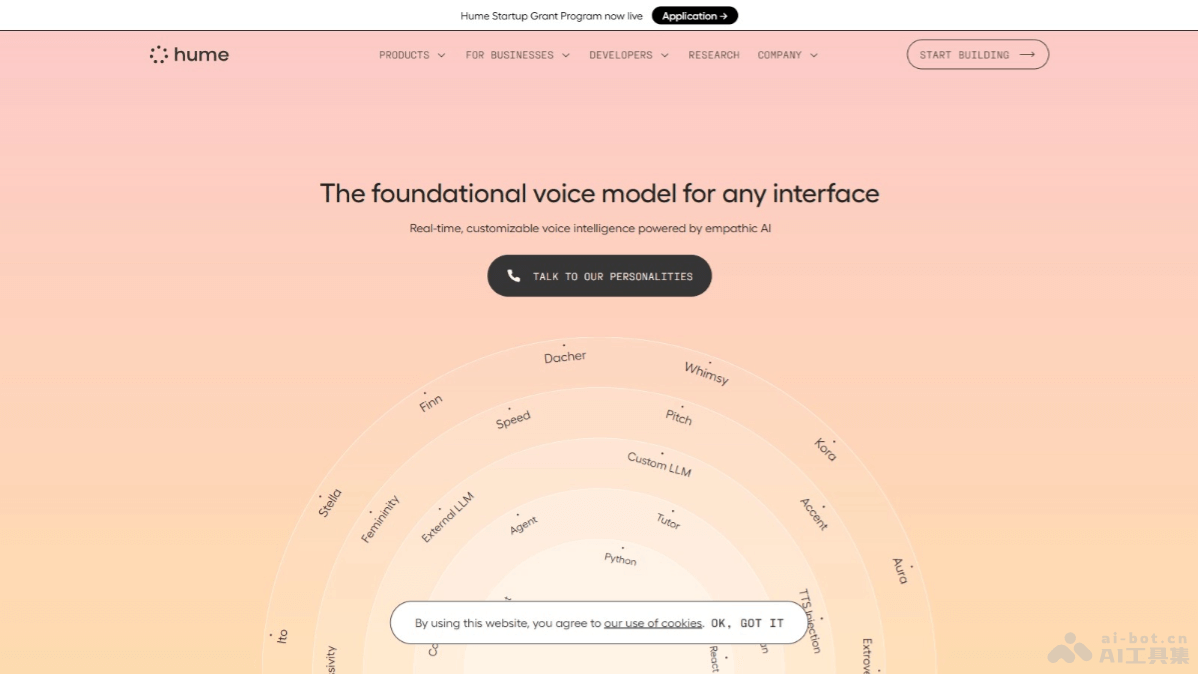
Hume AI's main features
- Emotion recognition and response: Based on analyzing speech and facial expressions, it recognizes users' various emotional states and gives corresponding responses according to their emotions.
- Emotion simulation: Simulates different emotional states to interact with users more vividly.
- Natural conversation: Conversation latency is short, and it can use filler words in conversation, like a real person thinking and listening.
- Emotion visualization: During the conversation, it displays emotion curves in real time, visually showing emotional changes in the conversation.
- Design synthetic voices and personalities: Hume AI provides tools that support users in adjusting EVI 2's base voice, including multiple continuous scales such as femininity, nasality, and pitch.
Hume AI's emotional expression
- Speech prosody: Hume AI can detect more than 25 patterns of tune, rhythm, and timbre, injecting complex, mixed meanings into everyday speech. The emotions it can recognize include amusement, anger, embarrassment, boredom, calmness, confusion, contempt, desire, determination, distress, fear, guilt, horror, pain, pride, sadness, surprise, and tiredness, etc.
- Vocal expression: Distinguishes 28 vocal expression styles considered to convey different meanings and the multiple ways they are mixed together. These include admiration, amusement, anger, awe, confusion, contempt, contentment, desire, disappointment, disgust, distress, ecstasy, embarrassment, excitement, fear, horror, interest, joy, pain, realization, relief, sadness, surprise, sympathy, tiredness, etc.
- Voice call types: Infers the probability of 67 descriptors (such as "laugh," "sigh," "scream," "oh," "ah," "um," etc.) to explore vocal expression.
- Expressions: Distinguishes 37 facial movements considered to convey different meanings and the multiple ways they are mixed together. These include admiration, adoration, aesthetic appreciation, anger, anxiety, awe, calmness, contempt, contentment, craving, desire, determination, disappointment, distress, doubt, ecstasy, embarrassment, empathic pain, entrancement, envy, excitement, fear, etc.
- Facial expression action capture: Improved automated Facial Action Coding System (FACS): measures 26 facial action units (AUs) and 29 other features, with even less bias than traditional FACS.
- Dynamic response: Measures dynamic patterns of facial expressions over a period of time, correlated with more than 20 different reported emotions. These include admiration, adoration, aesthetic appreciation, amusement, anxiety, awe, boredom, calmness, concentration, contemplation, confusion, contentment, craving, disgust, distress, empathic pain, envy, excitement, fear, guilt, horror, interest, joy, love, etc.
Hume AI's official website address
- Official website address:hume.ai
Hume AI's application scenarios
- Customer Service and Call Centers: Provide more humanized customer support, understand customers' emotions to deliver more effective service.
- Health and Wellness: In mental health assessment and intervention, assist in identifying patients' emotional states and provide corresponding emotional support.
- Education and Training: As a virtual teaching assistant or teacher, adjust teaching methods based on students' emotional responses to provide personalized learning experiences.
- Entertainment and Gaming: In video games and virtual reality (VR) experiences, provide more realistic and immersive interactive experiences.
- Smart Home and Internet of Things (IoT): Integrate into smart home devices to understand and respond to users' emotions and provide more personalized home management.