
Today I'm sharing some things that are good for removing the AI flavor.
Usually when you have AI write an article, right off the bat it's "it's not... but rather...", "it's worth noting that", "from multiple dimensions", "this marks", "this shows that..." The meaning may be on point, but it always feels like customer service writing a year-end summary.
Today I specifically found a few de-AI-flavor projects on GitHub for everyone. Once you install them, you'll find that what AI writes has a bit of a human touch.

Follow on WeChat and reply "open source" to join theAI Open Source Project Exchange Group
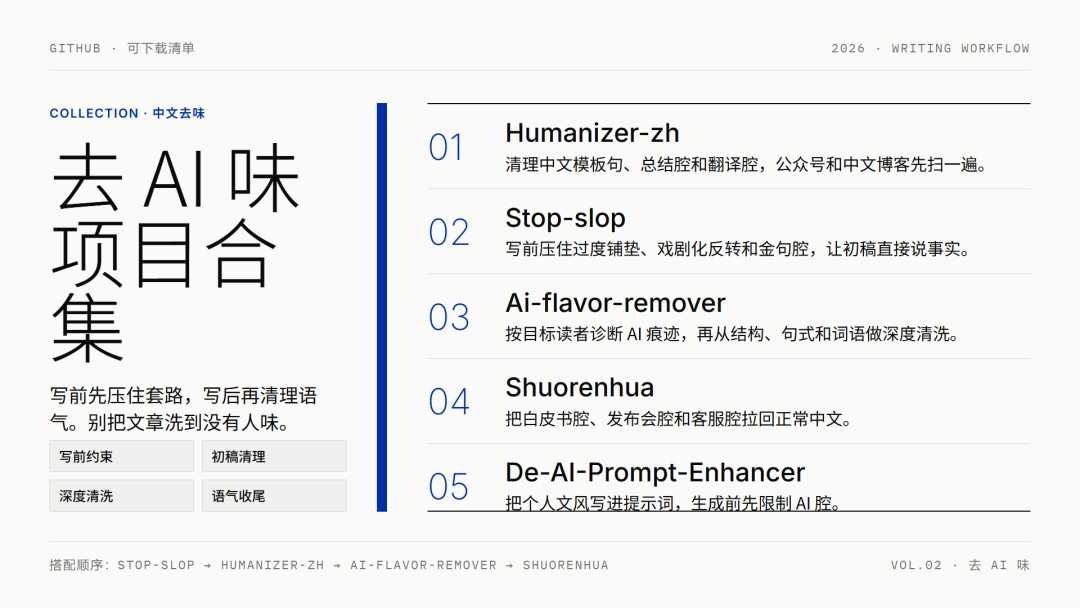
01. Humanizer-zh
Humanizer-zh is a Chinese de-AI-flavor tool made by Teacher Guicang, suitable for WeChat official accounts, Zhihu answers, Chinese blogs, and long technical articles.
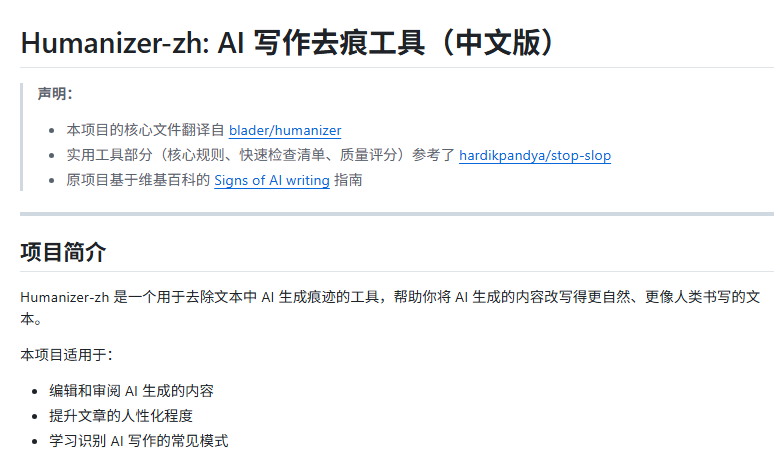
Humanizer-zh prioritizes handling template sentences, summary tone, and translationese in Chinese. For example, AI loves to write "this shows the important value of AI tools in content creation"; Humanizer-zh tends to change it to "it can save you from getting stuck for a while when writing a first draft, and that's practical enough." It pulls the focus of the sentence from the abstract back to the concrete.
Especially after using AI to finish a first draft, if you don't want to revise sentence by sentence but are afraid it will look obviously AI-generated once published, first let Humanizer-zh scan it. After deleting empty talk, adding some of your own subjective feelings will make it much better.
Project address:https://github.com/op7418/Humanizer-zh
02. Stop-slop
Stop-slop's main function is to make AI use fewer dramatic reversals, less excessive buildup, and fewer punchy lines.
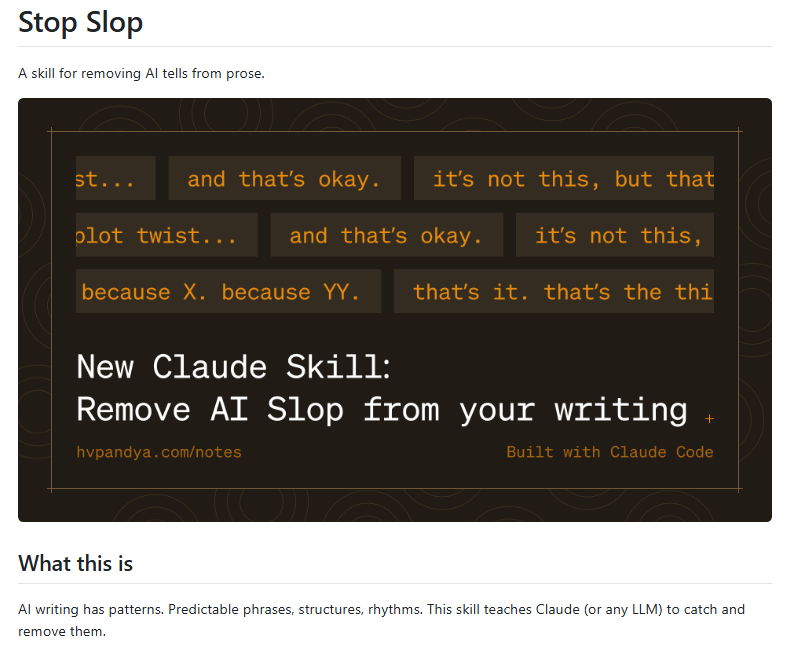
But one thing to mention is that Stop-slop won't make AI-generated articles more beautiful; it will only require the model to say less nonsense and directly state people, actions, facts, and results.
So stop-slop is best used as a basic rule. Whether writing articles, product copy, or blogs, first have the model write according to this set of rules, then manually optimize the copy as a whole, and there won't be an AI flavor.
Project address:https://github.com/hardikpandya/stop-slop
03. Ai-flavor-remover
Ai-flavor-remover handles stacked long sentences, empty adjectives, mechanical transitions, summary tone, and overly formal words.
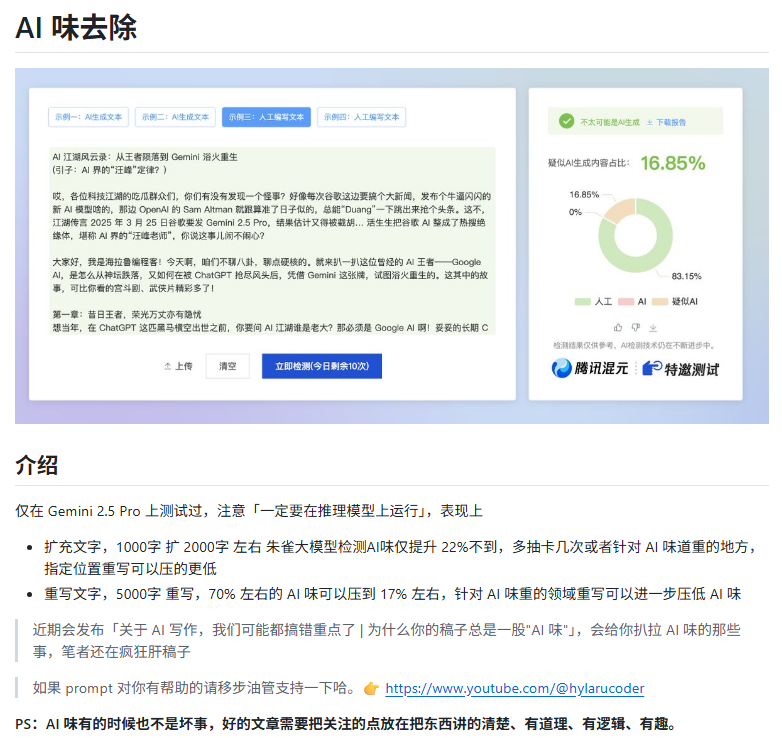
Ai-flavor-remover is a set of Chinese de-AI-flavor prompts, suitable for revising Chinese long articles, WeChat official account drafts, speeches, reading notes, and product introductions.
Ai-flavor-remover will understand the original text's goals and readers, then diagnose sentences with a strong AI flavor, then handle structure, sentence patterns, wording, details, and redundancy, and finally output "AI Feature Analysis," "Optimization Strategy," "Optimization Highlights," and "Optimized Article."
It is recommended to clean each article multiple times. The first time do an overall cleanup, and after the second time rewrite the paragraphs with the strongest AI flavor. The effect will be better.
Project address:https://github.com/hylarucoder/ai-flavor-remover
04. Shuorenhua
Shuorenhua does what its name says: make AI speak like a human.
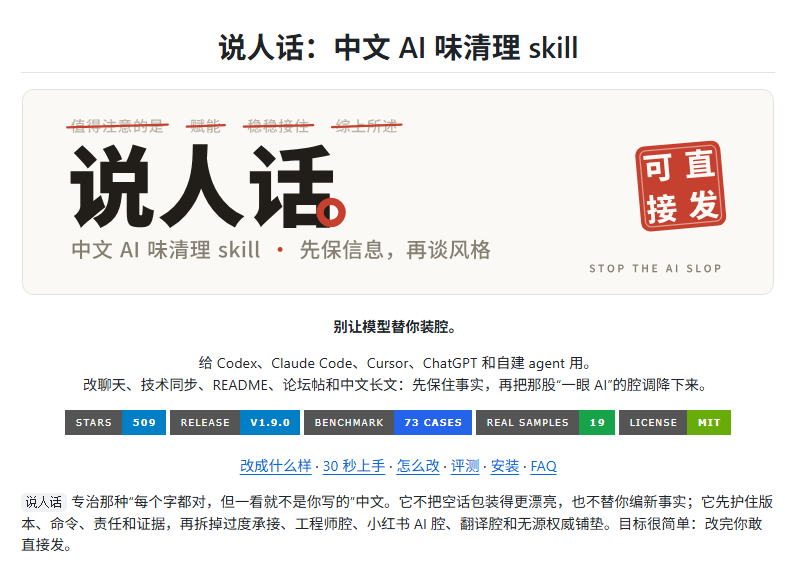
AI talks very pretentiously, I believe everyone has experienced this deeply (not sure if it's because it consumed too much data from a certain Q&A site). Technical articles like to pretend to be white papers, product articles like to pretend to be launch events, and chat replies like to pretend to be customer service.
Shuorenhua is specifically for treating these, making the tone of articles more appropriate. It has a wide range of applications and can be used for articles, READMEs, issue replies, technical explanations, and project introductions.
Project address:https://github.com/MrGeDiao/shuorenhua
05. De-AI-Prompt-Enhancer & Writer Booster SKILL
De-AI-Prompt-Enhancer & Writer Booster SKILL is a Chinese de-AI-flavor prompt enhancement package, based on Humanizer-zh with stronger style constraints.
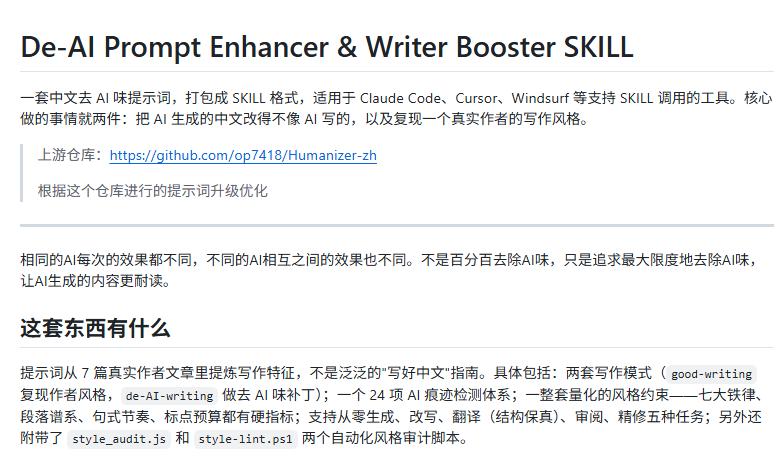
The project is divided into two modes: good-writing is used to reproduce a real author's style, and de-AI-writing is used to apply de-AI-flavor patches to non-first-person content.
The project provides 24 AI trace detection checks, seven major writing iron rules, paragraph genealogy, sentence rhythm, punctuation budget, and also comes with an automated style audit script.
It is suitable for writers who want to solidify their personal writing style into a Skill, and also for secondary refinement of Chinese long-form articles, translated manuscripts, and review manuscripts.
Project address:https://github.com/OUBIGFA/De-AI-Prompt-Enhancer-Writer-Booster-SKILL
06. How to use them together
When using them, do not use all of these together, otherwise after all the washing, the article will indeed no longer have an AI flavor, but it will also no longer have a human flavor.
First use Stop-slop to impose constraints on the underlying first draft; after the first draft is written, use Humanizer-zh for the first round of cleanup; if the first draft has a particularly strong AI flavor, then use Ai-flavor-remover for deep cleaning; finally use Shuorenhua to adjust the tone.
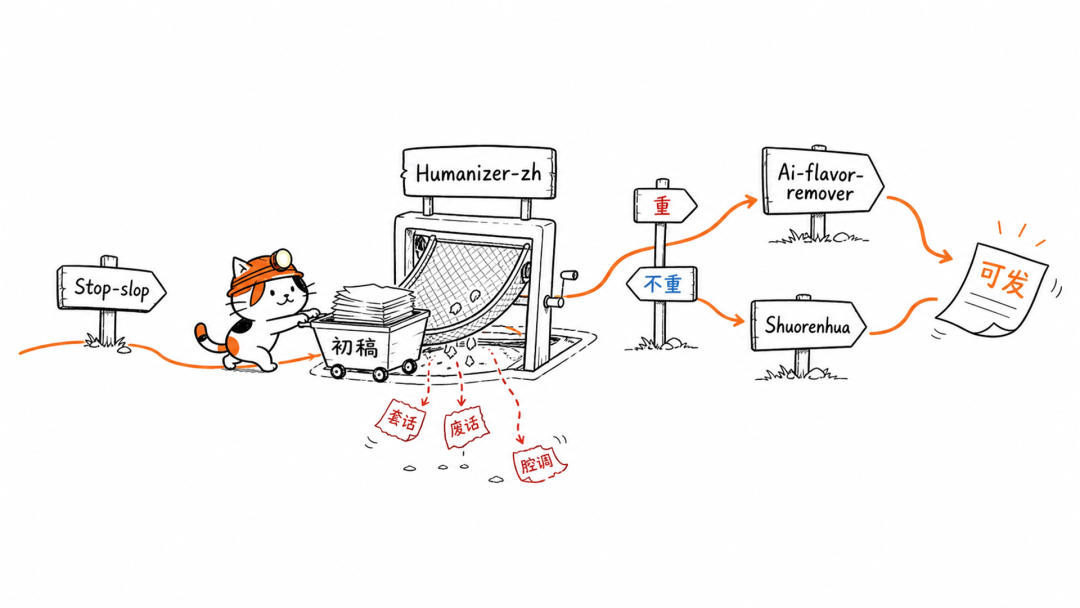
If you want to fix your own writing style over the long term, you can use De-AI-Prompt-Enhancer & Writer Booster SKILL when generating the first draft. In this way, each time the first draft is generated, the model will first move closer to your personal writing style.
07. Dig a little deeper
Removing the AI flavor表面上 is about making sentences read more like something a person wrote, but in fact it is about solving the credibility problem of content after AI writing enters the workflow.
Companies like Originality.ai,GPTZero, Winston AI, and Turnitin are all working on AI detection, proof of writing process, plagiarism checking, and content quality review.
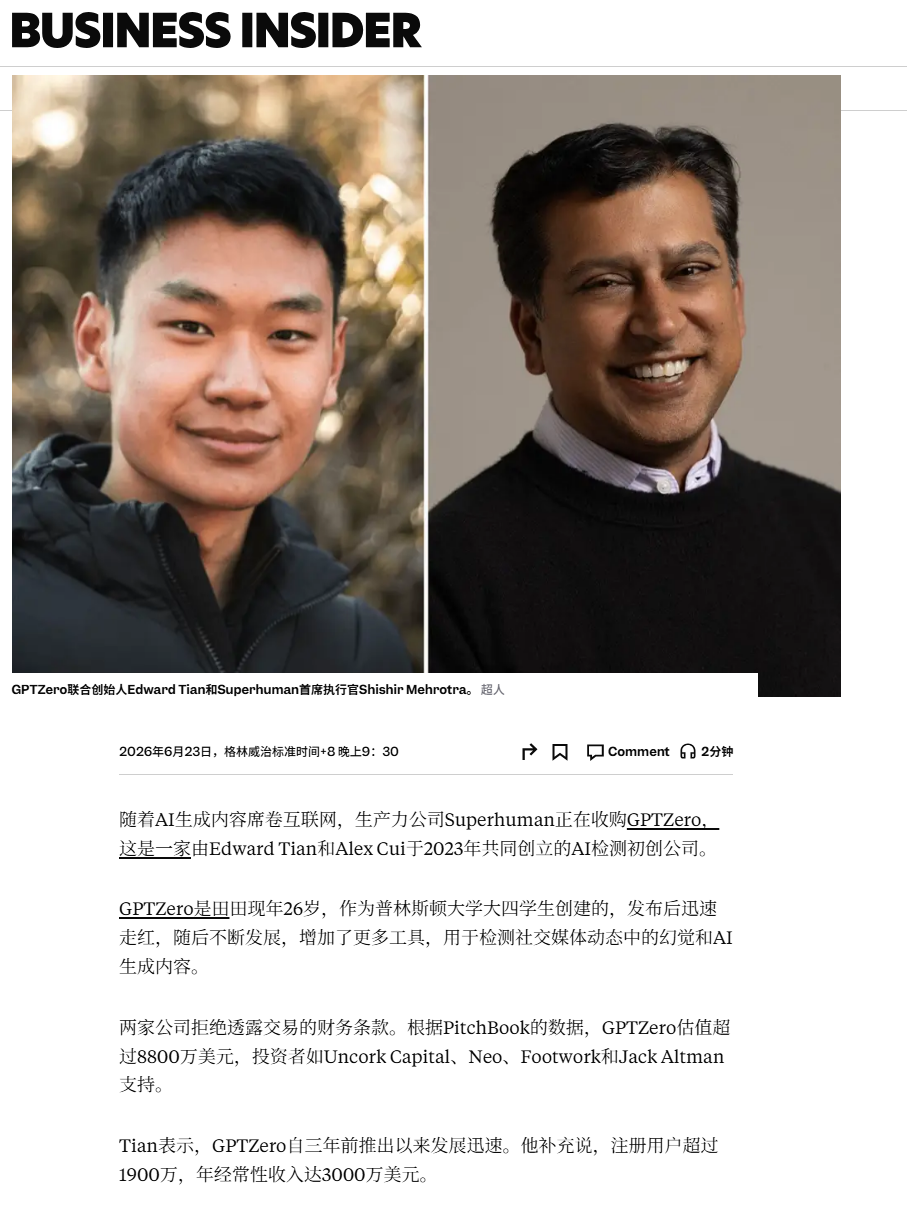
GPTZero has already been used by more than 3,500 universities and hundreds of institutions; Business Insider reported that GPTZero has more than 19 million registered users and has reached 30 million dollars in annual recurring revenue.
These tools allow content teams to publish large numbers of manuscripts every day without having the tone of their accounts worn flat by the same set of sentence patterns; marketing and cross-border teams can use AI to directly produce drafts and save a large amount of time from repetitive work.
The value of these open-source de-AI-flavoring methods today is not in teaching people to evade detection, but in pushing AI first drafts to a state where they can be read, published, and stood behind.
Original link:Recommended 5 practical de-AI-flavoring Skills, no longer held hostage by high AI rates