
What is HUGWBC
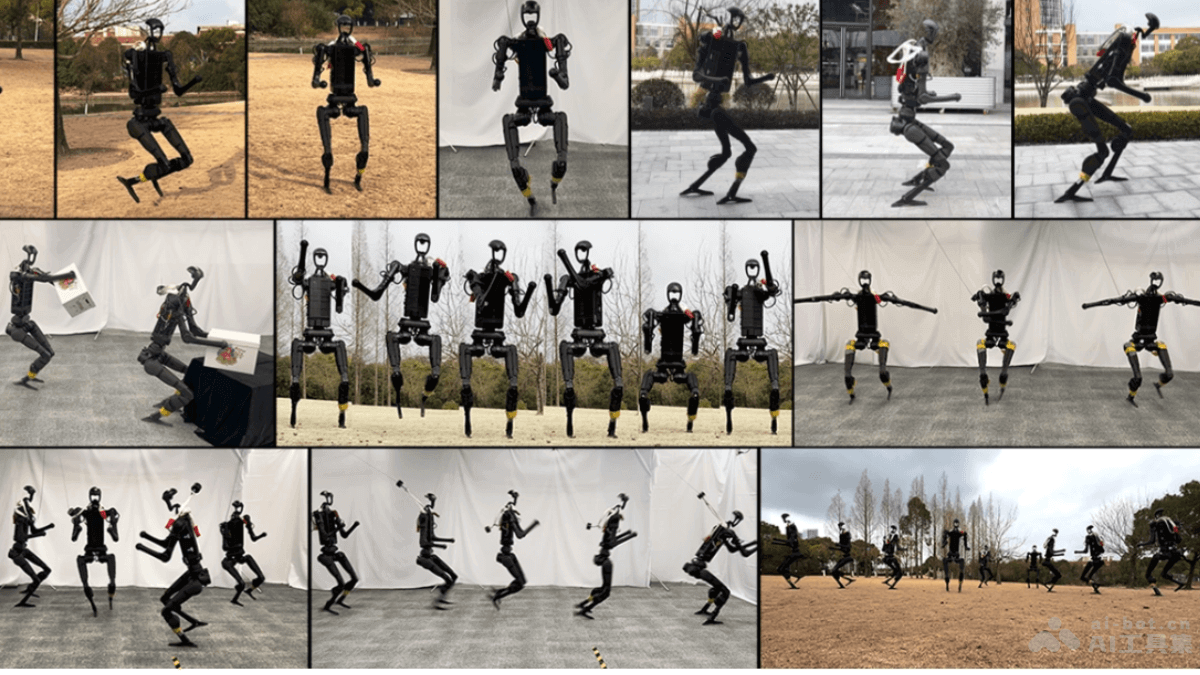
HUGWBC (Humanoid Unified and General Whole-Body Controller) is a humanoid robot whole-body controller jointly launched by Shanghai Jiao Tong University and Shanghai AI Lab, capable of achieving fine motion control. HUGWBC is based on an extended command space and advanced training techniques, enabling the robot to execute multiple natural gaits (such as walking, running, jumping, standing, and one-legged hopping), and supports real-time external upper-limb control signals to achieve complex motion manipulation tasks. HUGWBC is trained with reinforcement learning in a simulated environment, and uses an asymmetric training framework (AAC) to transfer the policy directly to the real robot.
Main Features of HUGWBC
- Supports Multiple Gaits: Supports controlling the robot to execute multiple gaits such as walking, running, jumping, standing, and one-legged hopping.
- Fine Parameter Adjustment: Supports adjusting parameters such as gait frequency, foot swing height, body height, waist rotation, and body pitch angle to adapt to different task requirements.
- Real-Time External Intervention: Supports real-time external control signals for the upper limbs (such as teleoperation or motion retargeting), allowing the robot to perform complex operations while executing motion tasks.
- High Robustness and Adaptability: HUGWBC can adapt to different terrains and external disturbances, maintaining stability and precision of motion.
Technical Principles of HUGWBC
- Extended Command Space: A general command space containing task commands and behavior commands is designed to flexibly control the robot's motion and posture.
- Reinforcement Learning Training: Based on reinforcement learning (especially the PPO algorithm), the control policy is trained in a simulated environment, and a reward function is defined to optimize the robot's motion performance.
- Asymmetric Training Framework: An asymmetric training framework (AAC) is adopted, where the critic network accesses all privileged information, while the actor network uses only sensor data available on the real robot, improving the generalization ability of the policy.
- Symmetry Loss: A symmetry loss function is introduced to encourage the policy to generate natural and symmetric motions, improving the stability and efficiency of motion.
- Intervention Training: External intervention signals are introduced during training to adapt to real-time control of the upper limbs while maintaining the stability and precision of lower-limb motion.
- Foot Trajectory Planning: A quintic polynomial trajectory planning method is used to ensure smooth motion of the foot during the swing phase, improving the naturalness and stability of motion.
Project Address of HUGWBC
- Project Official Website:https://hugwbc.github.io/
- arXiv Technical Paper:https://arxiv.org/pdf/2502.03206
Application Scenarios of HUGWBC
- Complex Terrain Navigation: Controls humanoid robots to walk, run, and jump on uneven terrain, adapting to various complex environments such as rugged mountain roads, ruins, or construction sites, and performing search and rescue tasks.
- Dynamic Task Execution: Supports robots in performing highly dynamic tasks such as fast running, jumping, and one-legged hopping, playing a role in scenarios requiring rapid response and high maneuverability, such as sports event assistance or emergency response tasks.
- Human-Robot Collaboration Tasks: Based on the real-time external upper-limb intervention function, enables humanoid robots to collaborate with human operators to complete complex tasks such as carrying, assembly, or fine manipulation, improving work efficiency and safety.
- Service Robot Applications: In home or service settings, enabling humanoid robots to perform daily tasks such as cleaning, moving objects, or assisting the elderly and people with disabilities, providing more natural and flexible services.
- Scientific Research and Development: Developing and testing new motion control algorithms, human-robot interaction technologies, and robot perception capabilities to promote the further development of humanoid robot technology.