
Introduction
With the continuous advancement of artificial intelligence technology, more and more people hope to use AI tools to improve work and study efficiency. Especially in the fields of programming, data analysis, and visualization, AI assistance makes many previously complex tasks much simpler. Most beginners do not know how to give accurate instructions to AI to obtain the expected results. A prompt is like a bridge between humans and AI; only by communicating correctly can AI's maximum capability be brought into play. This report will focus on how to write prompts so that AI can help you execute code, perform data analysis, and generate charts. It will unfold step by step in easy-to-understand language, from "What is a prompt" to "How to put it into practice," and then to the principles behind it and future trends, providing a comprehensive and systematic introduction. This will benefit AI beginners with zero foundation and workplace professionals who want to quickly master practical skills.

Basic Concepts
What Is a Prompt?
A prompt is an instruction or cue word. When interacting with AI, a prompt is the sentence or paragraph in which we tell AI "what you should do." A prompt is natural language; based on natural language, AI understands user needs and generates corresponding content, including writing code, answering questions, and creating charts. You can imagine it as entrusting an intelligent assistant to help the user complete a task; the clearer the instruction, the more accurately the assistant completes it. A prompt is similar to a bridge for human-computer communication, and how well it is written greatly affects the quality of the result.
Basic Concepts of Code Execution, Data Analysis, and Chart Creation
- Code execution: Let AI write a complete, runnable program for completing specified functions such as calculations, automation, and data processing.
- Data analysis: Calculate and process collected data, summarize characteristics, discover patterns, and make predictions.
- Chart creation: Visualize data, using graphics to make numbers more intuitive and easier to understand and compare.
AI technology combined with prompts can quickly turn task descriptions expressed as language instructions into code, enabling automatic generation and rapid iteration.
The Relationship Between AI and Prompts
AI models cannot "read" the deep meaning of human language; they generate text by recognizing language patterns and probabilities. A prompt is the key that activates the model and indicates the direction of the task. Concise and clear prompts can improve the precision and perfection of the model's output, while vague and chaotic prompts easily produce off-topic or irrelevant content.
How to Write Good Prompts
Basic Principles of Prompt Writing
- Clear and explicit: Use concise language to explain the specific content you want AI to complete, and avoid vague words.
- Specific goal: The more detailed the task, the more the result meets expectations.
- Provide context: Help AI understand the background and improve completion quality.
- Step-by-step output: For complex tasks, clear segmented instructions make it easier for AI to generate content step by step.
- Try adjustments: Try multiple prompt versions and optimize the input based on the answers.
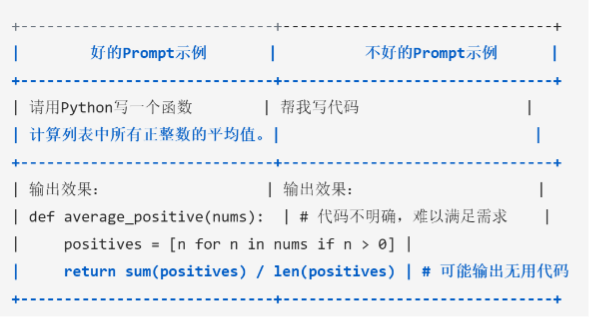
- Example prompt: Using "Please use Python to write a function that calculates the sum of squares of all numbers in a list" is more effective than "write code."
Prompt Writing Examples
Prompt Example for Executing Code
When AI writes code, it needs to include the following information: language (Python, JavaScript, etc.), function description (what algorithm or function to implement), and input/output details.
For example:
- "Please write a function in Python that calculates the average of all positive numbers in a list of integers and returns the result."
- Based on this Prompt, the AI will generate code that incorporates your requirements and implements the functionality.
Prompt example for data analysis
A data analysis Prompt should contain the following elements: a description of the data file or data source, the metrics to be counted or calculated (mean, median, standard deviation, etc.), and special requirements (handling missing values, data filtering, etc.).
For example:
- "Help me use pandas to read the csv file 'sales.csv', calculate the total sales for each product, exclude missing values, and output the top five products by sales."
Prompt example for chart generation
A chart creation Prompt should include: determining the chart type (bar chart, line chart, pie chart, etc.), explaining the data structure and specific values, and specifying the chart title, axis labels, etc.
For example:
- "Use matplotlib to draw a line chart, with the X-axis being the years 2018-2022 and the Y-axis being the annual sales, titled '5-Year Sales Trend'."
Common pitfalls
- Incomplete instructions, making the AI "guess" the requirements, resulting in inaccurate results.
- The Prompt is too long and contains a large amount of irrelevant description, which instead makes it difficult for the model to grasp the key points.
- Confusing multiple tasks by asking several questions at once; it is recommended to split them into independent Prompts.
- Ignoring the input and output descriptions, so the model does not understand the data structure and it is difficult to achieve precise processing.
Analysis of the principles behind Prompt writing
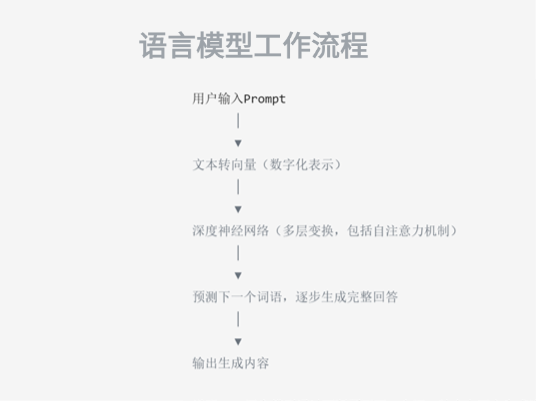
Understanding how to construct a Prompt requires exploring the working principles behind it. Why are some Prompt structures more effective than others? This is closely related to the underlying architecture and working mechanisms of large language models.
Transformer and attention
Modern mainstream LLMs (such as the GPT series) are all based on the Transformer architecture. The core innovation is the self-attention mechanism (Self-Attention). When the model processes a Prompt, it does not understand it word by word in isolation; it needs to calculate the relevance weights between each word (Token) in the Prompt and all other words.
- For code generation: When a Prompt such as "Use Python to write a function to calculate the Fibonacci sequence" is provided, the keywords "Python", "function", "calculate", and "Fibonacci sequence" receive very high attention weights. The model prioritizes retrieving code patterns and syntax structures from the training data that are strongly related to the high-weight vocabulary.
- For data analysis: When the Prompt contains words such as "Pandas", "DataFrame", "groupby", and "mean", the attention mechanism guides the model to focus on knowledge related to Pandas library data aggregation operations. Providing column names (such as 'Sales', 'Category') as context allows the model to associate general operations with specific data structures.
Context Window and In-Context Learning
LLMs have a fixed context window, the length of text they can process at one time (measured in Tokens). All input content—role-playing, instructions, data samples, examples—is within the window. The model generates the next Token based on all the information within the window.
In-Context Learning is a capability of LLMs. Without retraining the model, simply by providing a few examples in the Prompt (Few-Shot Prompting), the model can learn new patterns for solving similar problems.
The importance of Chain-of-Thought (CoT)
For complex tasks involving multi-step reasoning (such as multi-step data transformation or building machine learning pipelines), directly asking for the final answer will cause the model to make mistakes. Chain of Thought (CoT) requires the model to "think out loud" to solve this problem.
Prompt example:
- Bad Prompt: "Give me an analysis report."
- Good CoT Prompt: "Generate a sales data analysis report for me. Please think and output by following these steps:
- Describe the process of data loading and cleaning.
- Perform descriptive statistics and summarize the key findings.
- Analyze the sales performance of each product category.
- Summarize your findings and propose two business recommendations.
Instruction Tuning and Role-Playing
Modern LLMs have all undergone instruction tuning, that is, after large-scale general-corpus pretraining, they are fine-tuned with a large number of "instruction-answer" pairs. This enables the model to better understand and follow users' instructions.
Role-playing (for example, "You are a data scientist") activates a specific "expert" persona that the model learned during the instruction tuning stage. During training, the model has seen a large amount of text and code written by data scientists. By playing the role of a scientist, the model adjusts the style, terminology, and code patterns of its output, making the answer more consistent with the professional standards of the relevant field. Explicitly specifying the tech stack (such as Python, R, JavaScript, D3.js, Plotly, etc.) can play a similar role, helping the model narrow its search scope and focus on the relevant libraries and syntax.
Practical Application Scenarios
- Personal learning and programming assistance: Beginners use Prompt assistance to quickly obtain code examples, understand algorithm ideas and syntax, and improve programming efficiency.
- Enterprise data analysis automation: Express simple analysis requirements with Prompts to automatically generate statistical scripts and charts, saving analysis time and labor costs.
- Rapid generation of reports and visualizations: Marketing and sales teams use Prompts to quickly draw trend charts and pie charts, improving the quality and readability of reports.
- Programming education and training scenarios: Teachers let students complete step-by-step programming learning through Prompts, strengthening operational memory and understanding.
- Other creative applications: In fields such as content creation, decision support, and scientific research data processing, Prompts have shown great potential.

Future Outlook
The development prospects of Prompt technology are broad and full of potential. As model architectures and training algorithms continue to be optimized, AI's understanding of natural language will become more precise and intelligent, further lowering the threshold for writing Prompts, so that users without a professional background can also easily manipulate complex tasks. The rise of multimodal AI will enable seamless interaction among text, sound, images, and even code, expanding the boundaries of Prompt applications and bringing unprecedented release of creativity. The emergence of automatic Prompt optimization tools will assist users in quickly generating high-quality instructions and improve interaction efficiency. The deep integration of commercial software and educational platforms will give rise to more customized intelligent solutions and popularize the use of intelligent assistance. Discussions about privacy protection, algorithmic fairness, and ethics are becoming increasingly important, and standardization will become an important direction of technological evolution. Prompt is the entry point for AI innovation and also a bridge for future intelligent human-computer collaboration. Users who master the ability to write Prompts will become pioneers leading change in the digital age.