
Natural language processing (NLP) is a branch of artificial intelligence that enables computers to understand, interpret, and generate human language. Through a series of techniques, such as tokenization, part-of-speech tagging, named entity recognition, word embeddings, machine translation, and sentiment analysis, combined with algorithms ranging from traditional statistical methods to modern deep learning models (such as BERT, the GPT series, and large language models, LLMs), interaction with human language is achieved.
What is natural language processing?
Natural Language Processing (NLP) is a key branch of the fields of artificial intelligence (AI) and computer science. Its core goal is to enable computers to understand, interpret, manipulate, and ultimately generate human language.
It breaks down the language barrier between humans and machines, enabling computers to process and analyze the language we use, whether text or speech, as humans do. NLP technology combines computational linguistics (rule-based modeling of human language) with methods such as statistical modeling, machine learning (ML), and deep learning, enabling computers and digital devices to recognize and understand the meaning of text and speech and generate natural language output.
For example, smart suggestions in search engines, intelligent voice assistants (such as Siri and Alexa), machine translation, and intelligent customer service all rely on the support of NLP. NLP research has also driven the arrival of the era of generative AI, enabling large language models (LLMs) to communicate fluently and image generation models to understand text requests.
The scope of NLP research covers many aspects, from basic text analysis and information extraction to more advanced machine translation, question-answering systems, and more. It focuses on how to enable computers to "read" text and how to enable computers to understand the meaning, sentiment, and intent behind the text. For example, in intelligent customer service scenarios, NLP technology needs to understand the questions users ask, analyze their emotions, and give appropriate replies. In machine translation, NLP needs to understand the sentence structure and semantics of the source language and convert them accurately into the target language.
The core advantage of NLP lies not only in simple text parsing, but also in the comprehensive grasp of complex factors such as context, semantics, and sentiment. The goal is to enable computers to truly understand, interpret, and generate human language and achieve more natural and effective communication.
Core concepts of NLP: understanding different levels of language
Lexical analysis: starting from words
Lexical Analysis is the cornerstone of NLP and mainly focuses on the most basic units in text—words or morphemes. Its core task is to split a continuous stream of text into basic units with independent meaning, namely "tokens," and to identify the attributes of these tokens. This process is calledTokenization。
For example, for the English sentence "I love NLP!", tokenization yields ["I", "love", "NLP", "!"]. For languages such as Chinese that do not have obvious space separation, tokenization is more complex. For example, the sentence "我爱自然语言处理!" may need to be broken down into ["我", "爱", "自然语言处理", "!"].The accuracy of tokenization directly affects the effectiveness of subsequent NLP tasks。
Lexical analysis also includeslemmatization and stemming。
Lemmatization:is the process of reducing various inflected forms of a word (such as plurals, past tense, comparative forms, etc.) to their base form (lemma), for example, reducing "running" to "run" and "better" to "good".
Stemming:Stemming is the process of obtaining a stem by removing prefixes and suffixes from a word, for example, extracting "happiness" as "happi". Although the result of stemming may not be a valid word, it helps to group words with the same root into one category. These techniques help normalize text data, reduce vocabulary diversity, and simplify subsequent analysis and processing.
Part-of-Speech Tagging (POS Tagging):It is also an important component of lexical analysis, assigning a grammatical category to each token in a sentence, such as noun, verb, adjective, adverb, etc. For example, in the sentence "The quick brown fox jumps over the lazy dog", "fox" would be tagged as a noun, and "jumps" would be tagged as a verb. Part-of-speech tagging is crucial for understanding sentence structure and is the foundation of many NLP tasks (such as syntactic analysis, named entity recognition, machine translation, and sentiment analysis).
Named Entity Recognition (NER):It is also part of lexical analysis, and its goal is to identify entities with specific meanings in text, such as person names, place names, organization names, dates, times, currencies, etc., and classify them into predefined categories. For example, in the sentence "Apple Inc. was founded on April 1, 1976 by Steve Jobs", "Apple Inc." is an organization name, "April 1, 1976" is a date, and "Steve Jobs" is a person name. Accurate word segmentation and part-of-speech tagging are the key to the success of subsequent more advanced NLP tasks.
Syntactic Analysis: Understanding Sentence Structure
Syntactic analysis, also called parsing, builds on lexical analysis to further analyze the grammatical structure of a sentence, determine the relationships among the components of the sentence, and how they combine into a meaningful whole. The purpose of syntactic analysis is to construct the sentence'sparse tree or dependency graph, clearly showing the sentence's subject, predicate, object, attributive, adverbial, complement, and other components as well as the modifying or dependency relationships among them.
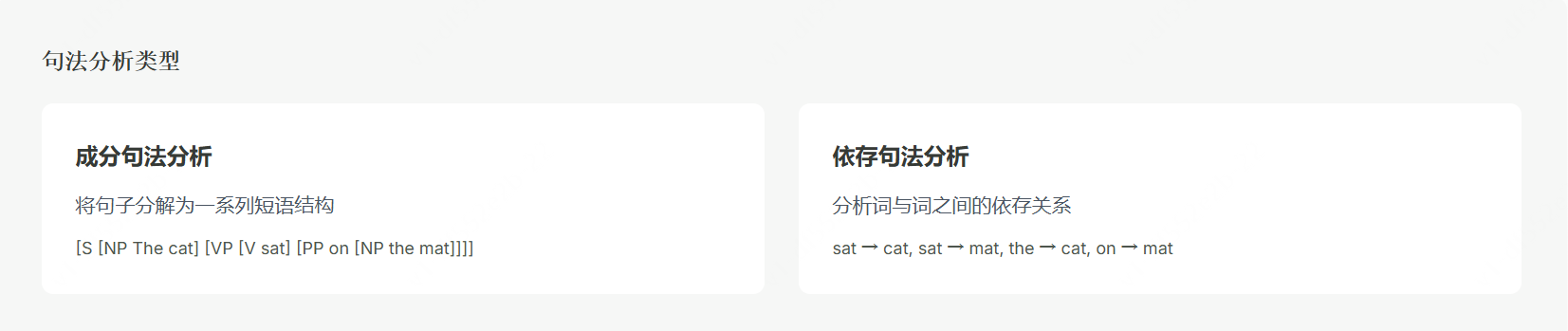
For example, for the sentence "The cat sat on the mat", syntactic analysis can identify that the subject is "The cat", the predicate is "sat", and "on the mat" is an adverbial indicating place.
Understanding syntactic structure is crucial for accurately understanding sentence meaning, especially when dealing with complex long sentences. The results of syntactic analysis can be used in many NLP applications, such as machine translation (helping adjust the word order of the target language), information extraction (identifying relationships between entities), and question answering systems (understanding the structure of questions).
Syntactic analysis is divided into two main types:constituency parsing and dependency parsing。
Constituency parsing:It focuses on how to decompose a sentence into a series of phrase structures, such as noun phrases (NP), verb phrases (VP), etc., ultimately forming a tree-like structure.
Dependency parsing:It focuses on the dependency relationships between words in a sentence, such as which word is the core verb and which words are its subject, object, or modifiers. For example, in the sentence "She bought a red car", "bought" is the core verb, "She" is the subject, "car" is the object, and "red" modifies "car".
Syntactic analysis is a core and challenging task in NLP, especially when dealing with ambiguous sentences (that is, a sentence may have multiple legal syntactic structures). In recent years, syntactic analysis methods based on deep learning have made significant progress and can analyze sentence structure more accurately.
Semantic Analysis: Exploring the Meaning of Language
Semantic Analysis is a deeper level in natural language processing, exploring the true meaning expressed by language, not merely surface-level vocabulary and syntactic structure. If syntactic analysis is understanding the "skeleton" of a sentence, then semantic analysis is understanding the "flesh and blood" and "soul" of the sentence.
The goal of semantic analysis is to convert text into structured information, involving multiple aspects such as word meaning, grammatical structure, and context. It attempts to answer questions such as "What does this sentence actually mean?" and "What proposition does this sentence express?" For example, in the sentence "The bank is closed," "bank" can refer to a financial institution or a riverbank, and semantic analysis needs to determine its exact meaning based on context. Similarly, the sentence "Flying planes can be dangerous" also has two possible interpretations: "Piloting planes can be dangerous" or "Planes that are flying can be dangerous," and semantic analysis needs to resolve this ambiguity.
Example of Semantic Ambiguity
In the sentence "The bank is closed," "bank" can refer to:
- A financial institution (bank)
- A riverbank (river embankment)
Semantic analysis needs to determine its exact meaning based on context.
Semantic analysis includes multiple subtasks:
- Word Sense Disambiguation (WSD), that is, determining the exact meaning of a word in a specific context.
- Semantic Role Labeling (SRL)is another important semantic analysis task, identifying the predicate in a sentence (usually a verb) and its related semantic roles, such as Agent, Patient, Instrument, Location, etc.
-
For example, in the sentence "John gave Mary a book in the library," for the predicate "gave," "John" is the Agent, "Mary" is the Recipient, "a book" is the Patient, and "in the library" is the Location. Through semantic role labeling, one can more deeply understand the event or state described by the sentence.
- Semantic analysis also involvessemantic relation extraction、Textual Entailmentand other tasks.
- Word Embedding technology, such as Word2Vec and GloVe, can represent words as dense vectors, capture semantic similarity between words, and provide powerful tools for semantic analysis. Achieving accurate semantic analysis is a major challenge in the field of NLP, because it requires not only linguistic knowledge but also a large amount of world knowledge and common-sense reasoning ability.
Pragmatic Analysis: Understanding the True Intent of Language
Pragmatic Analysis is the highest level of understanding in natural language processing, going beyond literal meaning and sentence structure to explore the true intent, implied meaning, and interactive relationship between speaker and listener of language in a specific context.
Pragmatic analysis focuses on "Why was this said?" and "Under what circumstances was this said?" For example, when someone says "It's cold in here," its literal meaning is to describe a low temperature, but in a specific context, the pragmatic intent may be a request to close the window or turn up the heating. The rhetorical question "Don't you know?" literally asks whether the other person knows, but its pragmatic function is often to express affirmation or reproach.
Pragmatic analysis involves multiple concepts:
- Speech Act Theory:It is considered that speaking itself is a kind of act, which can be divided into assertives, directives, commissives, expressives, and declarations, etc. For example, "I promise to finish tomorrow" is a commissive speech act.
- Conversational Implicature:That is, the speaker indirectly expresses a certain meaning by violating one of the maxims of the Cooperative Principle (such as the maxim of quantity, the maxim of quality, the maxim of relation, and the maxim of manner). For example, when asked for an opinion about a certain movie, if the answer is "Well, the cinematography was good," it may imply dissatisfaction with other aspects of the movie. Pragmatic analysis needs to take into account contextual information, the background knowledge of the speaker and the hearer, sociocultural factors, and so on.
- Anaphora Resolution/Coreference Resolution:It involves identifying which entity a pronoun or noun phrase in the text (such as "it," "they," "this issue") specifically refers to. Due to the complexity of pragmatic meaning and its high dependence on context, pragmatic analysis is an extremely challenging area in NLP and is still at the exploratory stage.
How AI Learns and Processes Language
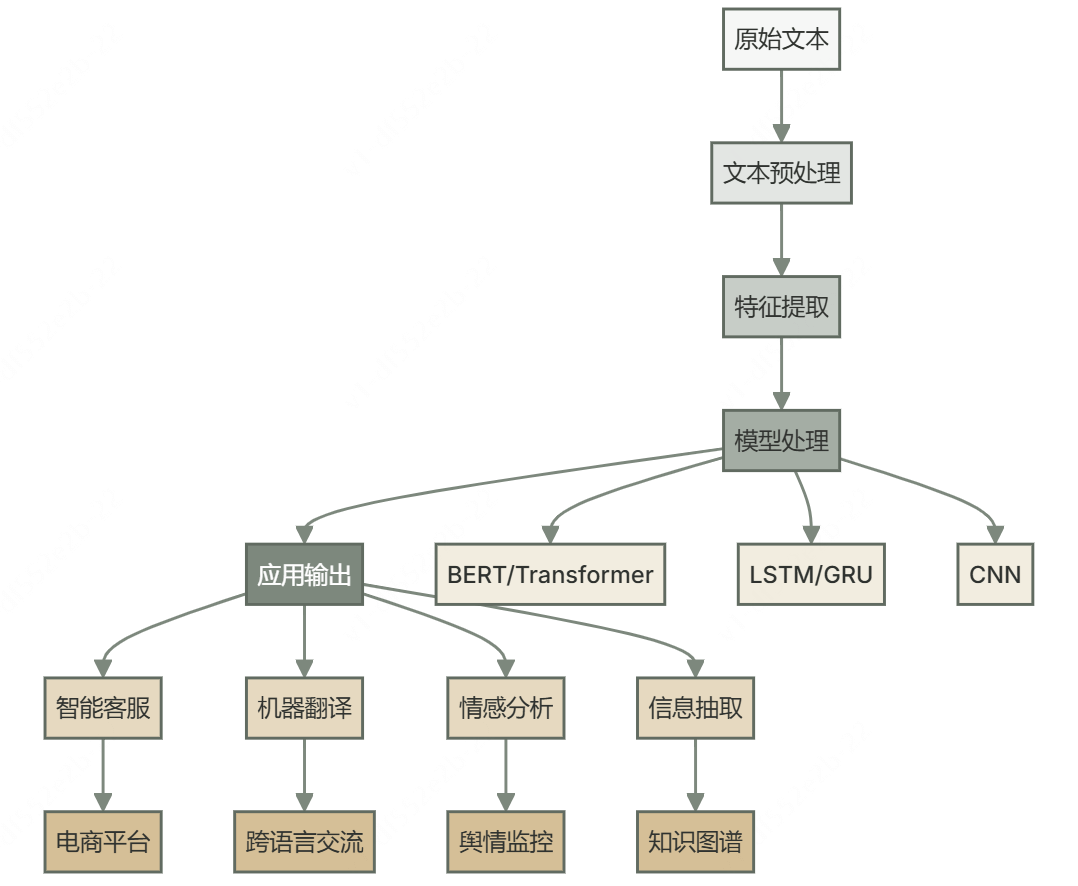
The process involves key links such as data preprocessing, text representation, and language models. By analyzing massive text corpora, AI systems learn knowledge at the lexical, grammatical, semantic, and even pragmatic levels, and can handle various complex language tasks.
Text Preprocessing: Preparing for Analysis
Text preprocessing is the first step in the NLP process and also a very critical part. Its purpose is to convert raw, unstructured text data into a clean and standardized format so that subsequent NLP algorithms can analyze and learn more effectively. Raw text data often contains a lot of information that is useless for analysis or even interferes with it, such as HTML tags, special symbols, extra spaces, spelling errors, stop words, and so on. Text preprocessing includes the following main steps:
- Text Cleaning: Remove irrelevant characters from the text, such as HTML tags, control characters, special symbols, and so on. For some tasks, it may also be necessary to convert the text to a uniform case format.
- Tokenization: Split continuous text into independent tokens, such as words, punctuation marks, and so on. For languages such as Chinese that do not have obvious separators, tokenization is a more challenging task.
- Stop Word Removal: Stop words refer to words that appear frequently in text but contribute little to expressing the core semantics, such as articles, prepositions, and conjunctions like "de," "shi," and "zai." Removing stop words can reduce the dimensionality of the feature space and improve the efficiency and performance of the model.
- Lemmatization or Stemming: Restore words to their base form or stem to reduce lexical diversity and help the model better identify word meanings. For example, restore "running" to "run."
- Spell Correction: Detect and correct spelling errors in the text, which is very important for improving the accuracy of subsequent analysis.
- Text Normalization: Convert text into a standard format, for example, converting numbers into word representations, expanding abbreviations, and so on.
The quality of text preprocessing directly affects the performance of subsequent NLP models. Different NLP tasks and application scenarios may require different preprocessing strategies.
Text Representation: Converting text into a form that machines can understand
Before computers can process natural language, text data must be converted from human-readable character sequences into machine-understandable numerical forms. This process is called Text Representation or Feature Engineering. Since machine learning algorithms and deep learning models can only process numerical data, the quality of text representation is crucial to the performance of NLP tasks. A good text representation method should be able to capture the semantic information of the text and be effectively used for downstream tasks. Common text representation methods can be divided into the following categories:
- Frequency-Based Methods:
- Bag of Words (BoW): Represents text as a vector of the occurrence frequencies of all words in a vocabulary. It ignores word order and grammatical information, focusing only on whether words appear or their frequencies. For example, the sentence "I love NLP and I love AI" under the vocabulary ["I", "love", "NLP", "and", "AI"] may have a BoW representation of [2, 2, 1, 1, 1].
- TF-IDF(Term Frequency-Inverse Document Frequency): TF-IDF is a statistical method used to evaluate the importance of a word to a document in a document set or a corpus. The more times a word appears in a document (the higher the TF), and the fewer documents it appears in across the entire corpus (the higher the IDF), the larger the TF-IDF value of the word, and it is considered to better represent the characteristics of that document.
- Word Embedding / Word Vector:
- One-Hot Encoding: Represents each word as a very long vector, where the dimension of the vector equals the size of the vocabulary, the index position of the word in the vocabulary is 1, and the remaining positions are 0. This method is simple and intuitive, but it is high-dimensional and sparse and cannot represent the semantic relationships between words.
- Word Embedding: Maps words into a low-dimensional, dense real-valued vector space, so that words with similar semantics are also closer in the vector space. Word2Vec, GloVe, and FastText are commonly used word embedding models. By training on large-scale corpora, these models learn distributed representations of words and can capture the semantic and grammatical relationships between words. For example, through word embeddings, a semantic relationship such as "king" - "man" + "woman" ≈ "queen" can be discovered.
- Contextualized Word Representations:
- ELMo(Embeddings from Language Models): ELMo uses a bidirectional LSTM model to generate word representations, and can dynamically adjust its word vectors according to the context in which the word appears, thereby solving the problem of polysemy.
- BERT(Bidirectional Encoder Representations from Transformers): BERT is based on the Transformer architecture and learns deep bidirectional context-related word representations by pretraining on large-scale unlabeled text. The word vectors generated by BERT can better capture the meaning of words in a specific context.
Choosing an appropriate text representation method depends on the specific NLP task, the amount of data, and the available computational resources.
Language Models: Predicting and Generating Text
A Language Model (LM) is a core concept in natural language processing. It calculates the probability of a sentence or word sequence appearing in a certain language, or predicts the next word based on the existing preceding context. Language models are the foundation of many NLP tasks, such as machine translation, speech recognition, text generation, spelling correction, and input method prediction. A good language model should be able to accurately capture the patterns of language, including word collocations, syntactic structures, and semantic coherence.
Key Technologies of NLP: Achieving Language Understanding and Generation
Tokenization
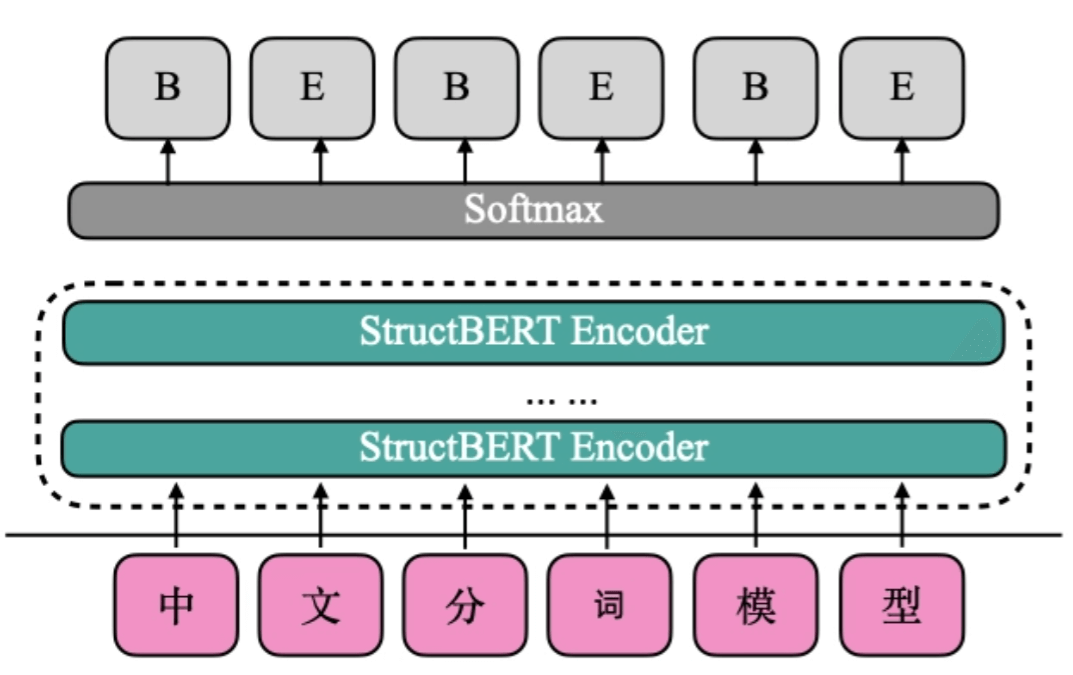
Tokenization, also known as word segmentation or lexical tokenization, is the most fundamental and important step in NLP, especially when processing languages such as Chinese, Japanese, and Thai that do not have obvious word separators. The goal is to segment a continuous sequence of characters (such as a sentence or paragraph) into a series of meaningful, independent words or tokens. For languages such as English that separate words with spaces, tokenization is relatively simple, using spaces and punctuation marks as boundaries.
For Chinese, tokenization is more challenging because there are no fixed separators between words, and there are a large number of ambiguous segmentation problems.
For example, "结婚的和尚未结婚的" can be segmented as "结婚/的/和/尚未/结婚/的" or "结婚/的/和尚/未/结婚/的". Both segmentations may be valid grammatically and semantically, and the correct one needs to be determined based on context.
Common tokenization methods include dictionary-based matching methods (such as maximum matching and minimum matching), statistical methods (such as Hidden Markov Model HMM and Conditional Random Field CRF), and deep learning-based methods (such as BiLSTM-CRF and Transformer). Accurate tokenization is the foundation for subsequent tasks such as part-of-speech tagging, syntactic analysis, and semantic understanding, and its quality directly affects the performance of subsequent NLP tasks.
Part-of-Speech Tagging
Part-of-Speech Tagging (POS Tagging) is the process of assigning an appropriate part-of-speech tag to each word (token) in a text on the basis of tokenization, such as noun, verb, adjective, adverb, preposition, conjunction, etc.
For example, knowing that a word is a noun can help determine that it may be the subject or object of a sentence, and knowing that a word is a verb can help determine the predicate of the sentence. The accuracy of part-of-speech tagging has a significant impact on downstream tasks.
Common part-of-speech tagging methods include rule-based methods (using rules written by linguistic experts for tagging), statistical methods (such as Hidden Markov Model HMM, Maximum Entropy Model MaxEnt, and Conditional Random Field CRF, where models learn the probabilistic relationships between words and their parts of speech by training on large-scale annotated corpora), and deep learning-based methods (such as using Recurrent Neural Network RNN, Long Short-Term Memory Network LSTM, or Transformer combined with a CRF layer for sequence labeling).
For example, for the sentence "我爱自然语言处理", the result of part-of-speech tagging might be "我/pronoun 爱/verb 自然语言处理/noun".
Named Entity Recognition (NER)
Named Entity Recognition (NER) is the process of identifying entities with specific meanings from unstructured text and classifying them into predefined categories, such as person names (PER), location names (LOC), organization names (ORG), dates (DATE), times (TIME), money (MONEY), percentages (PERCENT), etc.
For example, in the sentence "苹果公司于1976年4月1日由史蒂夫·乔布斯、史蒂夫·沃兹尼亚克和罗纳德·韦恩创立,总部位于美国加利福尼亚州库比蒂诺", the NER system needs to identify "苹果公司" (ORG), "1976年4月1日" (DATE), "史蒂夫·乔布斯" (PER), "史蒂夫·沃兹尼亚克" (PER), "罗纳德·韦恩" (PER), "美国" (LOC), "加利福尼亚州" (LOC), and "库比蒂诺" (LOC).
NER is of great significance for advanced NLP applications such as information extraction, knowledge graph construction, question answering systems, and machine translation. For example, in machine translation, recognizing named entities and translating them as a whole can avoid errors that may result from word-by-word translation. Mainstream NER methods include rule-based methods, dictionary-based methods, statistical machine learning-based methods (such as HMM, CRF, and support vector machine SVM), and deep learning-based methods (such as BiLSTM-CRF, Transformer-CRF, and fine-tuning of pretrained language models such as BERT). Due to their powerful feature learning ability, deep learning models have achieved remarkable results on NER tasks.
Word Embedding and Word Vectors
Word Embedding is a technique that maps words from a high-dimensional sparse one-hot encoding representation to a low-dimensional dense real-valued vector space, so that words with similar semantics are closer in the vector space. These low-dimensional vectors are calledWord Vectors. The core idea of word embedding is the "Distributional Hypothesis," which states that words with similar contexts often have similar semantics. By training on large-scale unlabeled text corpora, word embedding models can learn distributed representations of words and capture the semantic and grammatical relationships between words.
- Word2Vec:is an efficient tool and collection of algorithms for learning word vectors launched by Google. It can convert words into dense vectors of fixed dimensions (i.e., word embeddings), so that words with similar semantics are also close in position in the vector space. Word2Vec mainly includes two model architectures:Continuous Bag-of-Words (CBOW) and Skip-Gram. The goal of both is to learn high-quality word vectors, but the ways they train the network differ.
- GloVe(Global Vectors for Word Representation):is another widely used word embedding method, proposed in 2014 by a research team at Stanford University. The core idea of GloVe is to use global word-word co-occurrence statistics in a corpus to learn word vectors.
Machine Translation
The goal of Machine Translation (MT) is to use computers to automatically translate text or speech from one natural language (the source language) into another natural language (the target language).
The development of machine translation has gone through multiple stages:
- Rule-Based Machine Translation(Rule-Based Machine Translation, RBMT): mainly relies on bilingual dictionaries and grammar rules written by linguists.
- Statistical Machine Translation(Statistical Machine Translation, SMT): statistical analysis of large-scale bilingual parallel corpora, by building components such as translation models and language models, to find the translation result with the highest probability.
- Neural Machine Translation(Neural Machine Translation, NMT): adopts an end-to-end learning approach, using neural networks (usually an encoder-decoder architecture, such as the Seq2Seq model, and later the Transformer model) to translate directly from the source language to the target language, without the need to manually design complex features.
Sentiment Analysis
Sentiment Analysis, also known as Opinion Mining or Text Orientation Identification, identifies and extracts the subjective information expressed in text, such as the author's emotions, attitudes, evaluations, sentiments, etc. The goal of sentiment analysis is usually to determine the sentiment polarity of the text (such as positive, negative, neutral), or to identify more fine-grained sentiment categories (such as joy, anger, sorrow, happiness, fear, etc.).
Speech Recognition
Also known as Automatic Speech Recognition (ASR), its goal is to convert human spoken speech into the corresponding textual form. Simply put, it enables computers to "understand" what people say and convert it into editable and processable text.
Speech Synthesis
Also known as Text-to-Speech (TTS), it is the reverse process of speech recognition, and its goal is to convert textual information into natural and fluent speech output that humans can hear. Simply put, it enables computers to "speak".
Mainstream NLP Models and Methods: From Traditional to Deep Learning
Traditional Methods: Rule-Based and Statistical Models
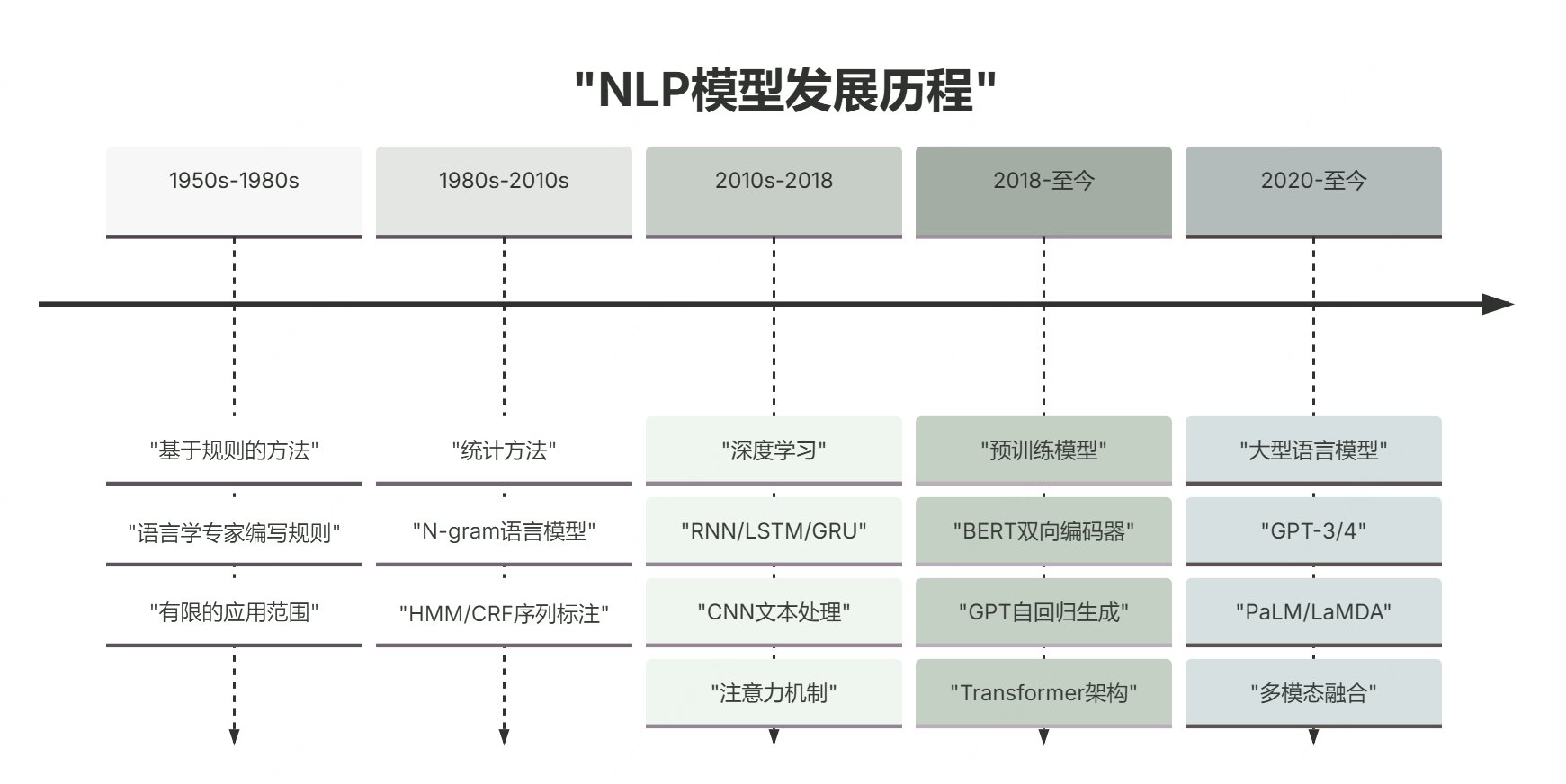
Before the rise of deep learning, NLP mainly relied on rule-based methods and statistical models.
- Rule-Based MethodsUse rule sets manually written by linguistic experts to process text, for example, performing syntactic analysis by defining grammar rules, or performing named entity recognition and sentiment analysis by building dictionaries and pattern-matching rules. The advantage is that the rules have good interpretability, but when faced with the diversity, ambiguity, and dynamism of language, the coverage of the rules and maintenance costs become the main bottlenecks.
- Statistical ModelsLearn the statistical patterns of language from large-scale text corpora. For example, N-gram language models predict the next word or evaluate the probability of a sentence by counting the frequency of word sequences.
Deep Learning Methods: The Rise of Neural Networks
With the improvement of computing power and the availability of large-scale annotated data, deep learning techniques, especially neural network models, have made breakthrough progress in the field of NLP and gradually become the mainstream methods. Compared with traditional methods, deep learning models can automatically learn hierarchical feature representations from raw data, avoiding cumbersome feature engineering, and can better capture complex patterns and long-distance dependencies in text.
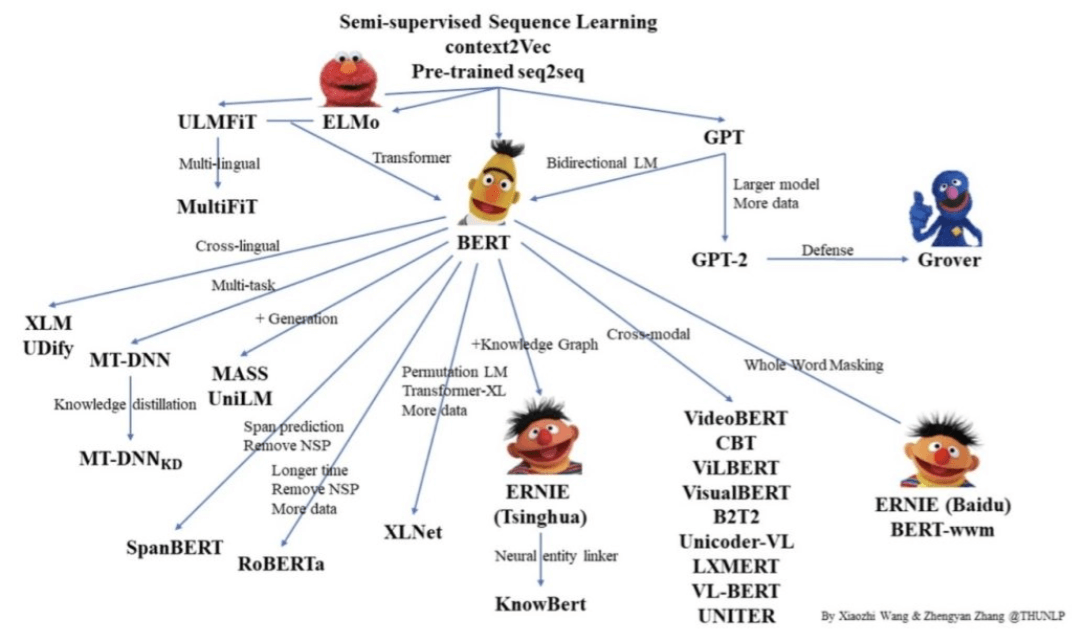
Pre-trained Language Models: BERT and GPT Series
Pre-trained Language Models (PLMs) are one of the most important advances in the field of NLP in recent years. The core idea is to first pre-train on ultra-large-scale unlabeled text corpora to learn general language representations, and then fine-tune (Fine-tuning) for specific downstream tasks. This "pre-training + fine-tuning" paradigm has greatly improved the generalization ability and performance of NLP models and reduced dependence on large amounts of annotated data.
The following table summarizes the main characteristics of the BERT and GPT series models:
| Feature | BERT (and similar models such as RoBERTa, ALBERT) | GPT Series (GPT-1/2/3, ChatGPT, GPT-4) |
|---|---|---|
| Architecture Basis | Transformer Encoder | Transformer Decoder |
| Pre-training Task | Masked Language Model (MLM), Next Sentence Prediction (NSP) | Autoregressive Language Model (left-to-right prediction) |
| Contextual Understanding | Bidirectional (considering both left and right context simultaneously) | Unidirectional (considering only the left side/previous context) |
| Main Advantages | Text understanding, classification, information extraction | Text generation, dialogue, creative writing |
| Typical Applications | Text classification, named entity recognition, question answering | Text generation, chatbots, code generation, summarization |
Breakthroughs in Large Language Models (LLMs)
The breakthrough advancements of LLMs are mainly reflected in the following aspects:
- Zero-shot and Few-shot Learning Capabilities: LLMs can complete various complex NLP tasks through natural language instructions (Prompts) without or with only a small amount of task-specific labeled data, demonstrating strong generalization ability and the ability to quickly adapt to new tasks.
- Emergent Abilities: As model scale increases, the performance of LLMs on certain tasks suddenly shows significant improvement, exhibiting new abilities not observed in smaller models, such as complex reasoning, multi-step problem solving, etc.
- Stronger In-context Learning and Instruction-following Capabilities: LLMs can better understand complex instructions and generate more relevant and consistent responses based on context.
- Multimodal Capabilities: Some advanced LLMs (such as GPT-4) have begun to possess the ability to process and understand multiple modalities of information (such as text and images), further expanding their application scenarios.
Main Challenges Facing NLP: Why Is Understanding Language So Difficult?
Ambiguity of Language
The same word, phrase, or sentence may have multiple different meanings in different contexts. For example:
- Lexical Ambiguity: A word may have multiple parts of speech (e.g., “打” can be a verb or a quantifier) or multiple meanings (e.g., “bank” can refer to a financial institution or a riverbank).
- Syntactic Ambiguity: A sentence may have multiple valid syntactic structures, leading to different interpretations. For example, “Flying planes can be dangerous” can be understood as “Piloting planes may be dangerous” or “Planes that are flying may be dangerous.”
- Semantic Ambiguity: Even if the syntactic structure is clear, the semantics of a sentence may still be ambiguous, especially when involving pronoun reference, ellipsis, or metaphor.
- Pragmatic Ambiguity: The speaker's true intention may differ from the literal meaning, such as sarcasm, irony, etc.
Resolving these ambiguities requires models to have strong contextual understanding and rich world knowledge, which remains a difficult problem for current NLP systems.
Complexity of Contextual Understanding
Accurately understanding the meaning of language depends heavily on contextual information, including previous content in a conversation, the background knowledge of the speaker and listener, the scenario in which the conversation takes place, and shared social and cultural common sense, etc. NLP models need to be able to capture and effectively utilize this complex contextual information. For example, the specific referents of pronouns (such as “he,” “it”) need to be determined based on context. The meaning of a word in a specific domain or cultural background may differ from its general meaning.
Data Sparsity and Annotation Challenges
Many NLP tasks, especially supervised learning tasks, rely heavily on large-scale, high-quality annotated data. Obtaining such annotated data is costly, time-consuming, and labor-intensive, especially in specific domains or low-resource languages. The problem of data sparsity: many reasonable linguistic expressions appear extremely infrequently or not at all in the training data, making it difficult for models to learn the patterns of these expressions.
The annotation process itself may also introduce subjectivity and inconsistency. How to effectively use a small amount of annotated data (few-shot learning) or completely unannotated data for learning remains an important research direction in the NLP field.
Integration of Domain Knowledge
Natural language contains a large amount of domain-specific knowledge and common sense. For example, in medical texts, understanding diseases, symptoms, medications, and their interrelationships is crucial; in legal documents, understanding legal provisions, cases, and procedures is necessary. NLP models need to effectively integrate this domain knowledge to perform accurate interpretation and reasoning. Effectively combining structured knowledge bases (such as knowledge graphs) with unstructured textual information and enabling models to learn to use this knowledge is a complex problem. Common-sense reasoning is also crucial for understanding language, for example, understanding basic common sense such as 'humans cannot fly.' Current NLP models still have shortcomings in explicitly utilizing and reasoning with domain knowledge and common sense.
Application Scenarios of NLP
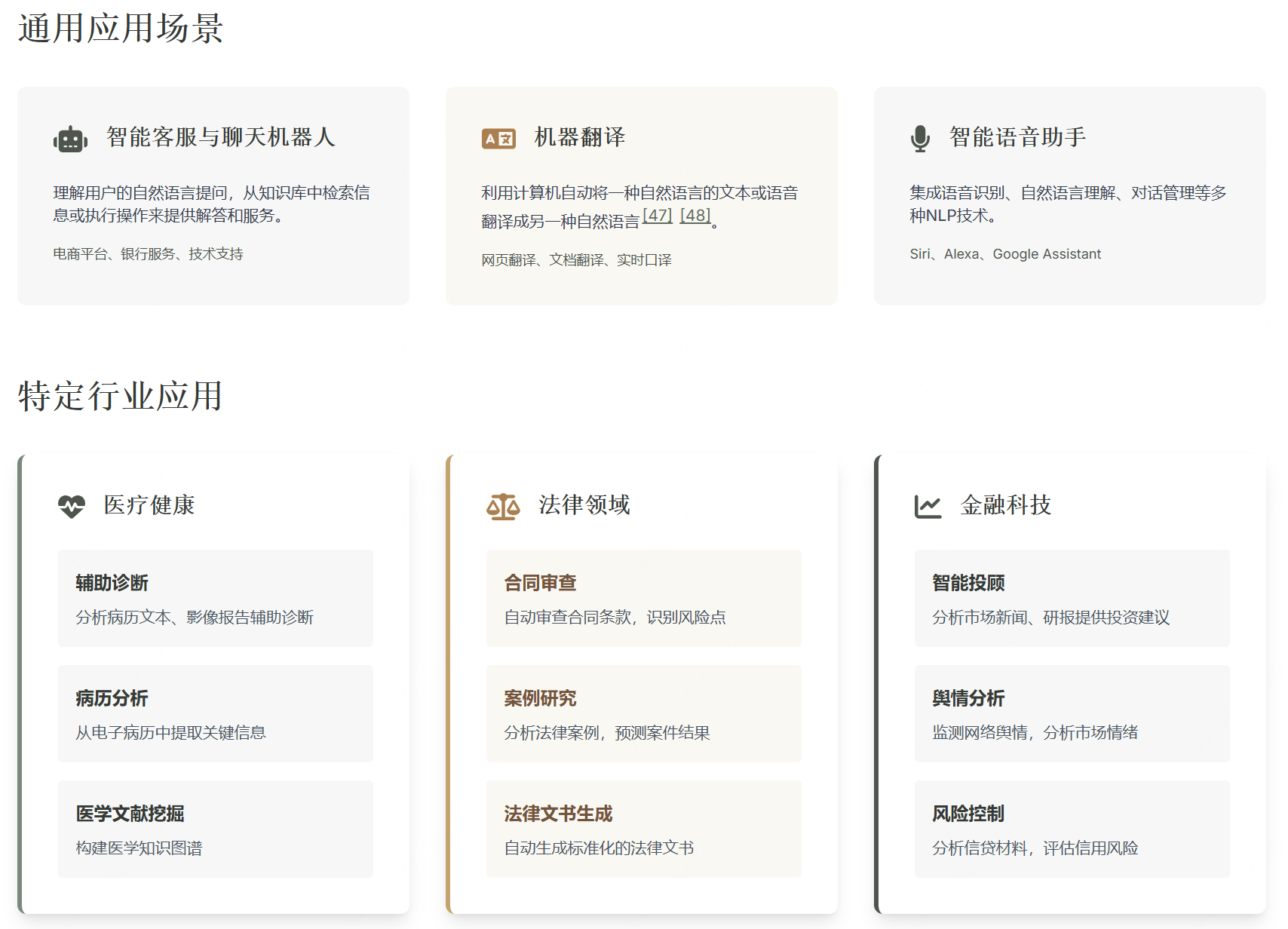
Natural Language Processing (NLP) technology has been widely applied in various fields, changing the way we interact with technology and greatly improving the efficiency of information acquisition and processing. It can be divided into two major categories: general applications and industry-specific applications.
Future Development Trends of NLP
-
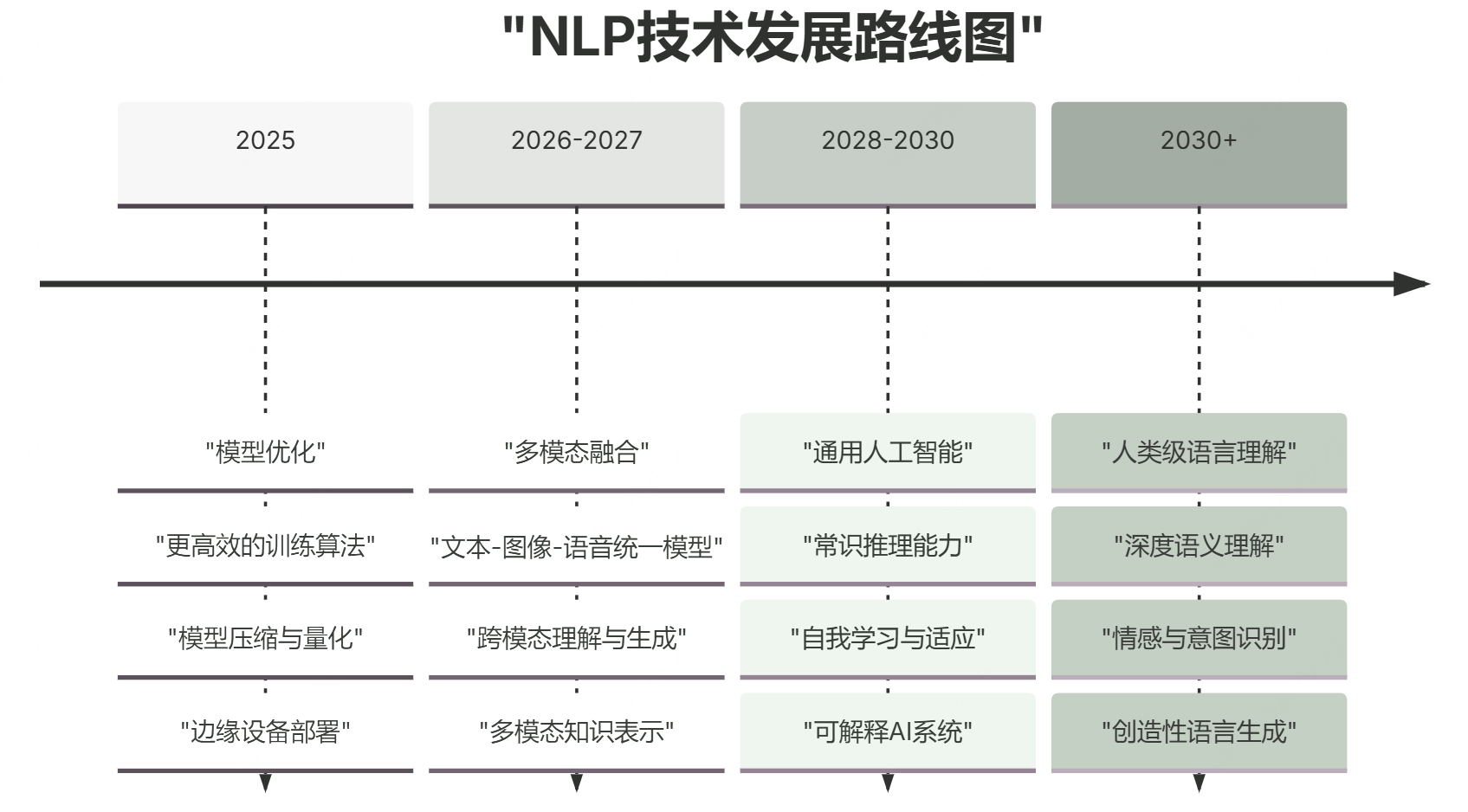
Larger, stronger models and more efficient training and inference: The scale of large language models (LLMs) is expected to continue increasing, and researchers are also exploring more efficient model architectures, training algorithms, and inference techniques to reduce computational cost and energy consumption, enabling LLMs to be deployed and applied more widely.
-
Multimodal fusion: Future NLP systems will place greater emphasis on processing and understanding information from multiple modalities, such as text, images, speech, and video, to achieve richer and more natural interaction. For example, generating images from textual descriptions, or generating text summaries from video content.
-
Common-sense reasoning and interpretability: Improving models' common-sense reasoning ability and interpretability is an important challenge in the NLP field. Future research will enable models not only to 'know what is so' but also to 'know why it is so,' to perform logical reasoning based on common sense, and to give reasonable explanations for decision-making processes.
-
Personalization and domain adaptation: NLP models will place greater emphasis on personalization and domain adaptivity, adapting and optimizing according to users' specific needs and preferences as well as the knowledge characteristics of different domains, to provide more precise and more fitting services.
-
Low-resource and trustworthy NLP: NLP technology for low-resource languages and few-shot learning scenarios will continue to develop. Ensuring the fairness, robustness, security, and privacy protection of NLP models (i.e., trustworthy NLP) will also become a research focus, addressing the risks of bias, misinformation, and abuse that models may produce.
-
Deep integration with knowledge graphs: Combining NLP more closely with symbolic knowledge representation methods such as knowledge graphs is expected to improve models' knowledge utilization and reasoning abilities and achieve deeper language understanding.
With the continuous advancement of technology, NLP will play a key role in more fields, driving artificial intelligence toward a higher level of intelligence and making communication between humans and machines more intelligent, natural, and efficient. For ordinary users, understanding the basic concepts and development trends of NLP will help them better utilize and adapt to this era of AI-driven language intelligence.