
Introduction: The Essence of AI Thinking
The process by which artificial intelligence (AI) imitates human thinking is not achieved overnight, but is built on a series of complex and sophisticated technological foundations. These technologies attempt to replicate, at different levels, the unique ways humans perceive the world, including how we learn new knowledge, how we make judgments and decisions based on existing information, and how we process and understand massive amounts of external information.
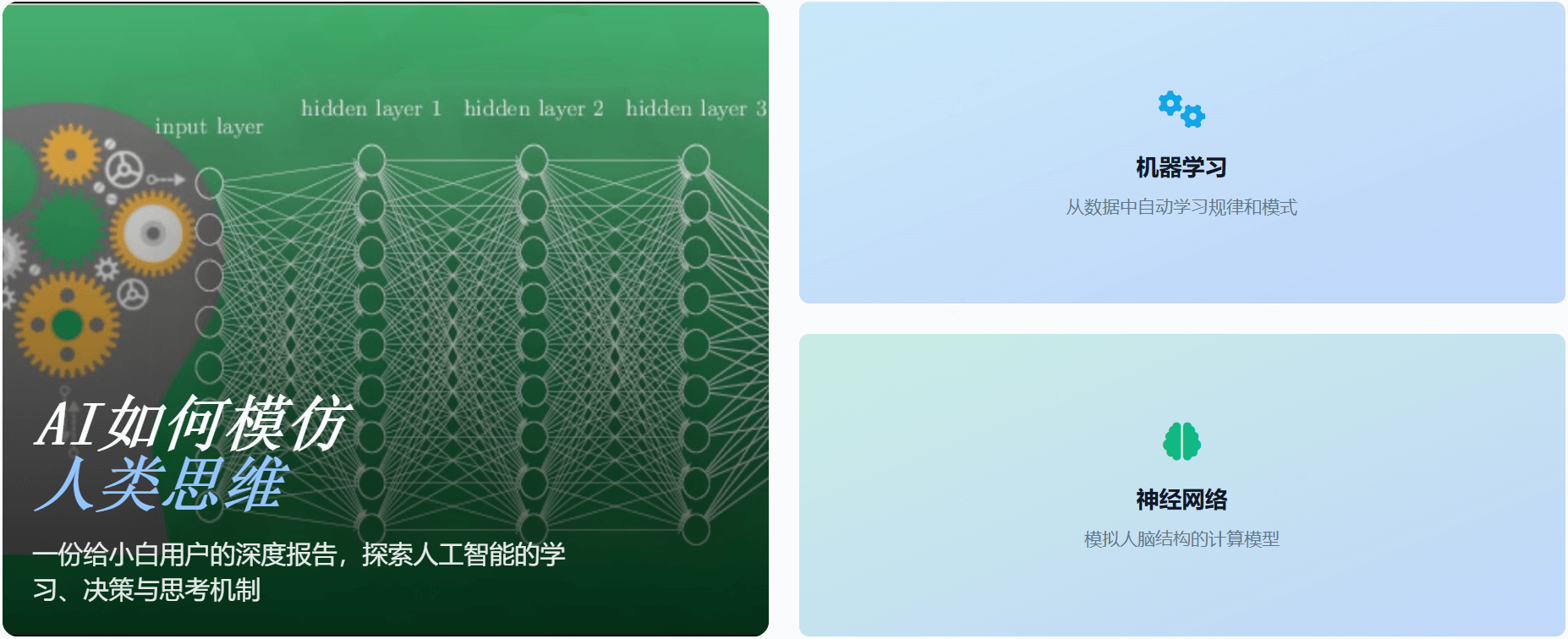
AI imitates human thinking mainly by learning patterns from large amounts of data through machine learning (especially deep learning) and building models. AI's decision-making mechanism relies on these models to perform reasoning and analysis on input data, and its way of processing information draws on the neural network structure of the human brain.
The continuous development and integration of these mechanisms have enabled AI to make significant progress on the path of imitating human thinking, demonstrating capabilities in various fields that are increasingly close to or even surpassing those of humans. AI exhibits human-like abilities in specific tasks and shows great potential in solving complex problems that traditional methods find difficult to address.
- Learning ability:Automatically learning patterns and regularities from massive amounts of data
- Decision-making ability:Reasoning and analysis based on models and data
- Processing ability:Efficiently processing information through neural network structures
The Core Mechanisms by Which AI Imitates Human Thinking
The core mechanisms mainly revolve around AI's learning process, decision-making mechanism, and information processing methods, which together form the cornerstone of AI's human-like intelligence. By simulating the learning patterns of the human brain, AI can acquire knowledge from experience; by drawing on human reasoning logic, AI can make judgments about complex situations; and by imitating the structure of the human brain's neural networks, AI can efficiently process and analyze information.
AI's Learning Process
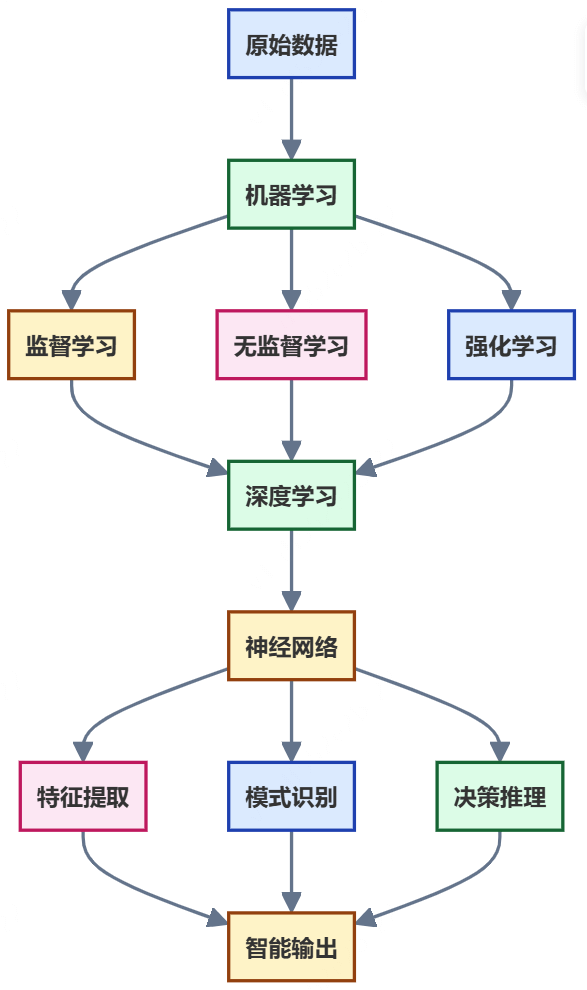
AI's learning process is the core link in its imitation of human thinking, mainly achieved throughmachine learning and deep learningthese two major technological pillars. Machine learning gives AI the ability to automatically learn patterns and regularities from data, while deep learning further draws on the hierarchical structure of the human brain's neural networks, enabling AI to process more complex and more abstract information. These learning methods enable AI systems to accumulate knowledge through "experience" like humans, continuously optimize their own performance, and perform outstandingly in specific tasks.
Machine Learning
It is the foundation for AI to achieve "learning" capabilities. The core idea is to enable computer systems to automatically analyze and learn patterns from data, and then use these patterns to make predictions or decisions about new, unknown data, without the need for explicit programming to specify every step. This process is very similar to how humans learn through experience.
- Reinforcement learning: Learning the optimal strategy through trial and error and a reward mechanism. For example, a simple machine learning program can learn to play chess through "trial and error": trying different moves, and if a certain move leads to victory, then that move will be reinforced in memory, and the next time a similar situation is encountered, it will be more likely to choose that move.
- Supervised learning: That is, AI learns to recognize different categories of things by analyzing large amounts of labeled data (for example, images labeled "cat" or "dog"). The AI model will try to find features that distinguish different categories and build a model that can accurately classify new images.
- Unsupervised learning: In this mode, AI needs to discover hidden structures or patterns from unlabeled data, such as grouping customers or identifying anomalies in data.
Deep Learning
It is a branch of machine learning that simulates the way the human brain processes information by building deep artificial neural networks, enabling it to learn more complex and abstract features. Compared with traditional machine learning methods, deep learning models usually contain multiple "hidden layers," and these hierarchical structures enable the model to extract and combine features layer by layer from raw data, forming higher-level conceptual representations.
- Hierarchical structure:Multiple hidden layers achieve layer-by-layer abstraction of features. For example, in image recognition tasks, a shallow neural network may only learn basic visual elements such as edges and corners, while a deeper network can combine these basic elements into local features of objects, and even into abstract representations of entire objects.
- Automatic features:Automatically learn useful feature representations. For example, by training on massive image data, deep learning models can identify objects and faces in images, and understand the emotions or scenes expressed by the images. There is no need to manually design complex feature extractors, which simplifies the model development process and raises the upper limit of model performance.
- Widely applied: Deep learning has made breakthrough progress in fields such as image recognition, speech recognition, and natural language processing.
AI's Decision-Making Mechanism
Reasoning Based on Data and Models
AI's decision-making mechanism is an important embodiment of imitating human thought, especially in solving problems and making judgments. Similar to how humans rely on experience, knowledge, and logic to make decisions, AI's decisions mainly depend on the models it has learned from large amounts of data, achieved through specific reasoning processes. It can make efficient and accurate judgments within specific domains, and even surpass human experts in some cases. AI's decisions are not simply "yes" or "no"; they are a complex process of computation and analysis aimed at finding the optimal or most reasonable course of action.
Core Elements
- Data analysis: analyze input information and extract key features
- Knowledge matching: compare with existing knowledge bases
- Inference and deduction: infer based on probability or logic
AI's reasoning ability can be divided into several types, including deductive reasoning and inductive reasoning. Deductive reasoning derives specific conclusions from general premises, while inductive reasoning summarizes general rules from specific observations.
For example, in the field of medical diagnosis, AI systems can analyze data such as patients' medical records and examination results, combine them with large amounts of medical literature and case databases, and infer the most likely disease type through complex algorithmic models, providing doctors with treatment recommendations. This decision-making process can be seen as simulating the thought process by which doctors make diagnoses based on symptoms and medical knowledge.
How AI Processes Information
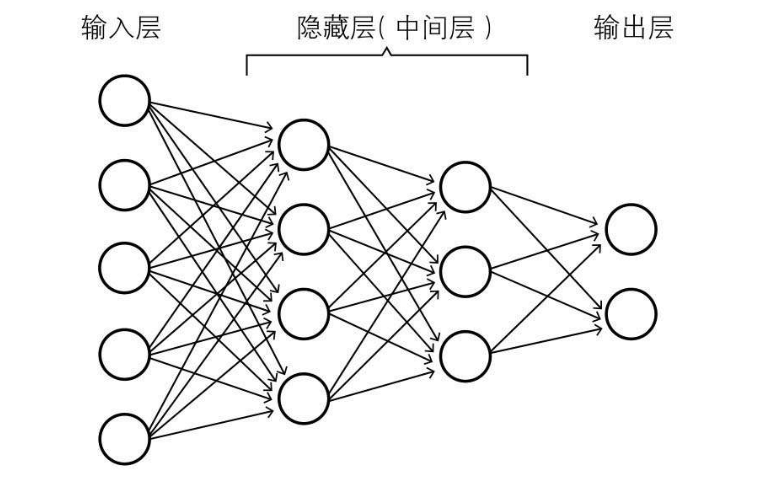
The way AI processes information, especially feature extraction through artificial neural networks (ANNs), is a core embodiment of imitating the structure and function of the human brain. Neural networks are composed of a large number of interconnected processing units (called "neurons" or "nodes"), and these neurons are arranged in a hierarchical structure, including an input layer, one or more hidden layers, and an output layer.
How Neurons Work
In a neural network, each neuron receives input signals from neurons in the previous layer. These signals are multiplied by a parameter called "weight" and then summed with weighting. The result after summation undergoes processing by an "activation function", which introduces nonlinear factors, enabling the network to learn more complex patterns.
Backpropagation Algorithm
The learning process of a network is to adjust these weight parameters so that the network can produce the desired output for a given input. This process is implemented through an algorithm called "backpropagation", which adjusts the weights layer by layer from the output layer to the input layer based on the error between the network output and the true label.
Feature extraction
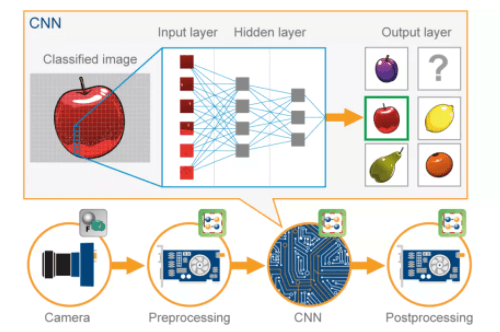
is a key step in how neural networks process information. Raw data (such as the pixels of an image or the words of a text) often has very high dimensionality and contains a large amount of redundant information. Through their hierarchical structure, neural networks can automatically learn feature representations that are most useful for the task and more discriminative. Deep learning models, especiallyconvolutional neural networks (CNNs) and recurrent neural networks (RNNs), perform exceptionally well in feature extraction.
For example, in image recognition tasks, neurons in lower layers may learn to recognize edges and corners, neurons in middle layers may combine these edges and corners into local parts of objects (such as eyes and noses), and neurons in higher layers may combine these parts into complete objects (such as faces).
Human-like abilities demonstrated by AI in specific tasks
Artificial intelligence has made significant progress in imitating human thinking, especially demonstrating impressive human-like abilities in specific tasks. Among them, language understanding and image recognition are the two areas where AI most prominently demonstrates human-like abilities. AI can not only "understand" what we say, but also "see" the world in our eyes, and has begun to possess a certain ability for association, reasoning, and creation.
Language understanding: the leap from words to semantics
AI's progress in language understanding enables it to communicate with humans more and more naturally and to process complex textual information. This is not merely about simply recognizing words or grammatical structures; more importantly, it is aboutunderstanding the meaning, intent, and emotion behind language, achieving a leap from surface symbols to deep semantics.
Key levels of language understanding
- Lexical analysis: splitting text into basic units (such as words or subwords)
- Syntactic parsing: analyzing the roles and structural relationships of the various words in a sentence
- Semantic understanding: grasping the true meaning of words and sentences in a specific context
- Sentiment analysis: determining whether the emotion expressed in the text is positive, negative, or neutral
Modern AI systems, especially those based on large-scale pretrained language models (such as the GPT series), analyze massive amounts of text data to learn vocabulary, grammar, idiomatic expressions, and even different language styles and dialects, building a deep understanding of language.
Image recognition: the "eyes" that understand the world
AI's breakthroughs in the field of image recognition have given it a human-like ability to "see," enabling it to extract information from images and videos, recognize objects, understand scenes, and interpret the deeper meanings contained in images. Through deep learning, especially the application of convolutional neural networks (CNNs), AI has achieved performance surpassing humans in tasks such as image classification, object detection, and image segmentation.
Developed by Shanghai AI Laboratory,the LAD (Let Androids Dream) framework, a system that enables AI to understand image metaphors and allegories like humans do. The LAD framework simulates the human cognitive process of understanding images, including three stages: Perception, Search, and Reasoning. In the perception stage, AI converts raw visual information into structured text descriptions and keywords; in the search stage, AI uses the keywords to retrieve relevant background knowledge to compensate for its deficiencies in cultural common sense and other aspects; in the reasoning stage, AI combines the perceived visual elements and the retrieved background knowledge, performs reasoning through a structured Chain of Thought (CoT), and ultimately generates an understanding of the image's allegorical meaning.
"Faced with a satirical image of 'a princess kissing a frog, but the princess herself turns into a frog,' the LAD framework can understand the allegorical meaning behind it that 'fairy tales do not always come true in reality,' rather than merely recognizing the two objects, the princess and the frog."
This deep-level image understanding capability is of great significance for AI applications in fields such as art appreciation, multimedia content creation, and cross-cultural communication. Although AI image recognition technology is already very powerful, it still faces challenges in handling abstract concepts, understanding complex scenes, and responding to adversarial attacks.
Other Human-Like Abilities: Association, Reasoning, and Creation
In addition to remarkable achievements in language understanding and image recognition, AI has also shown encouraging progress in imitating humans'abilities of association, reasoning, and creation. These higher-level cognitive functions enable AI not only to passively process information, but also to actively think, explore, and innovate
- Association ability: Large language models, through pretraining on massive text data, have learned the complex relationships among words, phrases, and concepts. When given a starting word or topic, AI can, based on these learned associations, generate related textual content, or associate one concept with another related concept.
- Reasoning ability: AI reasoning can be divided into multiple types, including deductive reasoning, inductive reasoning, and abductive reasoning. Chain of Thought (CoT) technology improves AI's performance on complex reasoning tasks by guiding AI to decompose complex problems into a series of easily understandable reasoning steps.
- Creative ability: Generative Adversarial Networks (GANs) can generate realistic face images or artworks. Models such as Stable Diffusion can generate high-quality images based on text descriptions, reflecting AI's potential in understanding and executing creative instructions.
Applications of AI in Daily Life
Artificial intelligence is no longer a concept in science fiction. It has become deeply integrated into our daily lives, bringing us unprecedented convenience and efficiency. From being awakened by a smart alarm clock in the morning to falling asleep at night in the warm atmosphere of a smart home, AI is everywhere. Behind these applications is precisely the embodiment of AI's ability to imitate human thinking in learning, decision-making, and information processing.
Smart Homes
One of the most intuitive applications of AI in daily life, through AI technology, makes our living environment more comfortable, convenient, safe, and energy-efficient. AI plays the role of the "brain" in smart homes, automatically controlling various devices in the home by learning users' living habits and preferences.
- Smart thermostats:can automatically adjust air conditioning or heating according to the user's daily schedule and indoor and outdoor temperatures, maintaining a constant indoor temperature and saving energy.
- Smart lighting systems:It can automatically turn lights on or off or adjust brightness and color temperature based on light intensity, time, and user activity to create a comfortable atmosphere.
- Smart security system:Using AI image recognition technology, it can recognize faces and distinguish family members from strangers. Once an abnormal situation is detected (such as an intrusion, fire, or gas leak), it will immediately alert the user and take corresponding measures.
- Smart speaker: As the control hub of the smart home, it can control other smart devices in the home through voice commands, such as playing music, checking the weather, and setting reminders.
AI personal assistant
For example, Siri and Google Assistant on smartphones, as well as Alexa and Xiao Ai Tong Xue built into smart speakers, have become indispensable helpers in many people's daily lives. These personal assistants use AI technologies such as natural language processing and machine learning to understand users' voice commands or text input and provide corresponding services.
- Managing schedules:For example, setting reminders, arranging meetings, and creating to-do lists.
- Answering questions:Whether it is a simple common-sense question or a complex query that requires an internet search, AI personal assistants can quickly provide answers or related information.
- Performing tasks: For example, sending text messages, making phone calls, playing music, navigating, and booking restaurants.
With advances in technology, AI personal assistants are becoming more and more "intelligent," able to hold more natural conversations, understand context, and predict users' needs. For example, they can proactively remind users of traffic conditions or nearby discount information based on the user's location and schedule. AI personal assistants are like a private secretary online around the clock, always ready to help us, greatly improving the efficiency of life and work.
IntravelAI-driven navigation applications (such as Amap, Baidu Maps, and Google Maps) can analyze road conditions in real time, plan the optimal route, avoid congestion, and provide accurate estimated arrival times. Ride-hailing platforms also use AI for order matching, dynamic pricing, and route optimization.
Inshoppinge-commerce platforms' recommendation systems use AI to analyze users' browsing history, purchase records, and preferences to accurately recommend products to users and improve the shopping experience. AI is used in intelligent customer service to answer user questions online 24/7 and handle after-sales issues.
Inentertainmentstreaming platforms (such as Netflix, Spotify, and Douyin) use AI recommendation algorithms to push personalized movies, music, or short video content based on users' viewing or listening history. AI is used in game development to create smarter and more challenging non-player characters (NPCs).
Inhealth managementfor example, smart bands or watches can monitor users' heart rate, sleep quality, and exercise data, and provide health advice through AI analysis.
Applications of AI in professional fields
Artificial intelligence not only demonstrates human-like capabilities in specific tasks, but also shows great potential insolving complex problems that traditional methods find difficult to handle. These problems often involve massive data, complex systems, and high uncertainty, such as climate change prediction, new drug development, and space exploration. With its powerful data processing capabilities, pattern recognition capabilities, and predictive modeling capabilities, AI is becoming a capable assistant for scientists and researchers.
Healthcare: Assisted Diagnosis and Personalized Treatment
AI inthe healthcare fieldis developing at an unprecedented speed, bringing revolutionary changes to the early detection of diseases, precise diagnosis, and personalized treatment. AI systems can assist doctors in identifying early lesions by analyzing massive amounts of medical imaging data (such as X-rays, CT scans, and MRIs). For example, in cancer screening, AI can detect tiny tumors with extremely high accuracy, improving the early diagnosis rate.
Inassisted diagnosis, AI can integrate multidimensional data such as a patient's medical records, genetic information, and lifestyle habits, and combine medical knowledge bases and the latest research literature to provide doctors with more comprehensive diagnostic suggestions and reduce the risk of misdiagnosis and missed diagnosis. For example, IBM's Watson for Oncology can analyze a patient's medical records and provide evidence-based recommendations for cancer treatment plans.
Inpersonalized treatment, AI can predict the effects and side effects of different treatment plans based on a patient's genetic characteristics, disease type, and drug response, helping doctors formulate the personalized treatment plan most suitable for a specific patient.
AI plays an important role in fields such as new drug development, intelligent health management, and robotic surgery, greatly improving the quality and efficiency of medical services and contributing to the cause of human health.
Fintech: Intelligent Risk Control and Quantitative Trading
Fintech is another important battlefield for AI applications. AI technology is reshaping core links in the financial industry such as risk control, customer service, and investment trading.
In intelligent risk control, AI can build complex risk assessment models by analyzing multidimensional data such as users' transaction behavior, credit records, and social networks, effectively identifying and preventing risks such as fraudulent behavior and credit default. For example, AI can monitor credit card transactions in real time. Once an abnormal transaction pattern is detected (such as a large out-of-town purchase), it will immediately issue a warning or freeze the account to protect the security of the user's funds.
In the field ofquantitative trading, AI algorithms can analyze massive amounts of market data (such as historical stock prices, news sentiment, and macroeconomic indicators), discover potential market patterns and trading signals from them, and automatically execute high-frequency trading strategies to obtain excess returns. AI-driven quantitative trading systems react quickly and are not affected by emotions, enabling rational decisions in complex market environments.
AI has a wide range of applications in robo-advisory, anti-money laundering, intelligent customer service, and precision marketing, helping financial institutions improve operational efficiency, reduce risks, and provide customers with more personalized and more convenient financial services.
Educational Innovation: Personalized Learning and Intelligent Tutoring
AI technology is bringing profound changes to the field of education, promoting the development of educational models from the traditional "one-size-fits-all" approach toward personalization and intelligence. AI systems can accurately assess each student's level of knowledge mastery, learning characteristics, and weak areas by analyzing student learning behavior data (such as answer records, study duration, and interaction frequency), and tailorpersonalized learning paths and content recommendations。
For example, intelligent learning platforms can dynamically adjust the difficulty and type of subsequent exercises based on students' answer performance, ensuring that students learn efficiently under appropriate challenges.
Inintelligent tutoringIn this regard, AI education robots or virtual teaching assistants can provide students with question-answering services 24/7, offer detailed explanations for students' specific questions, and give problem-solving approaches and methods. AI can assist teachers with homework grading, learning analytics, and other work, reducing teachers' repetitive labor so they have more energy to devote to teaching innovation and student interaction.
AI has also shown great potential in fields such as language learning, skills training, and special education, and is expected to break down barriers to educational resource inequality, enabling more people to enjoy high-quality educational resources and realize the educational ideal of teaching students according to their aptitude.
Artistic Creation: AI's "Imagination"
Traditional thinking holds that artistic creation is a unique expression of human emotion, imagination, and creativity, and is a field difficult for AI to reach. However, in recent years, AI's performance inartistic creationhas become increasingly eye-catching, beginning to challenge this traditional perception. Through advances in technologies such as deep learning and generative adversarial networks (GANs), AI can already create artistic works in multiple forms, including painting, music, poetry, and fiction.
For example, AI painting tools (such as Midjourney, Stable Diffusion) can generate images with strong visual impact and artistic beauty based on text descriptions input by users. The style can imitate famous painters or blend multiple artistic elements to create entirely new visual experiences.
Inmusic creation, AI can analyze large amounts of sheet music data, learn the harmony, melody, and rhythm patterns of different musical styles, and generate new musical fragments or complete pieces. AI can create poetry and fiction. At present, its works may still lag behind human writers in depth and emotional expression, but its ability in language organization and narrative structure cannot be underestimated. AI's exploration in the field of artistic creation provides us with new artistic experiences and creative tools, and also prompts us to rethink the nature and boundaries of creativity, as well as the relationship between humans and machines in creative activities.
AI's Potential in Solving Complex Problems
Artificial intelligence not only demonstrates human-like abilities in specific tasks, but also shows great potential insolving complex problems that traditional methods find difficult to address. These problems often involve massive data, complex systems, and high uncertainty, such as climate change prediction, new drug development, and space exploration. With its powerful data processing, pattern recognition, and predictive modeling capabilities, AI is becoming a capable assistant for scientists and researchers, and in some fields is beginning to independently undertake tasks of exploration and discovery. By simulating the process of human scientific thinking, AI is expected to accelerate the pace of scientific discovery, help us understand the world more deeply, and find innovative solutions to global challenges.
Scientific Research: Accelerating Discovery and Exploring the Unknown
Artificial intelligence is profoundly changing the paradigm of scientific research. Powerful data processing and pattern recognition capabilities have become powerful tools for accelerating scientific discovery and exploring unknown fields. AI can process and analyze massive datasets far beyond the scope of human capability, mining hidden patterns and correlations from them, helping scientists propose new hypotheses, design experiments, verify theories, and autonomously complete part or all of the research process.
For example, in the field ofdrug development, AI can analyze large amounts of compound data and biomedical literature to quickly screen potential drug candidate molecules and predict their efficacy and side effects, greatly shortening the new drug development cycle and reducing costs.
DeepMind'sAlphaFoldThe project successfully predicted the three-dimensional structure of proteins, solving a problem that had plagued the biology community for decades and opening a new path for understanding life mechanisms and developing new drugs.
Inmaterials scienceIn the field, AI models such asGNoMEcan predict the structures and properties of millions of new types of crystals, and are expected to bring revolutionary breakthroughs in new energy technology fields such as batteries and solar cells.
Inastronomy, AI helps astronomers identify exoplanets, analyze galaxy evolution, and detect weak signals such as gravitational waves from massive observational data.
InphysicsIn the field, by proposing new methods for modeling physical phenomena, it drives the development of theoretical physics. The scientific research paradigm is shifting from the traditional "hypothesis-driven" approach to "data-intensive scientific discovery," and further evolving toward the "robot scientist" paradigm.
For example, the "Adam" robot scientist can autonomously analyze the relationship between genes and enzymes in yeast metabolism, and "Eve" focuses on automating early-stage drug development. The improvement of AI's traceability and interpretability also makes the hypotheses and theories it forms more robust and universal. By elevating AI's role from an auxiliary tool to an active and creative researcher, we can expect more efficient scientific discovery and deeper scientific understanding.
Climate prediction: More accurate early warning and response
Climate change is one of the most severe challenges facing the world today, and accurate climate prediction is crucial for formulating effective response strategies. Based on powerful data processing and pattern recognition capabilities, artificial intelligence helps usmore accurately predict future weather patterns and climate change trends, providing a scientific basis for disaster prevention and mitigation, energy planning, and sustainable development.
Breakthrough progress in AI climate prediction
- Google DeepMind GenCast: It can generate global probabilistic weather forecasts for the next 15 days in 12-hour units based on current and past weather states. In predictions of more than 80 surface and atmospheric variables, its performance is better than the European Centre for Medium-Range Weather Forecasts (ECMWF) ensemble prediction system (ENS) on97.2% of 1,320 evaluation metrics。
- Application by the China Meteorological Administration: The National Meteorological Center and Tsinghua University jointly developed a radar echo extrapolation method based on a deep neural network,improving forecast accuracy by about 40%. AI also shows great potential in simulating extreme weather events and optimizing climate model parameterization schemes.
Through more accurate climate prediction, we can better provide early warning for natural disasters such as floods, droughts, and typhoons, optimize water resource management and agricultural planting, and provide more reliable scientific support for addressing long-term climate change.
The infinite possibilities of AI
In addition to scientific research and climate prediction, AI also shows infinite potential in solving various other complex problems. These problems often have characteristics such as large scale, complex structure, dynamic changes, and multi-factor interactions, making them difficult for traditional methods to address effectively. For example,
Inurban managementfield, AI can be used in intelligent transportation systems to optimize traffic signal timing, predict and ease traffic congestion, and improve the operational efficiency of urban traffic by analyzing traffic volume and road condition information in real time.
Inenvironmental protectionIn this regard, AI can monitor deforestation, water pollution, species migration, and other conditions by analyzing satellite images and sensor data, providing data support for environmental protection decisions.
Indisaster emergency response, AI can help analyze disaster situation data, predict disaster development trends, optimize the allocation of rescue resources, and improve rescue efficiency and success rates.
Insupply chain management, AI can predict market demand, optimize inventory levels, plan logistics routes, and improve the resilience and efficiency of supply chains.
Inthe energy sector, AI can be used for smart grid management, optimizing energy dispatch, forecasting energy demand, and improving the utilization rate of renewable energy.
AI is also playing an increasingly important role in cracking complex passwords, designing new materials, exploring the origins of the universe, and other fundamental scientific and engineering challenges. With the continuous advancement of AI technology, especiallyreinforcement learning, multi-agent systems, explainable AIand other directions, AI will be able to handle more complex, more dynamic, and more uncertain real-world problems, contributing greater strength to the development of human society. The potential of AI is far from fully tapped, and in the future it will provide innovative solutions to major challenges facing humanity in more fields we cannot yet imagine.
Artificial intelligence's process of imitating human thought is an evolutionary journey from simple rules to complex cognition. Through technologies such as machine learning and deep learning, AI can process and understand massive amounts of data, and in specific fields it even demonstrates capabilities approaching or surpassing those of humans. AI's "thinking" is still a simulation of human cognitive processes, rather than true consciousness or understanding. Future development requires, while enhancing AI capabilities, deep reflection on the nature of human intelligence and on how AI and humans can better collaborate and coexist. In this new era full of possibilities, we are witnessing the deep integration of technology and human wisdom, jointly creating a more intelligent future.