
What is Hologres
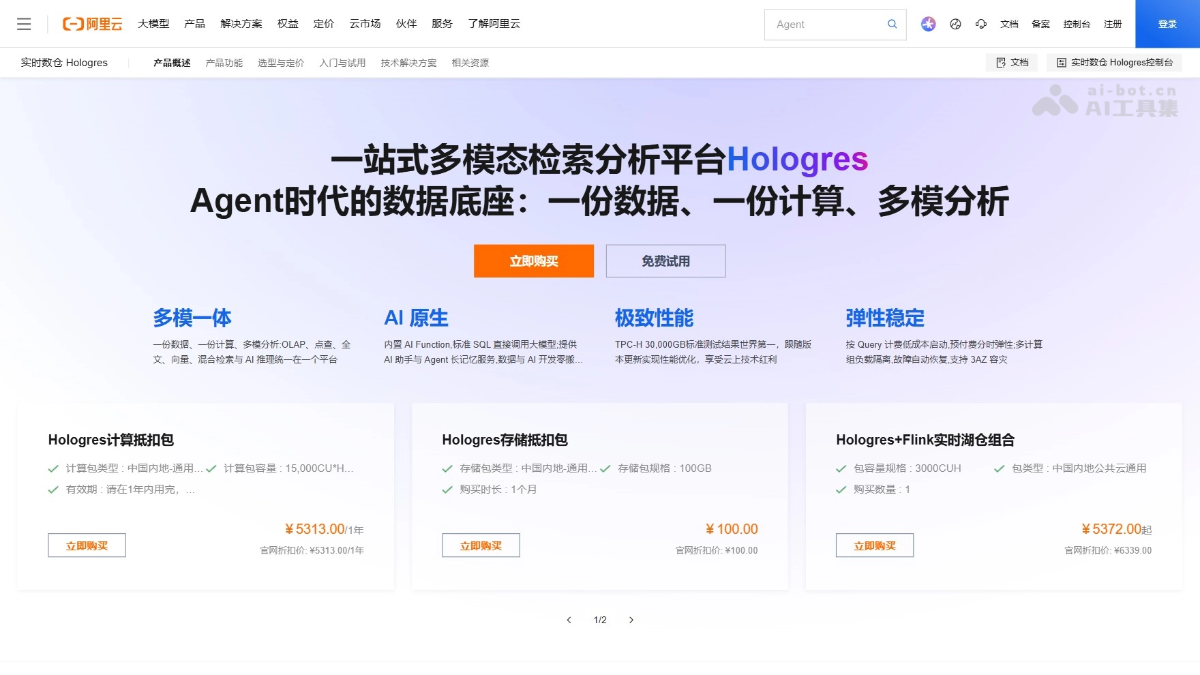
Hologres is launched by Alibaba Cloud as aone-stop Agentic multimodal retrieval and analytics platform, compatible with the PostgreSQL protocol, supporting PB-level real-time writes, updates, OLAP/ad hoc analytics, and high-concurrency point queries. The platform uses unified SQL to connect structured, semi-structured, and OSS unstructured data. Combined with Object Table, Dynamic Table, and AI Function, it provides full-text, vector, and hybrid retrieval as well as model invocation capabilities, and extends to Agent long-term memory and an observability foundation, making it suitable for Data+AI/RAG scenarios.
Main features of Hologres
-
Real-time data warehouse OLAP: Supports PB-level real-time data writes, updates, multidimensional analysis, and ad hoc queries.
-
High-concurrency point query Serving: Compatible with the PostgreSQL protocol, designed for low-latency online queries and high-concurrency data services.
-
Full-text/vector/hybrid retrieval: A single copy of data supports full-text retrieval, vector retrieval, hybrid retrieval, and RAG recall.
-
Multimodal Data+AI processing: Use Object Table to connect to OSS unstructured files, Dynamic Table for incremental processing, and AI Function for model invocation such as parsing, chunking, Embedding, translation, and generation.
-
Lakehouse and multi-source integration: Can connect to MaxCompute, Paimon, Iceberg, Flink, DataWorks, and external data sources such as MySQL/PostgreSQL.
-
Data warehouse AI assistant: Encapsulates experience such as diagnostics, SQL generation, specification recommendation, and cost governance into executable Skills.
How to use Hologres
-
Activate a trial: Go to the Alibaba Cloud Hologres official website https://cn.aliyun.com/product/hologres,点击开通/产品试用并完成账号与计费确认。
-
Create an instance: Create a Hologres instance and select the region, network type, CU specification, and storage method.
-
Configure access: Configure VPC/public network, IP whitelist, database accounts, and least-privilege permissions.
-
Connect to the instance: Use HoloWeb, psql, JDBC/ODBC, or BI tools to connect to the instance and create a database.
-
Model and create tables: Create tables based on the workload, distinguish between row storage/column storage, and add primary keys, distribution keys, vector indexes, and full-text indexes as needed.
-
Ingest data: Ingest data into Hologres through INSERT/COPY, Flink, DataWorks, MaxCompute, or synchronization tools.
-
Process multimodal data: Create Object Table to map OSS files, use Dynamic Table for incremental processing on the lake, and use AI Function to complete parsing, chunking, Embedding, or generation.
-
Unified query and analysis: Use unified SQL to execute point queries, OLAP, full-text/vector/hybrid retrieval, or AI inference, and save commonly used views and materialized queries.
-
Stress testing and launch: Before launch, conduct stress testing on concurrency, latency, recall accuracy, import throughput, and model Token cost.
-
Operations optimization: After production operation begins, enable monitoring for slow queries, resource consumption, cost, and auditing, and elastically scale up or down as needed.
Core advantages of Hologres
-
Integrated architecture: Converges OLAP, point queries, full-text, vector, hybrid retrieval, and AI inference into the same engine, reducing assembly of multiple components such as ClickHouse/Greenplum + HBase/Redis + Elasticsearch.
-
One dataset reused across multiple scenarios: The same dataset simultaneously serves BI reports, ad hoc analysis, online services, and RAG/Agent retrieval, reducing sync pipelines and the risk of data inconsistency.
-
Strong real-time capabilities: Supports real-time writes, real-time updates, and query-after-write, making it suitable for scenarios where high-concurrency, low-latency Serving and real-time analytics coexist.
-
Data+AI native: Through Object Table, Dynamic Table, and AI Function, OSS files, incremental processing on the lake, and model calls are brought into the SQL pipeline.
-
Good integration with the lakehouse and Alibaba Cloud ecosystem: Closely connected with components such as MaxCompute, Flink, DataWorks, OSS, and Bailian, making it suitable for implementation within the Alibaba Cloud ecosystem.
-
Fully managed and elastic: Cloud-native managed service reduces O&M costs and can elastically adjust resources based on load, making it suitable for businesses with large fluctuations in data volume and concurrency.
Comparison of Hologres with similar competing products
| Dimension | Hologres | ClickHouse |
|---|---|---|
| Product positioning | Alibaba Cloud's integrated real-time lakehouse platform, covering OLAP, point queries, full-text/vector/hybrid retrieval, and AI inference | Open-source columnar OLAP database, strong in high-speed scanning, aggregation analysis, and compressed storage |
| Open source and controllability | Closed-source commercial cloud product, weak controllability, but no O&M required | Open-source core, can be self-built or use ClickHouse Cloud/Altinity, strong controllability |
| SQL/protocol | Compatible with the PostgreSQL protocol, friendly for BI/business integration | Strong SQL-like capabilities, but the dialect and ecosystem tools are not fully consistent with PG/MySQL |
| Real-time writes/updates | Focuses on real-time writes, real-time updates, and query-after-write | Strong append writes; high-frequency updates/real-time primary key updates require versioning capabilities and merge strategy support |
| Point query Serving | Natively oriented toward high-concurrency, low-latency online services | Can perform point queries, but its advantages lie more in large-batch scan aggregation |
| OLAP performance | Balances real-time OLAP and online Serving | Usually stronger in single-query throughput, columnar compression, and wide-table aggregation |
| Full-text retrieval | Built-in full-text retrieval, can be combined with vector/scalar hybrid recall | Has full-text capabilities, but search relevance and tokenization ecosystem are usually not as good as dedicated retrieval systems |
| Vector/hybrid retrieval | Native support for vector retrieval and hybrid retrieval, close to RAG | Vector capabilities are available, but often require additional indexes/components and tuning |
| Data+AI pipeline | Object Table + Dynamic Table + AI Function, AI processing can be brought into SQL | Usually externally connects ETL, model services, vector databases/search systems, flexible but fragmented |
Hologres application scenarios
-
Real-time BI and business analysis: Writes transaction, order, and traffic data in real time, uniformly supporting report dashboards, ad hoc analysis, and business monitoring.
-
Real-time risk control and marketing: Combines real-time events, user profiles, and vector/full-text recall to perform millisecond-level risk determination, similar case retrieval, and personalized recommendations.
-
Enterprise RAG knowledge base: After parsing PDFs/images/audio and video, it chunks and embeds them, using hybrid retrieval to serve Q&A, customer service assistance, and policy retrieval.
-
Customer service voice and ticket analysis: Performs speaker diarization, ASR transcription, sentiment analysis, and summary generation on recordings, turning them into searchable data assets.
-
Agent long-term memory and multimodal inspection: Provides cross-session memory, image comparison, and discrepancy verification capabilities for scenarios such as AI learning companions, AI Coding, and shelf inspection.